Photo to the order at mold startup
In a plastic closures factory, every mold change starts with a paper production order and a handwritten startup sheet: mold, cavity, resin color, destination customer. Those two documents can sit for 4 to 8 hours in a folder before anyone transcribes them. If a bottler's auditor shows up, someone has to reconstruct what ran in which shift.
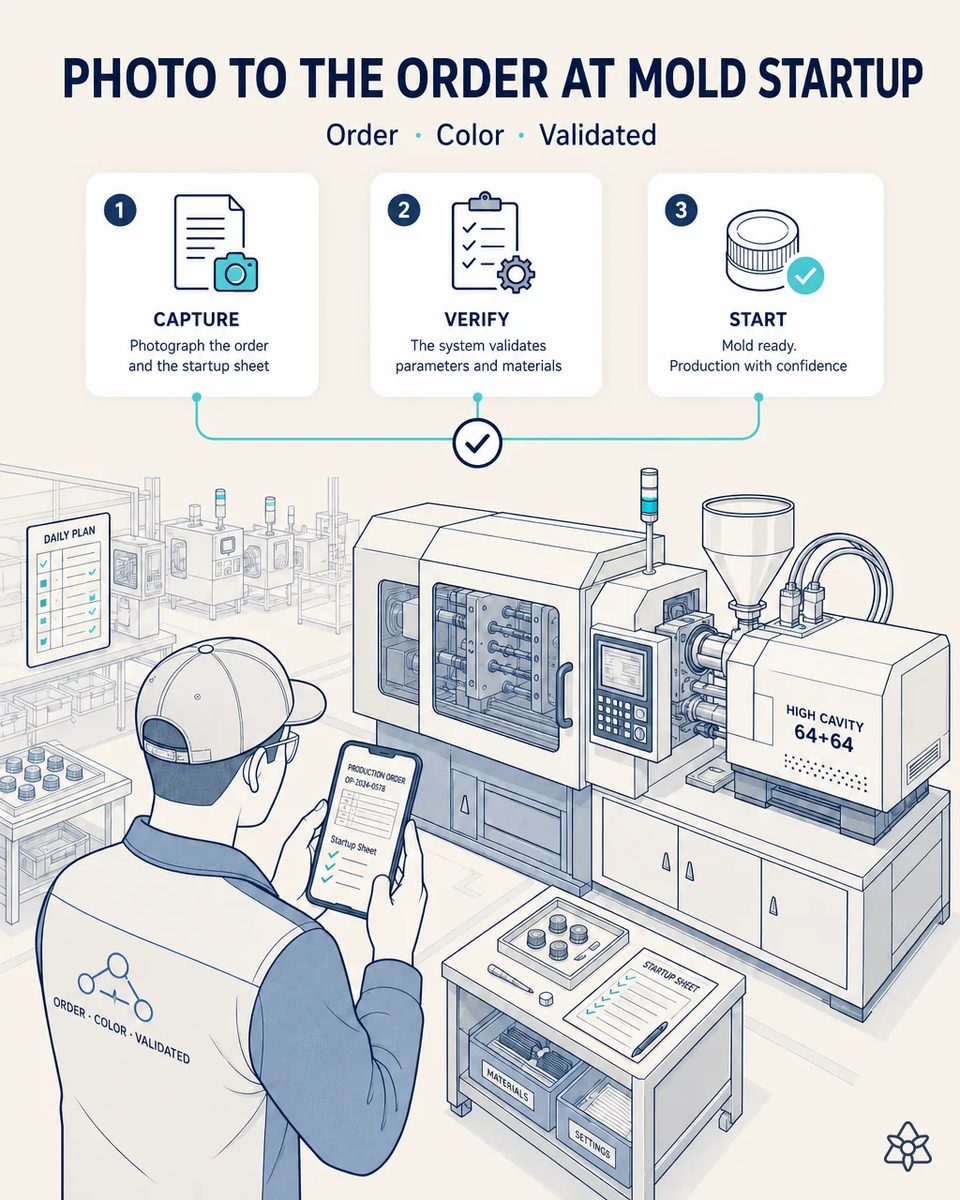
Every mold change starts on paper and waits hours to exist.
In a plastic closures factory, every mold change starts with a paper production order and a handwritten startup sheet: mold, cavity, resin color, destination customer. Those two documents can sit for 4 to 8 hours in a folder before anyone transcribes them. If a bottler's auditor shows up, someone has to reconstruct what ran in which shift.
- Each mold change in a closure plant opens with a printed production order and a handwritten startup sheet: mold, cavity count, resin and masterbatch color, destination bottler, plus whatever the technician noted about blocked cavities or hot-runner zones.
- Both documents go into a folder by the press. Transcribing them is nobody's main job, so they wait 4 to 8 hours — longer when the change happened on the night shift or just before a weekend.
- During that window the batch is being molded, bagged and palletized, but in the central system it does not exist yet. Closures pile up in octabins with no record of which mold, cavity set and color made them.
- When a bottler's auditor or a complaint arrives, someone has to rebuild from paper what ran in which shift. It is slow, and a handwritten note such as "cavity 17 blocked" is exactly the detail that gets lost on the way.
Connect in photo mode — two phone photos at the press, and the batch is born.
With iLEAN Connect, the technician takes two photos with his phone at startup. An anchored model extracts mold, cavity, resin color, customer and notes. The batch already exists in the central system the moment the photo is taken, with nobody typing anything.
The technician keeps filling in the same startup sheet he has always used; he only adds two photos. That is why this is usually the first case a closure plant approves: it asks the floor for nothing new and closes the gap that bottler auditors find first. Within days, the folder by the press stops being the only copy of what happened.
Mold startup on paper versus mold startup photographed
| Aspect | Today, on paper | With iLEAN Connect |
|---|---|---|
| Time until the batch exists | 4-8 h, more on night changes | Zero: at the photo |
| Mold, cavities and color | Handwritten on the sheet | Extracted fields tied to the batch |
| Blocked cavities noted by hand | Lost unless retyped | Recorded against the mold |
| Destination bottler | On the paper order only | Linked to the batch from minute one |
| Rebuilding a shift for an auditor | Digging through folders | One query by batch or mold |
| Routine of the setup technician | — | Same sheet, plus two photos |
4-8 hours of latency to digitize the order and sheet → zero latency, batch available the moment the photo is taken.
Impact estimate — to be validated with your daily mold changes.
The block below is an estimate to be validated against your plant's actual data. We put it forward so the committee has an order of magnitude; we refine it during the assessment.
- Estimated payback 4-9 months, depending on how many batch and mold changes your presses run per day.
- The production supervisor's transcription time is recovered: the hours spent retyping orders and startup sheets go back to the floor, where they are needed during changeovers.
- Capture latency drops from 4-8 hours to zero: the batch is queryable the moment the photo is taken, including night and weekend mold changes.
- A bottler's audit question about what ran in which shift, with which mold and which color, gets answered from the system instead of being reconstructed from a folder.
Payback 4-9 months · from 4-8h latency to zero latency. Payback of 4 to 9 months depending on daily batch-change volume, recovering the production supervisor's transcription time. Estimate to validate.
And the fair question from the production manager
“What if it misreads a cavity number or the masterbatch code on the startup sheet?” — reading fields from a document whose layout is known is an anchored task, where the best models drop below 1.5% error [1]. And there is a second net: the extracted summary goes to the tablet at the press and the technician confirms or fixes it with two taps before anything reaches the ERP. A low-confidence field is flagged, never guessed.
[1] OpenAI paper "Why Language Models Hallucinate", 2025 — on the reliability of AI in anchored tasks.
What people ask about photographing the mold startup order
Do we have to redesign our closure startup sheet?
No. The model reads the sheet you already use, including handwritten notes in the margins. Redesigning forms is exactly the kind of change that stalls projects on the press floor. The technician keeps the pen and the clipboard; the phone is the only new thing.
Does it capture blocked cavities and hot-runner notes?
Yes, and they are the most valuable part, because they explain later why a batch ran with fewer cavities or why closure weight drifted. They are extracted like any other field and linked to the mold. The next time that mold is mounted, the history of its blocked cavities is already there.
What happens on a night-shift mold change?
The same as on a day shift: the photo creates the batch at once. Today that is precisely where the gap is longest, because nobody transcribes until the office opens. A Sunday mold change stops being a Monday transcription job.
Do we need ERP integration from the first startup?
No. The batch lives in iLEAN's central memory from the first photo, and the push to the ERP is connected afterwards, once the value is proven on your presses. Starting without integration also keeps IT off the critical path of the pilot.
Does it work on compression molding lines too?
Yes. The documents differ slightly, but the pattern is the same: order plus startup sheet, photographed at the start of each run, whatever the molding process behind the closure. Only the fields that matter for each process are configured differently.
More cases from this series
- Connect listens to the lab's Excel and pushes it to the ERPILEAN absorbs the lab's quality-control Excel and pushes it to the ERP after validation. Saves ERP…
- External camera on a legacy press panelAn external camera reads a veteran press's panel without touching it; its parameters are digitized batch…
- Human-verification tablet next to the pressEvery iLEAN capture passes through a tablet by the press; the technician confirms with two taps before…
- Photo to the delivery note and the resin octabin labelPhoto the delivery note and resin octabin label; iLEAN extracts the batch and pushes it to the ERP after…
- ILEAN silently copied on the resin supplier's emailILEAN silently reads the resin supplier's alert and suggests replanning before the press goes idle.
- Connect voice mode for the shift leadThe shift lead dictates incidents while walking between presses; iLEAN structures them and replies…
Tell us how many mold changes a day your closure presses go through.
We work on your plant's real data, not ours. Assessment with no commitment.
Request estimated ROI within 48h ‹ See all cases of plastic closures See packaging