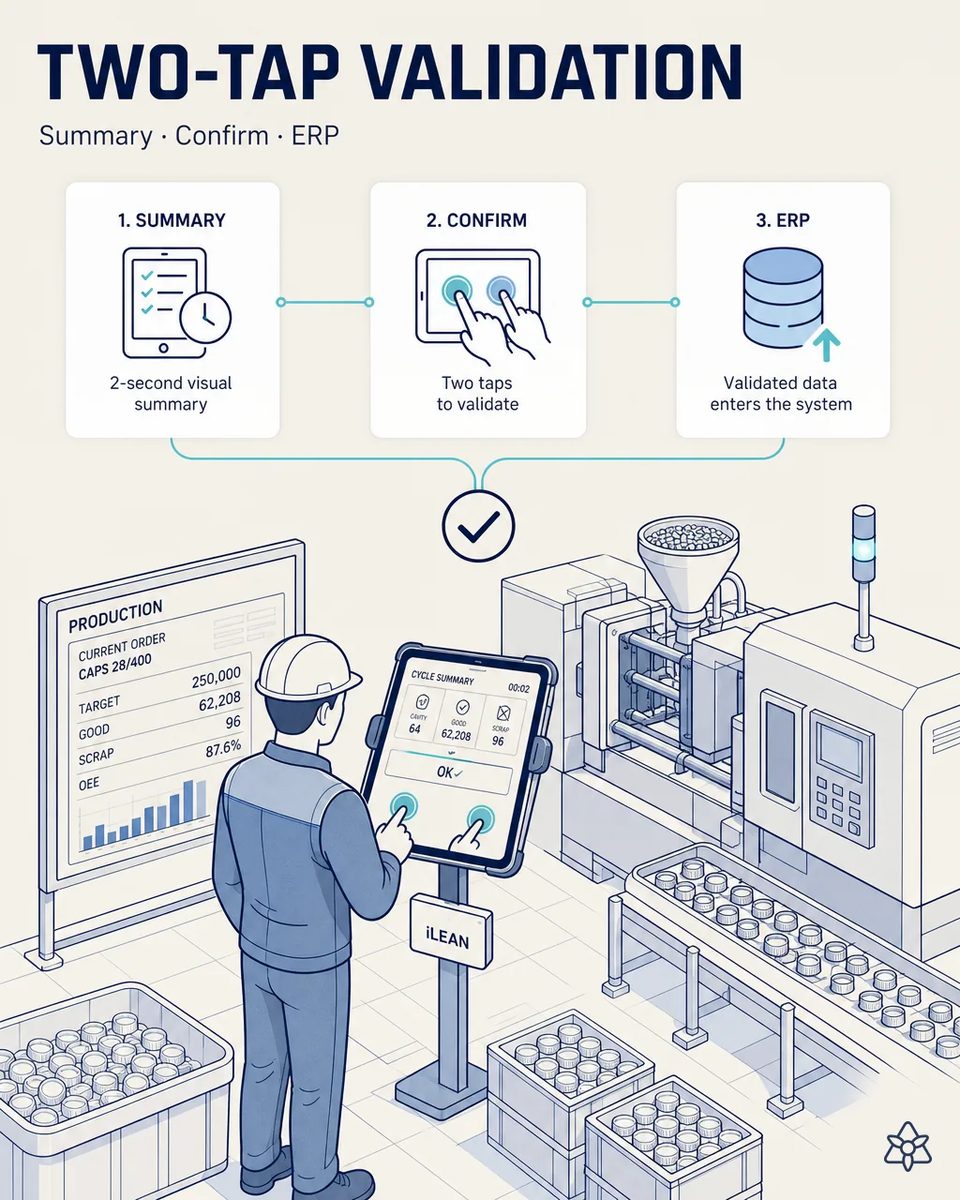
Human-verification tablet next to the press
The main cultural blocker to digitization is the fear that AI will enter data on its own and contaminate the ERP. But technicians don't want to type either. Every iLEAN capture — the photographed order, the voice-dictated incident, the supplier email — shows up on a tablet as a visual summary.
Nobody wants AI writing resin batches into the ERP unchecked.
The main cultural blocker to digitization is the fear that AI will enter data on its own and contaminate the ERP. But technicians don't want to type either. Every iLEAN capture — the photographed order, the voice-dictated incident, the supplier email — shows up on a tablet as a visual summary.
- The main cultural brake on digitization in a closure plant is the fear that AI will enter data on its own and someone will have to clean up the ERP master afterwards.
- It is a reasonable fear: a wrong resin batch or color code in the master travels to the batch record, the certificate of conformity and the bottler's incoming inspection. Correcting it afterwards leaves doubts about every record around it.
- But technicians do not want to type either. They are there to keep presses, molds and color changes running, and every form added at the press is filled in late or not at all.
- So plants stay stuck between unvalidated data contaminating the ERP and data never captured out of distrust. Neither supports the batch-to-batch traceability bottlers audit.
Connect with human verification at the press — two taps, no form.
The technician confirms with two taps: ✓ it enters the ERP, or ✏️ fix it before it enters. No training, no habit change. This is what sets iLEAN apart from an autonomous agent: no data crosses into the central system without a human reviewing it first.
This is the piece that makes all the others approvable. Every capture — the photographed order, the dictated incident, the supplier email — arrives as a short visual summary, and nothing crosses into the central system until a person confirms it. That is what separates iLEAN from an autonomous agent. Quality approves the flow because it keeps the last word.
Data entry at the press today versus data confirmed with two taps
| Aspect | Today | With iLEAN |
|---|---|---|
| Who sees a closure capture before the ERP | Nobody, or it is never captured | The technician at the press |
| Effort per record | A form at a terminal | A summary and two taps |
| Wrong color code or resin batch | Found by the bottler | Fixed before it enters |
| Order photos, voice and supplier emails | Three separate worlds | One confirmation screen |
| Corrections made at the press | Lost | Kept to improve extraction |
| Training for press technicians | A new ERP screen | None: confirm or fix |
Unvalidated data contaminating the ERP → validated data in seconds, clean master data.
An enabling piece for the closure plant — no standalone payback.
The block below is an estimate to be validated against your plant's actual data. We put it forward so the committee has an order of magnitude; we refine it during the assessment.
- No standalone payback: it is the enabling piece of the whole iLEAN matrix and its value is strategic, not directly monetizable. We say so instead of inventing a figure.
- Without it, the other pieces do not get signed off by quality or management, so the return of the matrix runs through this tablet even though none of it is booked here.
- From unvalidated data contaminating the ERP — or no data at all — to data captured and validated in seconds, by the person standing next to the press. No back-office cleanup, no weekly reconciliation between what happened and what was typed.
- And the master stays clean, which is what every certificate of conformity and every batch record sent to a bottler depends on. A dirty master is the fastest way to lose a bottler's trust in your certificates.
Strategic value · the piece that enables the whole matrix. The enabling piece for the whole iLEAN matrix — without it, the other pieces don't get signed off. Strategic value, not directly monetizable.
And the fair question from the production manager
“If a technician confirms everything, what is the AI saving?” — the assembly, not the decision. Pulling mold, cavity, color and resin batch out of a photo, a dictation or an email is an anchored task, where the best models drop below 1.5% error [1]; the technician only checks a summary that arrives already built. Two taps replace a form, and every correction is kept so the system learns where it fails. Over time he corrects less and confirms more. That is the sign the system is learning your presses.
[1] OpenAI paper "Why Language Models Hallucinate", 2025 — on the reliability of AI in anchored tasks.
What people ask about the verification tablet at the closure press
Can any closure data skip the tablet and go straight to the ERP?
No. It is architecture, not a setting: data crosses into the ERP only after a person confirms or fixes it. There is no administrator switch that bypasses it.
What does the technician see on the tablet screen?
A short summary: order, mold, cavities, color, resin batch and counts where relevant. Enough to spot an error at a glance, with the original photo or message one tap away. The summary is designed to be read in about two seconds, standing at the press.
Is a correction traceable if quality questions it later?
Yes. The original value, the corrected value and who changed it are all kept. That trail is what quality reviews when a batch record sent to a bottler is questioned. Quality can also see which fields get corrected most often, and why.
How much training do press technicians need?
Practically none: the gesture is confirm or fix. That is deliberate, because on a three-shift press floor any tool that needs a course does not survive the night shift. New technicians learn it during their first changeover, watching a colleague.
Should the tablet go in with the first case or later?
With the first. Whatever case starts the project, this is what lets quality approve it, so it is deployed alongside it from day one. Deploying it later would mean asking quality to approve something it cannot control.
More cases from this series
- Connect listens to the lab's Excel and pushes it to the ERPILEAN absorbs the lab's quality-control Excel and pushes it to the ERP after validation. Saves ERP…
- External camera on a legacy press panelAn external camera reads a veteran press's panel without touching it; its parameters are digitized batch…
- Photo to the order at mold startupThe technician photographs the production order and startup sheet; the batch exists in the system at…
- Photo to the delivery note and the resin octabin labelPhoto the delivery note and resin octabin label; iLEAN extracts the batch and pushes it to the ERP after…
- ILEAN silently copied on the resin supplier's emailILEAN silently reads the resin supplier's alert and suggests replanning before the press goes idle.
- Connect voice mode for the shift leadThe shift lead dictates incidents while walking between presses; iLEAN structures them and replies…
Ask to see the two-tap confirmation running beside one of your presses.
We work on your plant's real data, not ours. Assessment with no commitment.
Request estimated ROI within 48h ‹ See all cases of plastic closures See packaging