Connect listens to the lab's Excel and pushes it to the ERP
The quality lead fills in an Excel sheet every batch with torque, leak test, weight and color. It lives in a shared folder the ERP never sees. Someone spends half a day a month retyping that data into the ERP, with weeks of lag between the real data and the official record.
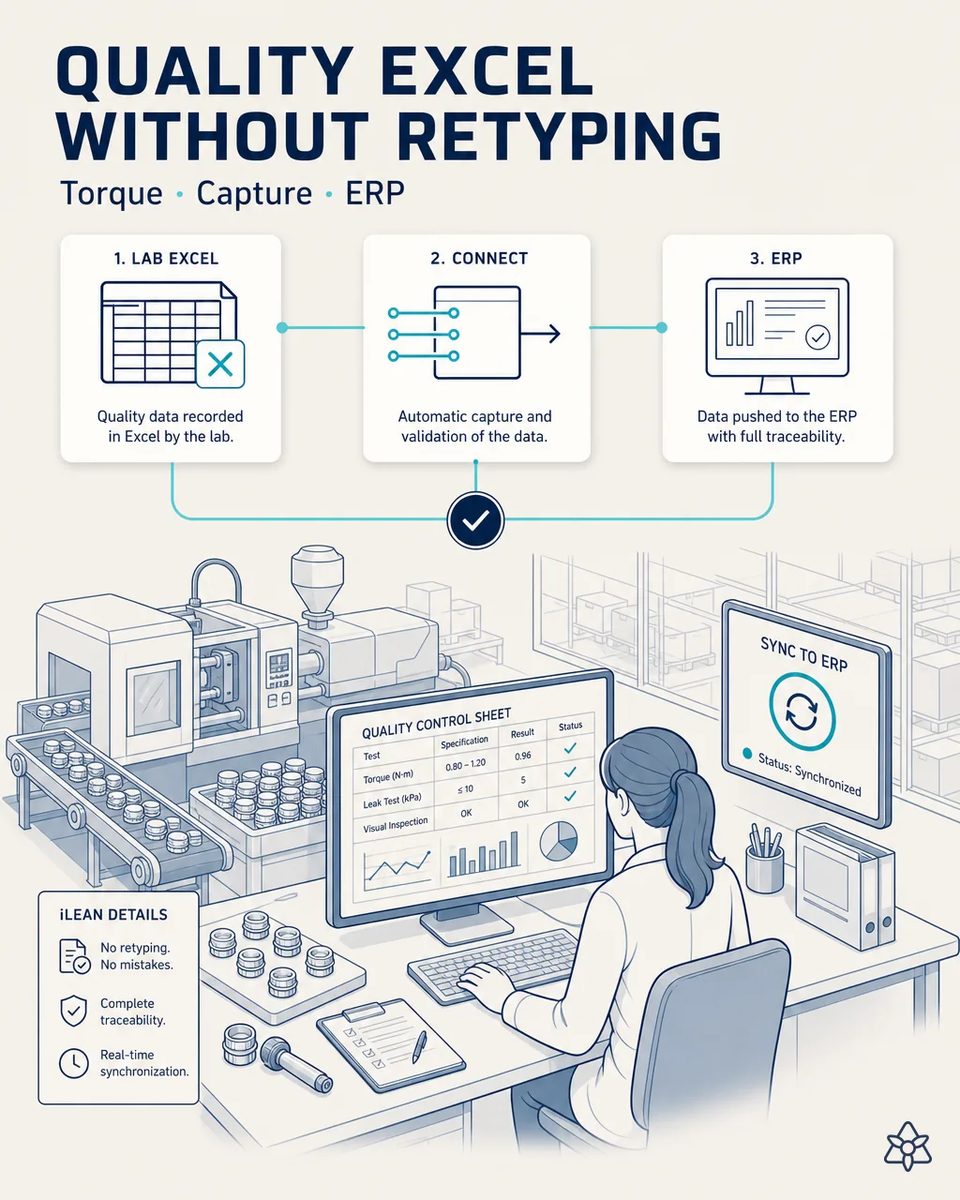
The closure lab's results live in a folder the ERP never sees.
The quality lead fills in an Excel sheet every batch with torque, leak test, weight and color. It lives in a shared folder the ERP never sees. Someone spends half a day a month retyping that data into the ERP, with weeks of lag between the real data and the official record.
- Every batch, the quality lead logs application and removal torque, leak test, weight and color in an Excel sheet built up over years, with its own columns, units and notes.
- The file lives in a shared folder. The ERP never sees it, so the official batch record lags the real measurements by weeks.
- Someone spends half a day a month retyping that data into the quality module, and every retyped figure is a chance for a transposed digit on a torque value. The person doing it knows the figures are already old when they enter.
- Several lab people hold ERP licenses only to enter results. The licenses cost money all year; the data still arrives late, and a bottler's question about a batch waits for the retyping. The lab works well; the problem is where its work ends up.
Connect in listen-inward mode — the lab keeps its Excel, the ERP gets the data.
Connect's listen-inward mode detects when the Excel is saved, parses the delta with an anchored model, and presents it for validation. After the supervisor validates, the data is automatically inserted into the ERP via API. The lab keeps working exactly as before.
Nobody in the lab changes how they work. iLEAN detects when the sheet is saved, reads only what changed and presents it for validation; after the supervisor's confirmation the results enter the ERP through its API. The spreadsheet stays exactly as it is. Only the retyping disappears. The lab keeps its tools, its habits and its file names; the ERP finally gets the figures on the day they are measured.
Closure lab results today versus results flowing to the ERP
| Aspect | Today | With iLEAN Connect |
|---|---|---|
| Lag between torque test and ERP record | Weeks | Zero once validated |
| Monthly retyping of lab results | Half a day | None |
| Torque and leak values per batch | In a shared folder | In the batch record |
| Lab people entering data in the ERP | Several licensed users | Only the supervisor validates |
| ERP quality licenses for lab entry | One per data entry user | −50 to −80% typical |
| The lab's Excel routine | — | Unchanged |
Weeks of lag between real data and the ERP → zero latency; -50/-80% quality-module licenses.
Impact estimate — to be validated against your ERP license invoice.
The block below is an estimate to be validated against your plant's actual data. We put it forward so the committee has an order of magnitude; we refine it during the assessment.
- Estimated payback 4-9 months, mostly from licenses and retyping time. The license saving is recurring, so it keeps paying after the first year.
- A typical 50-80% reduction in quality-module licenses: if several lab people log into the ERP only to enter data today, only the supervisor needs to validate now.
- The half day a month of retyping disappears, and with it the transposition errors on torque and weight values that nobody catches until a claim. Clean figures in the ERP are what make torque trends per mold possible.
- The lag between the real measurement and the official record goes from weeks to zero, so a bottler's question about a batch's torque is answered from the ERP the same day. Trends across molds and resin batches become visible without exporting anything.
Payback 4-9 months · −50 to −80% quality-module licenses. If several lab people log into the ERP just to enter data today, that's several licenses. With Connect, only the supervisor validates: a typical 50-80% reduction in quality-module licenses. Estimated payback 4-9 months. Estimate to validate.
And the fair question from the production manager
“That sheet has been edited by different people for years, with merged cells and notes everywhere — can it really be parsed?” — that is the anticipated case: parsing does not depend on fixed positions, it interprets columns, units and margin notes without anyone standardizing the file. It is an anchored task, where the best models drop below 1.5% error [1], and the supervisor validates the delta before it is pushed to the ERP. Every push is traceable to the save that produced it.
[1] OpenAI paper "Why Language Models Hallucinate", 2025 — on the reliability of AI in anchored tasks.
What people ask about connecting the closure lab's Excel
Does the closure lab have to change its spreadsheet?
No. iLEAN reads the file as it is. Asking the lab to standardize years of format is what usually kills this kind of project. New columns added by the lab are detected and mapped once.
Does it re-read the whole file every time it is saved?
No. It detects what changed since the last save, the delta, and only presents those new results for validation. That keeps validation short: the supervisor sees today's results, not the whole history.
Which results does it push for each closure batch?
Whatever the sheet records: typically application and removal torque, leak test, weight, color reading and visual checks, each attached to its batch in the ERP. If the lab adds a new test, such as ovality or tamper band breaking force, it joins the mapping without changing the sheet.
What if a removal torque value is outside specification?
It is pushed as measured and flagged, so the out-of-spec batch is visible in the ERP at once instead of weeks later when someone retypes it. Quality decides what happens next; the system only makes sure the result is not hidden in a folder.
Does connecting the lab sheet need ERP changes?
No. It uses the API the ERP already exposes for quality results. If there is none yet, the data stays in iLEAN's memory until that connection is ready. The lab notices nothing in either case.
More cases from this series
- External camera on a legacy press panelAn external camera reads a veteran press's panel without touching it; its parameters are digitized batch…
- Human-verification tablet next to the pressEvery iLEAN capture passes through a tablet by the press; the technician confirms with two taps before…
- Photo to the order at mold startupThe technician photographs the production order and startup sheet; the batch exists in the system at…
- Photo to the delivery note and the resin octabin labelPhoto the delivery note and resin octabin label; iLEAN extracts the batch and pushes it to the ERP after…
- ILEAN silently copied on the resin supplier's emailILEAN silently reads the resin supplier's alert and suggests replanning before the press goes idle.
- Connect voice mode for the shift leadThe shift lead dictates incidents while walking between presses; iLEAN structures them and replies…
Tell us how many people log into the ERP just to enter lab results.
We work on your plant's real data, not ours. Assessment with no commitment.
Request estimated ROI within 48h ‹ See all cases of plastic closures See packaging