The existing inspection camera, stitched to the ERP
The plant already has an in-line vision system inspecting every closure at high speed: thread, color, defect. But its data lives isolated in its own console. Rejection rate and defect codes stay on the vision equipment, never linked to the resin batch or the order running at that moment.
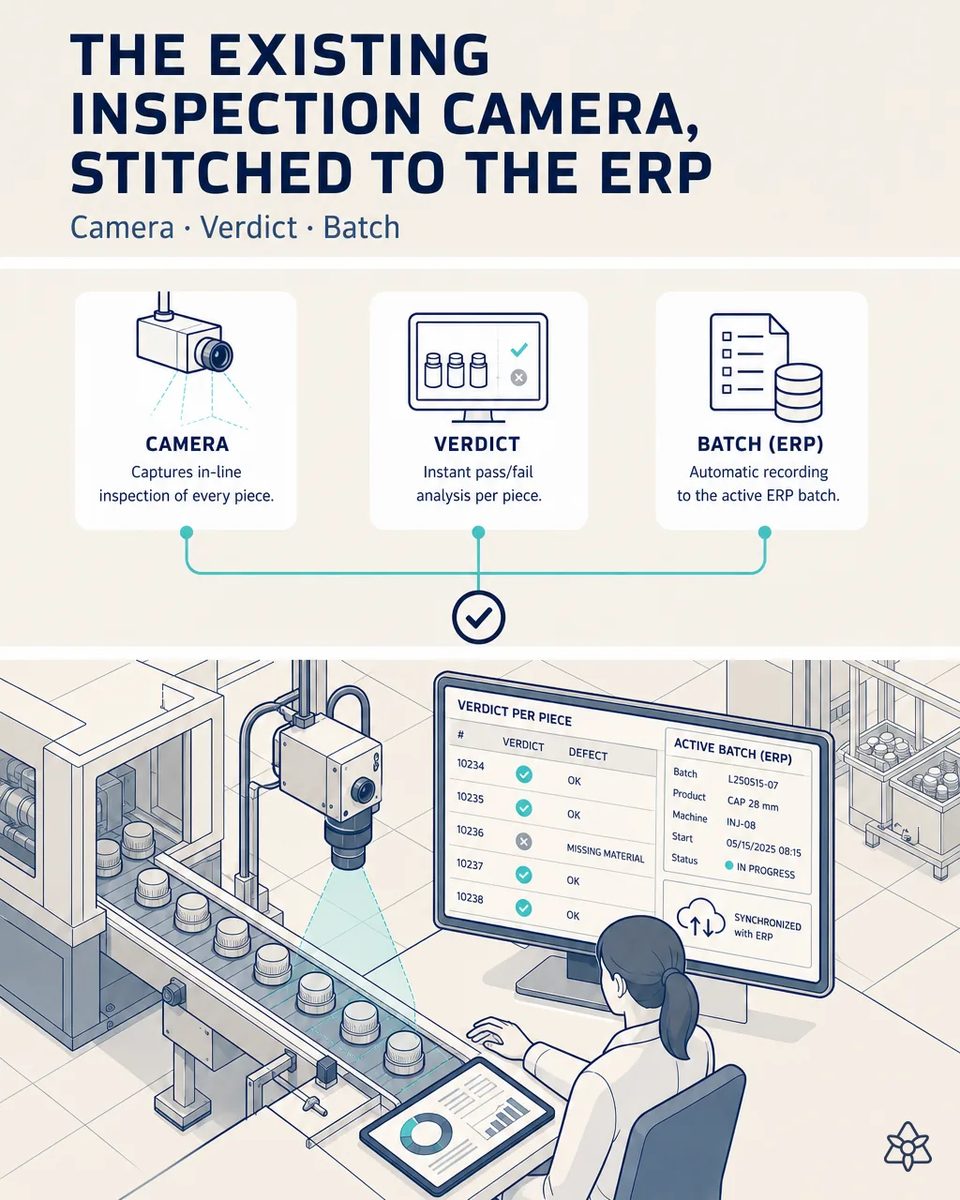
The camera inspects every closure, and its data stays on its console.
The plant already has an in-line vision system inspecting every closure at high speed: thread, color, defect. But its data lives isolated in its own console. Rejection rate and defect codes stay on the vision equipment, never linked to the resin batch or the order running at that moment.
- The plant already has an in-line vision system checking every closure at high speed: thread, tamper-evident band, color, short shot, liner presence.
- Its data lives isolated in its own console. Reject rate and defect codes stay on the vision equipment and are never linked to the resin batch or the order running at that moment. The console shows today's reject rate; it does not know which bottler that batch is going to.
- When a bottler complains, someone exports logs by date, guesses which batch was running and matches them by hand. It takes days.
- The integration was always planned, but it never reached the top of the IT list because the camera works and the ERP works. The gap sits between them. Meanwhile, every claim costs the same days of manual matching.
Connect stitches the vision console to the ERP through the API it already has.
Through the API the vision system already has, Connect automatically matches every piece-by-piece verdict with the active batch and order in the ERP. The rejection summary per batch becomes available in the ERP with nobody transcribing anything.
Nothing is replaced and no camera is reconfigured. Connect takes the verdicts through the interface the vision system already exposes and matches each one to the batch and order active in the ERP. The quality summary per batch is simply there when someone asks. Quality stops exporting logs and starts reading trends per mold and per resin batch. That is where the vision investment starts to pay twice.
Inspection data today versus inspection data on the batch
| Aspect | Today | With iLEAN Connect |
|---|---|---|
| Where closure reject data lives | The vision console | The ERP batch record |
| Link to resin batch and order | None | Automatic, per verdict |
| Defect codes per batch | Exported by hand | Summarized in real time |
| Answering a bottler's claim | Days | Minutes |
| Inspection recipes and thresholds | — | Unchanged |
| Integration project in the IT queue | Waiting | Not needed |
Reject data isolated in a local console → real-time per-batch quality summary in the ERP.
Impact estimate — to be validated against your recent bottler claims.
The block below is an estimate to be validated against your plant's actual data. We put it forward so the committee has an order of magnitude; we refine it during the assessment.
- Estimated payback 3-6 months, one of the fastest in the matrix. The camera and the ERP already exist; only the stitching is new.
- Customer claim response goes from days to minutes: the reject history of the batch in question is already in the ERP. The answer arrives while the bottler is still on the phone.
- Reject rates per batch can be compared across molds, colors and resin batches without exporting a single log. A mold whose reject rate creeps up shows before it becomes a claim.
- And the vision investment the plant already made starts producing traceability, not just ejected parts. Its data finally reaches the people who negotiate with the bottler.
Payback 3-6 months · claim response in minutes. Fast payback of 3 to 6 months, customer claim response in minutes instead of days. Estimate to validate.
And the fair question from the production manager
“Isn't a proper integration project cleaner?” — it is, the day it reaches the top of the list, and that is the problem: it is the classic case of a modern system left isolated because there was never time. Matching a verdict to a batch by line and timestamp is an anchored task, where the best models drop below 1.5% error [1]. This stitching replaces neither system and needs no shutdown window, so it does not compete in that queue. If a full integration comes later, nothing done here is lost.
[1] OpenAI paper "Why Language Models Hallucinate", 2025 — on the reliability of AI in anchored tasks.
What people ask about stitching the closure inspection camera to the ERP
Do we need to change the vision system's configuration?
No. Connect reads the verdicts through the interface the system already has. Inspection recipes, thresholds and ejection stay exactly as they are. The vision supplier does not need to be involved beyond confirming access to the interface.
What if our closure vision system has no API?
Most current ones have one or export results to a file or database. If yours only shows results on screen, the external camera approach used on veteran press panels also works here. In both cases the vision system itself stays as it is.
How does each verdict find the right closure batch?
By line, timestamp and the order active in the ERP at that moment. A mold or color change opens a new batch and the verdicts follow it. If two lines share a console, each verdict is attributed to its own line and order.
Can we see defect types per batch, not just the reject rate?
Yes. Thread, tamper band, short shot and color codes are kept per batch, which is what a root-cause discussion with a bottler needs. Seeing that tamper band rejects rise with one resin batch is the kind of pattern that never shows on the console alone.
Does this overlap with the Edge cameras in other cases?
No. This case uses the camera you already own; Edge adds inspection where there is none, or validation at mold changes. Both feed the same batch record. Together they cover the lines with a camera and those without one.
More cases from this series
- Connect listens to the lab's Excel and pushes it to the ERPILEAN absorbs the lab's quality-control Excel and pushes it to the ERP after validation. Saves ERP…
- External camera on a legacy press panelAn external camera reads a veteran press's panel without touching it; its parameters are digitized batch…
- Human-verification tablet next to the pressEvery iLEAN capture passes through a tablet by the press; the technician confirms with two taps before…
- Photo to the order at mold startupThe technician photographs the production order and startup sheet; the batch exists in the system at…
- Photo to the delivery note and the resin octabin labelPhoto the delivery note and resin octabin label; iLEAN extracts the batch and pushes it to the ERP after…
- ILEAN silently copied on the resin supplier's emailILEAN silently reads the resin supplier's alert and suggests replanning before the press goes idle.
Tell us how long it took to answer your last closure claim from a bottler.
We work on your plant's real data, not ours. Assessment with no commitment.
Request estimated ROI within 48h ‹ See all cases of plastic closures See packaging