The mold change does not start without visual evidence
The mold or format change is where a PET packaging plant loses the most availability and the most resin at once: the line stops, the mold goes on, the previous material is purged, and then comes a start-up queue where everything goes to regrind until weight and wall thickness distribution fall inside the window. Today "ready to start" is a signature with no objective evidence. With iLEAN Edge, fixed cameras compare the real state against the reference state and the line does not start until everything is conforming and signed.
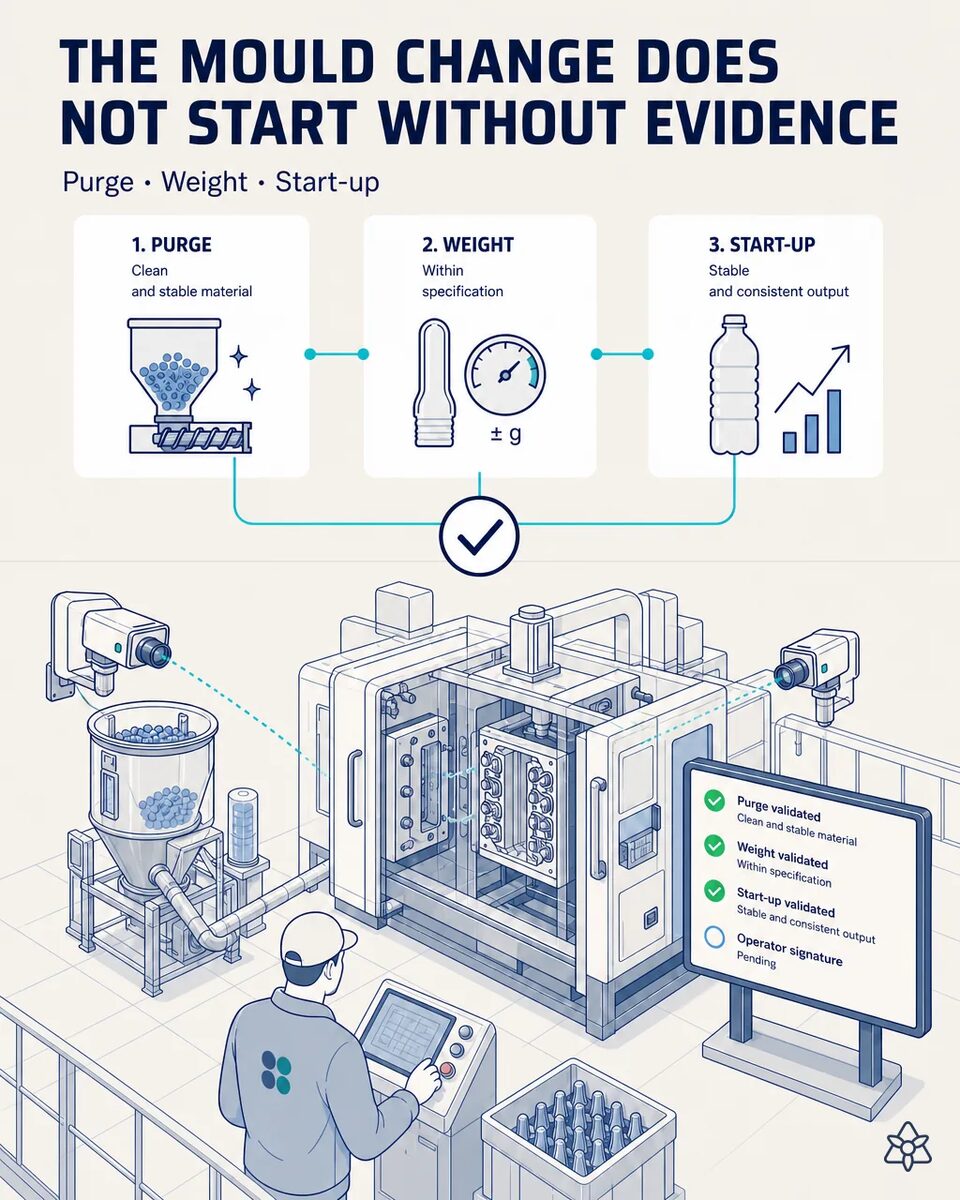
Two chained costs, and only one of them is visible.
The mold change has two chained costs and only one of them is visible. The visible one is the start-up queue: line hours and kilos of resin going to regrind until weight and wall thickness distribution stabilise. It is accepted as inevitable and is not measured comparably between shifts or between lines. The expensive one appears now and then: if the purge was not complete — and the risk rises when recycled content or color changes — the first batch of the new reference comes out carrying the previous material and has to be held in full. That batch has already consumed resin, machine hours and labour. Behind both sits the same cause: "ready to start" depends on somebody saying so, with no photo, no objective comparison and no record. When something goes wrong there is no way to reconstruct what state the machine was actually in at start-up.
- The visible one is the start-up tail: line hours and kilos of resin going to regrind until weight and thickness distribution stabilize. It is assumed as unavoidable and is not measured comparably between shifts or lines.
- The expensive one shows up occasionally: if purging was not complete, the first lot of the new part number comes out with the previous material and has to be blocked entirely.
- The risk of incomplete purging rises exactly when recycled content or color changes, which is increasingly often.
- And "ready to start" is today a signature with no objective evidence behind it.
Edge with JIDOKA AI and SMED AI — one brakes, the other shortens.
Edge + JIDOKA AI + SMED AI. Fixed cameras on the points that decide the start-up. Step by step:
The machine does not start because the system says so: it starts when the evidence supports it and a person signs on that evidence. That distinction matters for anyone worried a camera will stop their line.
- Reference state. For each reference, the "ready to start" state is defined: correct and complete mold, cavities clear, purge finished, hopper in condition.
- Visual comparison. Edge cameras on the mold carrier, the blow nozzle, the outfeed conveyor and the feed hopper compare the current state against that reference. Each point issues its own verdict.
- Weight control. The first parts are weighed and checked against the target window.
- JIDOKA AI block. The line does not start until every point confirms. The machine does not start because the system says so: it starts when the manager signs against that evidence. The signature stays human, but now it is backed up.
- SMED AI. The system guides the changeover sequence and times each step, so the change stops being a ritual of variable duration and becomes a measured process, comparable between shifts and between lines.
- Automatic evidence. The before and after photos of each point feed the audit evidence pack directly.
Today's mold change versus the validated change
| Aspect | Today | With iLEAN Edge |
|---|---|---|
| Start-up validation | A blind signature | Signature on point-by-point visual evidence |
| Kilos lost per changeover | Whatever they turn out to be | Estimated ≥30 % reduction |
| Batch contaminated by incomplete purge | Happens occasionally | Eliminated |
| Mold and cavities | Checked by eye | Against the reference state for that part number |
| Weight of the first pieces | Groped for | Checked against the target window |
| Changeover duration | Not comparable between shifts | Measured and guided by SMED AI |
Estimated impact — to validate with your own numbers.
The block below is an estimate to be validated against your plant's actual data. We put it forward so the committee has an order of magnitude; we refine it during the assessment.
- Estimated payback 5-10 months in a plant with high mix and frequent mold changes.
- The return is measured in OEE points recovered and in kilos of resin that stop going to regrind, with an estimated ≥30 % reduction.
- Batch contaminated by incomplete purging: eliminated, and it is the cost nobody budgets for because it only appears occasionally.
- Changeover duration measured comparably between shifts and lines, which it is not today.
Estimated payback 5-10 months in a plant with a high mix and frequent mold changes. The return is measured directly in OEE points recovered and in kilos of resin that stop going to regrind, with an estimated reduction of at least 30% in kilos lost per changeover. On top of that sits the elimination of the batch held for an incomplete purge, an infrequent but very expensive event. *Estimate to be validated.*
And the fair question from the production manager
«What if the camera blocks my line for no reason?» — conformity is checked against the reference state defined for that specific part number, not against a generic criterion. In case of doubt the system does not block silently: it escalates to the supervisor, who signs on the evidence. It stops on a verifiable discrepancy, not on model uncertainty.
[1] OpenAI paper "Why Language Models Hallucinate", 2025 — on the reliability of AI in anchored tasks.
What people ask about validating the mold changeover
What exactly is checked?
Correct and complete mold, unobstructed cavities, sufficient purging, and the weight of the first pieces against the target window. The points are defined at commissioning with your team.
Doesn't it lengthen the changeover?
The check takes seconds, and SMED AI pulls the other way: it guides the sequence and learns from that part number's history. The goal is a shorter window, not a longer one.
Does it detect incomplete purging?
It is one of the states trained explicitly, and the risk rises exactly when recycled content or color changes, which is when it is needed most.
Can validation be skipped?
An exception can be defined with a supervisor signature and it is recorded as such. What cannot happen is starting up with no trace of who decided to skip it.
How is the kilo saving measured?
With your own data: kilos to regrind per changeover before and after. It is one of the few cases where measurement is direct and nothing has to be estimated.
More cases from this series
- The audit is always ready, with nothing rebuilt by handEvery critical change and every batch generates its evidence. Agents organises it by standard and…
- Zero grams lost: the resin balance, live, from silo to palletFour coordinated rings close the balance between resin kilos entering through the silo and thousands of…
- The blow molder start-up recipe, captured in one photoThe blow molder set-up sheet, captured by photo: the batch's real recipe enters the system at second…
- The order changes by email and the plan rebuilds itselfiLEAN reads the schedule-change email or WhatsApp, cross-checks it against the live plan and silo…
- The shift lead dictates without stopping his walk through the plantThe shift lead dictates issues while walking between injection and blow molding. iLEAN structures each…
- The PET lab reaches the ERP without a single retyped figureiLEAN reads the PET test sheet as it is saved and, after validation, posts it to the ERP. Typical 50-80%…
Tell us how many mold changes you run per week and how many kilos each one costs.
We work on your plant's real data, not ours. Assessment with no commitment.
Request estimated ROI within 48h ‹ See all cases of PET packaging See packaging