An eye on every cavity, at the real speed of the line
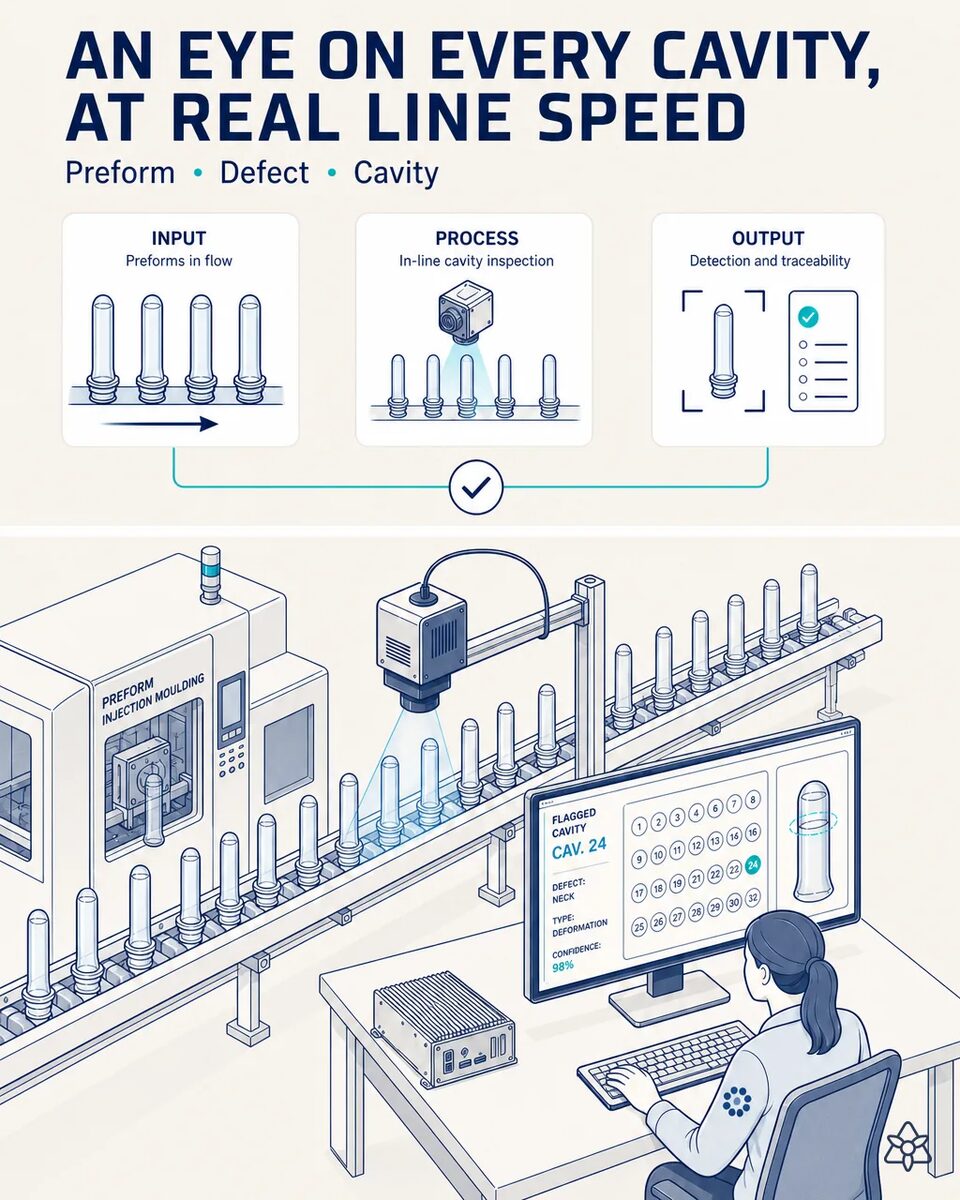
A multi-cavity injection machine and a rotary blow molder do not allow complete visual inspection by a person: you inspect one or two per cent by sampling, and sampling leaves gaps. The defects that slip through are always the same — black specks, bubbles, pearlescence, malformed neck finish, scuffing, ovality, wall thickness distribution — and they are paid for on the bottler's filler. Edge iLEAN inspects one hundred per cent of the parts and, above all, attributes every defect to its mold and its cavity.
The cost is not your own scrap: it is the customer's line stopping.
At real line speed, human control of a PET line is statistical by necessity. The eye tires, and sampling by definition does not see most of the parts. The characteristic defects of the sub-sector are well known: black specks or contamination in the preform, bubbles, crystallinity or pearlescence from a drifted oven profile, malformed neck finish or flash, scuffing from guide rail friction, ovality and wall thickness distribution outside the window. The cost is not your own scrap, which is minor: it is your customer's line stopping. A bottle with irregular wall thickness fails at high speed on the bottler's filler, and there the damage is somebody else's downtime plus the commercial relationship. And there is a trend that worsens the picture: the more rPET in the blend, the higher the input variability — color, viscosity, residual contamination — and the defect rate rises with it.
- At real cadence, human control of a PET line is statistical by necessity: one or two percent is sampled and sampling leaves gaps.
- The defects are known and repetitive: black speck or contamination, bubble, crystallinity or pearling from a deviated oven profile, badly formed neck or flash, scuffing, ovality and thickness distribution out of window.
- Your own scrap is the smaller part. The expensive part is a defective bottle stopping the bottler's filler.
- And without cavity-level attribution, the finding stays at "this lot has more scrap", which is not actionable.
Edge — AI vision at the line, trained on the plant's real product.
Edge: AI vision at the edge of the line. Step by step:
What changes is not only coverage: it is attribution. Knowing the defect comes from cavity seven of that mold turns a quality problem into a specific maintenance work order.
- Cameras at the two key points. Preform injection outfeed and blow molder outfeed.
- Model trained on real product. A convolutional network trained on good and bad examples of the plant's specific formats, not on a generic catalog.
- Inference at the edge. Milliseconds per part on a local GPU. The image never leaves for the cloud: no latency, no traffic cost and no bandwidth problem.
- Rejection. The defective part is removed before it reaches the pallet.
- Attribution to mold and cavity. Every detection is tagged with its source mold and cavity. This is what changes the nature of the data: it stops being quality control and becomes a maintenance work order — "cavity thirty-seven has been producing black specks for two shifts".
- Closing the loop with labeling. The same camera can read the printed label and check it against the live order.
Today's sampling versus Edge vision
| Aspect | Sampling control | With iLEAN Edge |
|---|---|---|
| Inspection coverage | 1-2 % of pieces | 100 % |
| Point of detection | The customer's filler | The line itself |
| Nature of the finding | "This lot has more scrap" | Root cause by mold and cavity |
| Action it allows | Block the lot | Intervene on the specific cavity |
| Where the image is processed | — | On site: no latency, no traffic cost |
| With high recycled content | More variability, same sampling | More variability, 100 % control |
Estimated impact — to validate with your own numbers.
The block below is an estimate to be validated against your plant's actual data. We put it forward so the committee has an order of magnitude; we refine it during the assessment.
- Estimated payback 5-12 months, depending on current scrap rate and the weight of customer complaints.
- The return grows with the percentage of recycled resin in the blend, because input variability is higher.
- Bottler line stoppages avoided, which is where the cost stops bearing any relation to the price of the bottle.
- From an aggregate finding per lot to a root cause attributed to mold and cavity.
Estimated payback 5-12 months, depending on the current scrap rate and the weight of customer complaints. The return grows with the recycled resin percentage in the blend, because input variability is higher. The justification changes a great deal between a 12,000 bottles/hour line and a 60,000 one: it is worth calibrating against real line speed. *Estimate to be validated.*
And the fair question from the production manager
«What if it rejects good pieces?» — the false positive is the real risk of any vision system, which is why the network is trained on good and bad examples of the plant's specific formats, not on a generic model. Borderline pieces are escalated for a person to decide, and every decision feeds back into training. Seeing one hundred percent also means drift shows as a trend before a lot is compromised.
[1] OpenAI paper "Why Language Models Hallucinate", 2025 — on the reliability of AI in anchored tasks.
What people ask about in-line vision
Where do the cameras go?
At the two key points: the preform injection exit and the blow molder exit. They are two different defect families and are trained separately.
Does it keep up with cadence?
Yes: milliseconds per piece on a local GPU. The image does not leave the site, which removes latency, traffic cost and any discussion about where product imagery ends up.
How does it attribute a defect to a cavity?
By crossing the detection with which cavity produced that piece. That is what makes the data actionable: you intervene on the specific cavity instead of reviewing the whole mold.
How many pieces are needed to train it?
Fewer than feared, because the sub-sector's defect catalog is known and repetitive. What is needed is that they be real pieces from your formats.
Is it worth more with high recycled content?
Yes, markedly: the higher the recycled percentage, the higher the input variability and the more sampling costs you.
More cases from this series
- The audit is always ready, with nothing rebuilt by handEvery critical change and every batch generates its evidence. Agents organises it by standard and…
- Zero grams lost: the resin balance, live, from silo to palletFour coordinated rings close the balance between resin kilos entering through the silo and thousands of…
- The blow molder start-up recipe, captured in one photoThe blow molder set-up sheet, captured by photo: the batch's real recipe enters the system at second…
- The order changes by email and the plan rebuilds itselfiLEAN reads the schedule-change email or WhatsApp, cross-checks it against the live plan and silo…
- The shift lead dictates without stopping his walk through the plantThe shift lead dictates issues while walking between injection and blow molding. iLEAN structures each…
- The PET lab reaches the ERP without a single retyped figureiLEAN reads the PET test sheet as it is saved and, after validation, posts it to the ERP. Typical 50-80%…
Tell us how many incidents you have had in a customer's filler this year.
We work on your plant's real data, not ours. Assessment with no commitment.
Request estimated ROI within 48h ‹ See all cases of PET packaging See packaging