Nothing enters the system without a human having signed for it
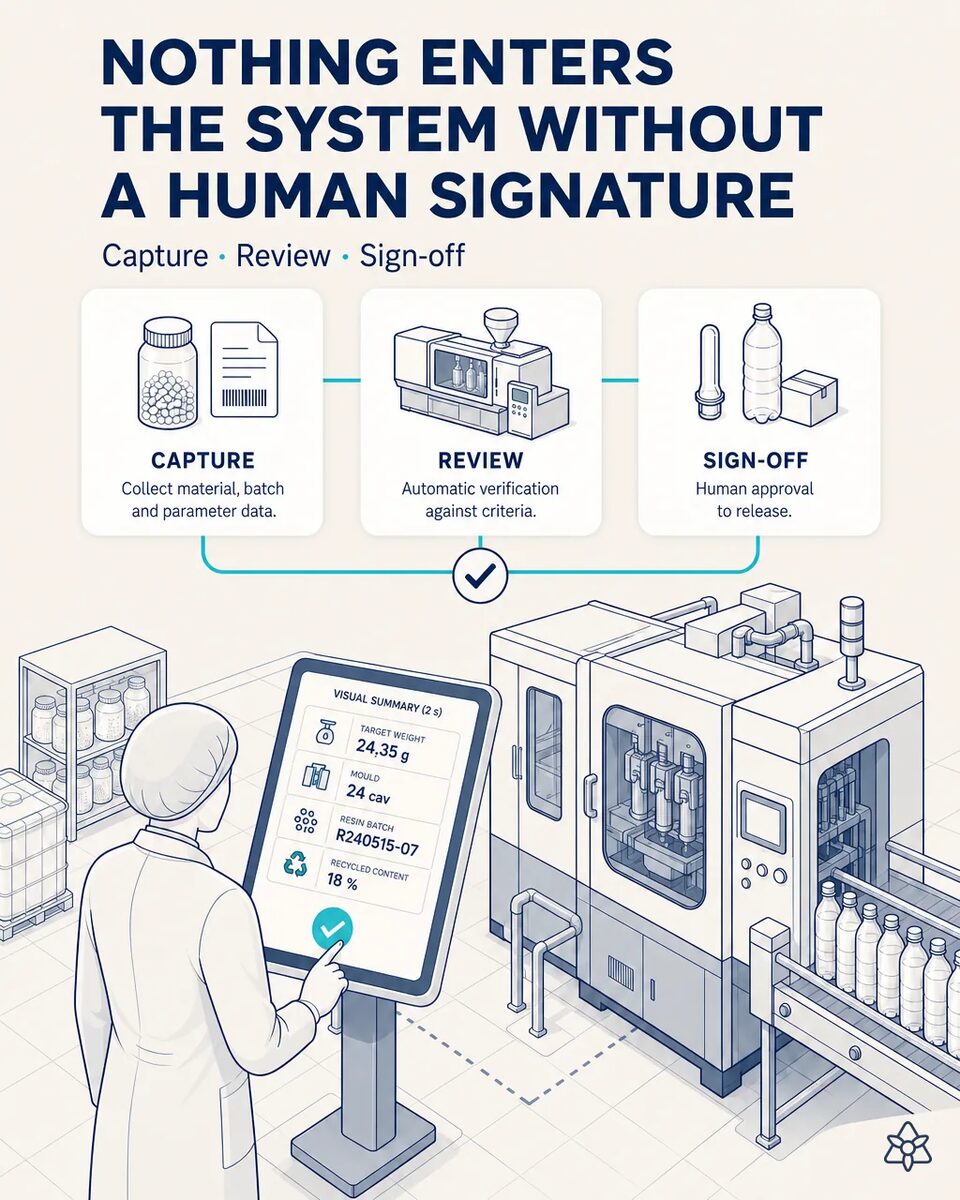
This is what separates an IRIS system from an autonomous AI agent that pushes unsigned data in and ends up contaminating the ERP master. In a PET packaging plant four fields cannot be wrong: preform and bottle weight, mold and active cavities, resin batch and recycled content in the blend. With iLEAN, every capture appears on the line tablet as a two-second visual summary: the operator confirms or corrects, and only then does the data cross into the central system.
The brake is not technical: it is trust, and it is reasonable.
The real blocker to digitising a shop floor is almost never technical: it is trust. The objection is always the same — if the AI enters data on its own, somebody has to clean the ERP master afterwards — and it is a reasonable objection. A contaminated master costs more to fix than the problem it was meant to solve. But the alternative does not work either: asking the operator to type. On a blow molding line at real speed, any manual entry is done late, done badly or not done at all. In a PET plant the risk is highly concentrated. The four critical fields — weight, mold and cavities, resin batch, recycled content — decide whether the container is conforming and whether the recycled content declaration handed to the customer is true. An error there is not a record-keeping error: it is a product conformity problem.
- The objection is always the same — if the AI writes data on its own, someone has to clean up the ERP master afterwards — and it is reasonable: a contaminated master costs more to fix than the problem it was meant to solve.
- But the alternative does not work either: on a blow molding line at real cadence, any manual capture happens late, happens badly or does not happen.
- In a PET plant the risk is highly concentrated in four data points: preform and bottle weight, mold and active cavities, resin lot and the blend's recycled content.
- Those four underpin quality, traceability and the material balance. An error in any of them contaminates all three at once.
Connect with early human verification — a summary, not a form.
Connect, early human verification mode. An industrial tablet at the blow molder and the injection machine, or at the supervisor's station. Step by step:
The interface is designed for validating, not for entering data. That difference is what makes it get used: asking an operator to fill in a form at real cadence is asking them not to do it.
- Capture by any route. Photo of the set-up sheet, dryer panel reading, voice note, parsed email or inline weight measurement.
- Visual summary. What was captured appears on the tablet as a summary, not a form. The interface is designed for validating, not for data entry.
- Two taps. The operator confirms with one tap, or corrects the specific field before it goes in.
- Crossing to the master. Only after the human signature does the data cross into central memory and, where applicable, into the ERP via API.
- Signature traceability. Who validated what and when is recorded, feeding the audit evidence pack directly.
The three ways of resolving it, compared
| Aspect | Autonomous AI | Operator types it |
|---|---|---|
| ERP master protected | No | Yes |
| Actually done at cadence | — | No: late, badly or never |
| Operator time | Zero | Minutes |
| Training required | — | High |
| The four critical data points | Unsigned | Half captured |
| Approvable by the board | No | Yes, but unused |
An enabling piece — no payback of its own, and stated as such.
The block below is an estimate to be validated against your plant's actual data. We put it forward so the committee has an order of magnitude; we refine it during the assessment.
- This case has no payback of its own worth calculating: it is the enabling piece of the whole matrix.
- Without early human verification, the other eleven cases do not get signed off by the board.
- It is what turns "the AI writes data" into "the AI prepares and a person signs", which is a different conversation.
- It removes both unvalidated data reaching the ERP and data never captured out of distrust of the AI.
This case is the enabling piece of the whole matrix and has no payback of its own worth calculating. Without early human verification the other eleven cases do not clear a steering committee: it is what turns "the AI enters data" into "the AI prepares and the person signs". *Strategic value, not directly monetisable.*
And the fair question from the production manager
«If a person signs in the end, where is the saving?» — the work is not in deciding, it is in assembling. Today somebody would have to weigh, check the panel, look up the resin lot and type it. With the verification gate it all arrives assembled in a two-second summary and they only confirm or correct the specific field. And every correction is stored: the system learns where its extraction fails.
[1] OpenAI paper "Why Language Models Hallucinate", 2025 — on the reliability of AI in anchored tasks.
What people ask about human validation
How long does it take the operator?
The summary is meant to be read in two seconds and resolved with a tap. If it cost minutes it would be filled in afterwards, which is the failure this case closes.
Can the AI write to the ERP without a signature?
No, and it is not configurable: it is the architecture. Data crosses into central memory and into the ERP only after the human signature.
Does it work for captures from any source?
Yes: a photo of the setup sheet, a dryer panel reading, a voice dictation, a parsed email or an in-line weight measurement. All pass through the same gate.
Does the operator need training?
Practically none, and that is deliberate: the interface does not ask them to enter data, it asks them to confirm or correct one specific field. It is a design decision, not a usability detail.
What gets recorded?
What summary was shown, who confirmed it, when, and what they corrected if anything. That is what later serves as evidence and as feedback for the model.
More cases from this series
- The audit is always ready, with nothing rebuilt by handEvery critical change and every batch generates its evidence. Agents organises it by standard and…
- Zero grams lost: the resin balance, live, from silo to palletFour coordinated rings close the balance between resin kilos entering through the silo and thousands of…
- The blow molder start-up recipe, captured in one photoThe blow molder set-up sheet, captured by photo: the batch's real recipe enters the system at second…
- The order changes by email and the plan rebuilds itselfiLEAN reads the schedule-change email or WhatsApp, cross-checks it against the live plan and silo…
- The shift lead dictates without stopping his walk through the plantThe shift lead dictates issues while walking between injection and blow molding. iLEAN structures each…
- The PET lab reaches the ERP without a single retyped figureiLEAN reads the PET test sheet as it is saved and, after validation, posts it to the ERP. Typical 50-80%…
Tell us what objection stopped your last data project on the floor.
We work on your plant's real data, not ours. Assessment with no commitment.
Request estimated ROI within 48h ‹ See all cases of PET packaging See packaging