A photo of the work order at run startup
In a metal packaging factory, every lithography run starts with a paper work order and a spec sheet fixing the exact Pantone, varnish and gauge. Today those documents take hours to get digitized. With iLEAN Connect, two phone photos are enough for the batch to exist in the central system instantly.
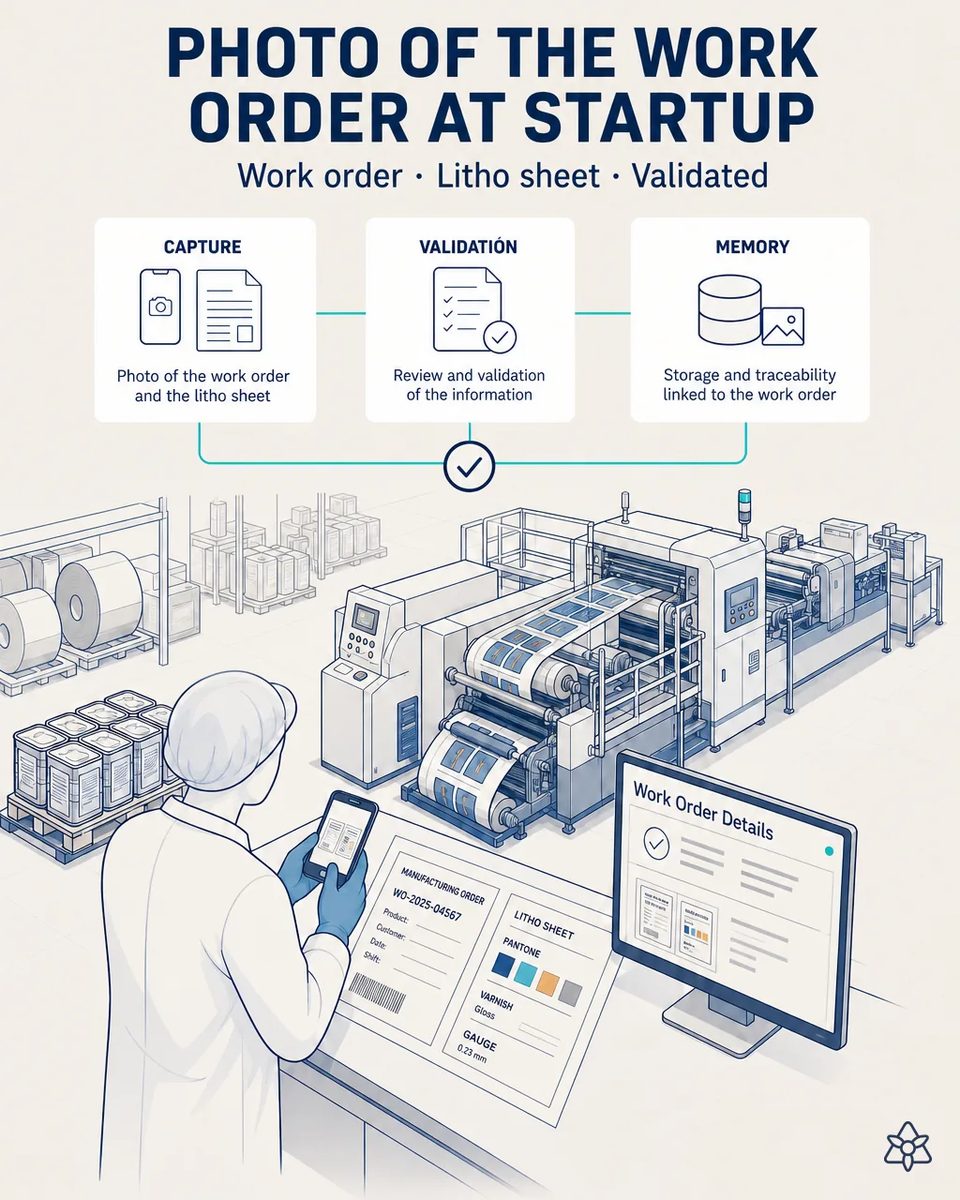
Every litho run starts on paper and stays on paper for hours.
The shift's work order is printed with ERP data and any last-minute adjustment (corrected Pantone, varnish change, quality note) gets handwritten. The lithography spec sheet is handwritten by habit of the technical office. Both can sit undigitized for 4-8 hours, piling up in a technical office folder until someone transcribes them — when the BRC auditor arrives, someone has to reconstruct which run each coil belongs to.
- The shift work order prints with ERP data, but any last-minute adjustment gets handwritten on it: a corrected Pantone, a change of interior varnish, a quality note carried over from the previous run.
- The lithography spec sheet is handwritten out of the technical office's habit: client, format, ink sequence, varnish, tinplate or TFS gauge.
- Both sit for 4 to 8 hours in a technical office folder until somebody transcribes them, and longer when the run started on the night shift.
- When the BRCGS Packaging auditor asks which run a coil fed, somebody has to rebuild it by hand from folders that were never meant to answer that question.
Connect in photo mode — two photos at startup, and the run already exists.
Connect photo mode. The operator takes two phone photos at run startup. An anchored LLM extracts structured fields — client, format, Pantone, varnish, gauge, notes — and stores them in central memory. Zero change of habit for the operator.
The handwritten correction is the most valuable line on the sheet, because it records what was actually printed, not what was planned. Captured at the first sheet, it stops depending on somebody deciphering it a day later.
The litho run on paper versus the litho run captured at startup
| Aspect | Today, on paper | With iLEAN Connect |
|---|---|---|
| Time until the run exists in the system | 4-8 h in a folder | Instant, from the first sheet |
| Pantone corrected by hand | Only on the paper copy | Extracted and tied to the run |
| Varnish and gauge per run | Typed when somebody has time | Structured fields, queryable by client and format |
| Coil-to-run link for the auditor | Rebuilt from scattered papers | One web lookup per run |
| Technical office transcription | Every work order, every shift | Review only, no typing |
| Operator's routine at the press | — | The same, plus two photos |
4-8 h of digitization latency → instant. Auditor facing scattered papers → instant web lookup per run.
Impact estimate — to be validated with your numbers.
The block below is an estimate to be validated against your plant's actual data. We put it forward so the committee has an order of magnitude; we refine it during the assessment.
- Estimated payback 4-9 months, depending on the number of runs started per day.
- Technical office transcription time recovered, which today goes into copying work orders instead of preparing the next ones.
- Digitization latency drops from 4-8 hours to instant, including runs started on the night shift.
- And the auditor's question about which run used which coil becomes a lookup instead of an afternoon of folders.
Estimated payback of 4 to 9 months depending on run volume per day, recovering the technical office's transcription time. Estimate to validate.
And the fair question from the production manager
“What if it misreads a Pantone reference scribbled in the margin?” — reading fields from a work order and a spec sheet with a known layout is an anchored task, where the best models drop below 1.5% error [1]. And there is a second net: a low-confidence field is flagged, and the line lead confirms or corrects it before it crosses into central memory. Every correction is stored, so the fields that are hardest to read on your sheets improve run after run.
[1] OpenAI paper "Why Language Models Hallucinate", 2025 — on the reliability of AI in anchored tasks.
What people ask about capturing the litho run startup
Does the technical office have to redesign the spec sheet?
No. The model reads the lithography spec sheet as it is drawn today, handwritten fields included, so nobody has to change a format that works for the press. Corrections in the margin, crossed-out values and initials are read too, and flagged when the handwriting is ambiguous.
Which fields does it extract from the work order?
Client, format, Pantone references, interior and exterior varnish, tinplate or TFS gauge and the free-text notes, each stored as a structured field tied to the run. That is what later lets you query every run of one client printed with a given varnish and gauge.
What happens with a run started on the night shift?
It enters the system at the same moment as a day run. Today that is precisely the run that waits longest in the folder, sometimes until the next morning. With capture, the night lead's corrections carry the same weight as the day shift's, instead of reaching the office as a cold folder.
Does it help with a BRCGS Packaging audit?
Yes: the link between coil, varnish and run is queryable from day one, so answering the auditor stops depending on rebuilding it from paper. The original photos stay attached as evidence, so the auditor sees the handwritten document alongside the structured record.
Can we run it without connecting the ERP first?
Yes. The captures go to iLEAN's central memory from the first run, and the push to the ERP is added once the value is visible. Starting outside the ERP also keeps IT out of the critical path of the first weeks.
More cases from this series
- The lab spreadsheet stops living in a world apart from the ERPiLEAN absorbs the lab's varnish migration and adhesion spreadsheet and pushes it to the ERP after…
- The truck no longer waits while the delivery note is typedA photo of the delivery note and heat-number labels digitizes tinplate receiving and pushes it to the…
- A supplier alert that doesn't cost 90 minutes of stopped lineiLEAN reads a coil delay alert instantly and replans the work order before the lithography line stops.
- The curing curve, without touching the ovenAn external camera digitizes the varnish curing curve of an isolated vintage oven, with no replacement…
- Nothing enters the central system without human validationEvery iLEAN capture passes through a tablet with a visual summary before crossing into the ERP: the…
- Information that no longer dies at the end of the shiftWith a Bluetooth earpiece, the line manager dictates issues while walking and iLEAN structures and saves…
Tell us how many hours a litho work order waits in the folder before anyone types it.
We work on your plant's real data, not ours. Assessment with no commitment.
Request estimated ROI within 48h ‹ See all cases of metal packaging See packaging