Nothing enters the central system without human validation
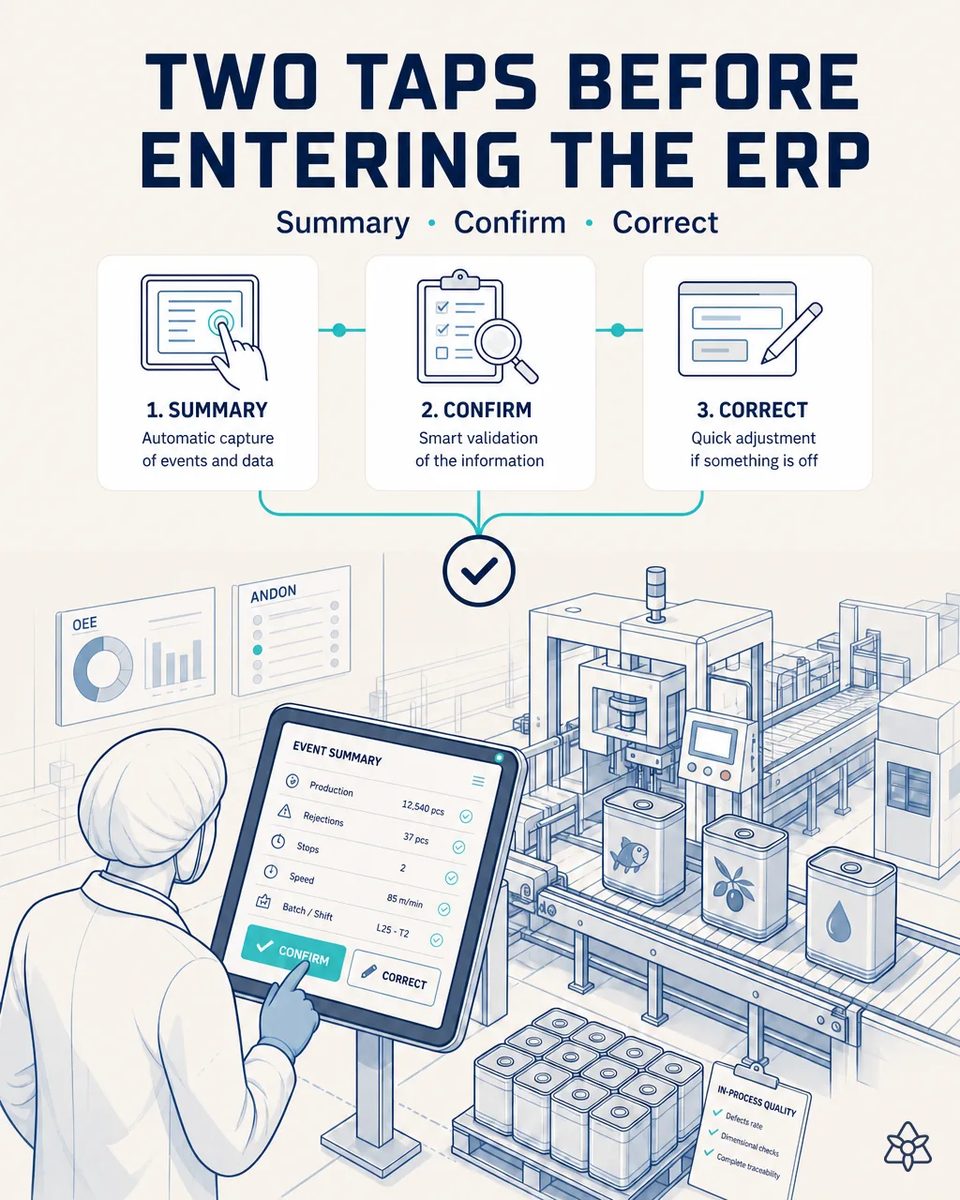
What sets iLEAN apart from an autonomous AI agent is that no capture enters the central system without a human seeing it first. In a metal packaging factory, that means an industrial tablet by the line with two validation taps.
The real blocker is not technology, it is a reasonable fear.
The main cultural blocker to digitalization is the fear that AI enters data on its own and someone later has to clean up the ERP master — especially when the data affects a food-contact spec. But the operator doesn't want to go back to typing either.
- The main cultural brake on digitalization is the fear that AI enters data on its own and somebody later has to clean up the ERP master.
- In metal packaging that fear is well founded: a wrong varnish code or gauge on a food-contact spec is not a typo, it is a potential migration nonconformity.
- At the same time, the operator does not want to go back to typing at a terminal several stations away from the forming line.
- Between the two, data ends up either unvalidated or never captured, and both leave the master less reliable than before.
Connect with early human verification — a two-second summary, two taps in metal packaging.
Connect early human verification mode. Every capture (photo, voice, parsed email) shows up on the tablet as a 2-second visual summary. The lead confirms with two taps — enter the ERP or correct before entering.
This is what separates iLEAN from an autonomous AI agent. The AI assembles the record; a person on the line decides whether it enters. Without that gate, none of the other eleven cases would get signed off.
Data entry at the forming line, before and after the validation gate
| Aspect | Today | With iLEAN |
|---|---|---|
| Who writes to the ERP master | Whoever types, often later | A line lead, confirming a summary |
| Varnish and gauge on a food-contact spec | Typed, sometimes wrong | Shown in the summary and confirmed |
| Time per record at the line | Minutes at a remote terminal | About two seconds, two taps |
| A wrong extraction | Cleaned out of the master afterwards | Corrected before it enters |
| Captures from photo, voice and email | Each with its own path, or none | One validation gate for all of them |
| Trail of who approved what | Not kept | Name, time and correction stored |
Unvalidated data contaminating the ERP, or data not captured due to distrust → data captured and validated in seconds, clean master.
No standalone payback — it is the piece the rest depends on.
The block below is an estimate to be validated against your plant's actual data. We put it forward so the committee has an order of magnitude; we refine it during the assessment.
- This case has no standalone payback: it is the enabling piece of the whole matrix and its value is strategic, not directly monetizable.
- Without early human verification, none of the other pieces gets signed off by quality or by management.
- It turns “the AI enters data” into “the AI prepares, a person confirms”, which is a conversation a food-contact plant can actually have.
- Result: data captured and validated in seconds, and an ERP master that stays clean.
The enabling piece of the whole iLEAN matrix: without this early human verification, none of the other pieces get signed off. Strategic value, not directly monetizable.
And the fair question from the production manager
“If a person confirms everything, what is the AI actually doing?” — assembling. Today somebody has to find the run, open the screen and type each field. Here it arrives prepared from the photo, the dictation or the email; extracting those fields is an anchored task where the best models drop below 1.5% error [1], and the lead only confirms or corrects. Every correction is stored and feeds back into extraction. That trail also answers the question every auditor asks: who approved this record, when, and on what.
[1] OpenAI paper "Why Language Models Hallucinate", 2025 — on the reliability of AI in anchored tasks.
What people ask about validating before the ERP
Can any capture skip the tablet in metal packaging?
No. It is the architecture, not a setting: photos, dictations and parsed emails all pass through the same human gate before crossing into the ERP. There is no setting that lets a capture write to the master on its own, not even for a trusted source.
What does the lead see on the screen?
A short visual summary of the capture, such as production, rejects, stops and batch, with a confirm button and a correct button. It is designed to be read at a glance, with gloves on, without leaving the station.
Why does it matter more for food-contact specs?
Because a wrong varnish or gauge entered silently can end up on a run that ships to a packer client. The gate makes sure a person has seen it first. On those fields the summary highlights the value so it is not confirmed out of habit.
Does the line lead need ERP training?
No. They validate a summary on a tablet next to the line; they do not navigate the ERP or learn its screens. Onboarding usually takes a single shift, because the only decision is confirm or correct.
Why does it have no return figure of its own?
Because its value is that the rest of the matrix becomes approvable. Its return shows up in the other cases, not in a line of its own. That is why we present it as the piece that makes the others approvable, not as a project to justify alone.
More cases from this series
- The lab spreadsheet stops living in a world apart from the ERPiLEAN absorbs the lab's varnish migration and adhesion spreadsheet and pushes it to the ERP after…
- The truck no longer waits while the delivery note is typedA photo of the delivery note and heat-number labels digitizes tinplate receiving and pushes it to the…
- A supplier alert that doesn't cost 90 minutes of stopped lineiLEAN reads a coil delay alert instantly and replans the work order before the lithography line stops.
- The curing curve, without touching the ovenAn external camera digitizes the varnish curing curve of an isolated vintage oven, with no replacement…
- Information that no longer dies at the end of the shiftWith a Bluetooth earpiece, the line manager dictates issues while walking and iLEAN structures and saves…
- A photo of the work order at run startupThe work order and the lithography spec sheet get digitized with a photo at startup, with no change to…
Tell us what stops you today from letting captured data reach your ERP.
We work on your plant's real data, not ours. Assessment with no commitment.
Request estimated ROI within 48h ‹ See all cases of metal packaging See packaging