The curing curve, without touching the oven
The varnish curing oven in a metal packaging factory is typically 12-20 years old, lives isolated from the network, and its panel shows the temperature curve that determines whether food-contact varnish is properly polymerized. With iLEAN Connect, an external camera reads that panel and digitizes the curve without touching the oven.
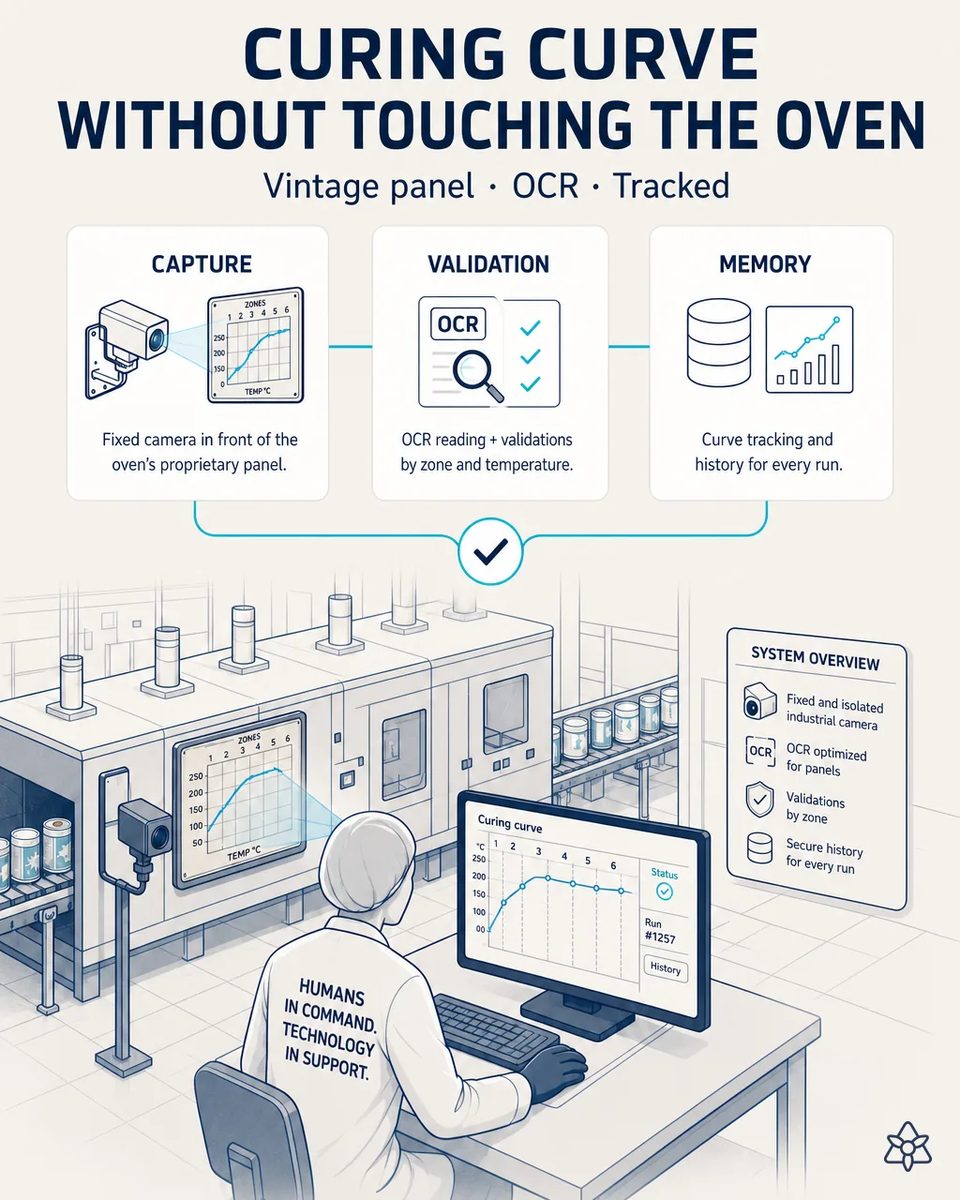
The curve that decides whether the varnish is cured disappears every cycle.
Replacing the oven costs over half a million euros and weeks of line downtime, so today nobody touches it or connects it. Its panel shows everything the quality lead would need to correlate the curing curve with migration results or complaints — but that data dies every cycle when the screen rotates.
- The varnish curing oven is typically 12 to 20 years old, isolated from the network, and its panel is the only place the temperature profile by zone is shown.
- That profile decides whether a food-contact interior varnish is properly polymerized: a run cured under profile can look fine and fail the migration test weeks later. By then the cans have been formed, filled and shipped by the packer client.
- Replacing the oven costs over €500,000 and weeks of line downtime, so nobody connects it and nobody touches it.
- When the screen rotates, the curve is gone. The quality lead is left without the one datum needed to correlate a complaint or a migration result with a specific run.
Connect in photo mode on the oven panel — read from outside, nothing installed inside.
Connect photo mode on the panel. A fixed industrial camera points at the panel; an anchored-LLM OCR interprets each frame, structures the time curve per run, and cross-references it with the ERP to know which run was in the oven at each moment.
The curve already exists; it is just never kept. Reading it from outside turns a screen that refreshes every cycle into a history per run, and leaves the oven exactly as it was commissioned. It is the cheapest way to get the most important process datum of a food-contact can out of a machine nobody wants to touch.
The curing oven as it is today versus the curing oven read by camera
| Aspect | Today | With iLEAN Connect |
|---|---|---|
| Temperature profile by zone | Visible only while on screen | Stored per run, cycle after cycle |
| Which run was in the oven | Inferred from the shift report | Crossed with the ERP automatically |
| Migration result vs. curing curve | No correlation possible | Root cause per run in minutes |
| A run cured below profile | Found at the migration test | Flagged against the reference curve |
| Oven controls and software | — | Untouched, nothing installed |
| Oven replacement | A €500,000+ line in the plan | Deferrable indefinitely |
Zero curve-to-complaint correlation → root-cause analysis per run in minutes. Oven replacement becomes indefinitely deferrable.
Impact estimate — to be validated with your numbers.
The block below is an estimate to be validated against your plant's actual data. We put it forward so the committee has an order of magnitude; we refine it during the assessment.
- Estimated payback 5-10 months.
- Avoided oven replacement capex, which runs over €500,000 plus weeks of line downtime.
- Fewer migration nonconformities, through the curve-to-result correlation that cannot be made today.
- And a complaint investigation that starts from the actual curing curve of that run, not from memory. With a few months of curves, quality can also see drift in a zone before it shows up as a migration result out of spec.
Estimated payback of 5 to 10 months, avoiding oven replacement CAPEX (>€500,000) and reducing migration non-conformities through curve-to-result correlation. Estimate to validate.
And the fair question from the production manager
“Can a camera reading an old panel be trusted for food contact?” — the task is anchored: fixed screen, temperature fields in known positions and physically bounded ranges per zone, where the best models drop below 1.5% error [1]. Any frame whose value falls outside the possible range is discarded instead of stored, and the quality lead validates the curve before it is tied to a migration result.
[1] OpenAI paper "Why Language Models Hallucinate", 2025 — on the reliability of AI in anchored tasks.
What people ask about reading the curing oven
Does the oven manufacturer need to be involved?
No. The camera sits in front of the panel, opens no ports and installs nothing on the controller, so the oven stays exactly as it was commissioned. Its warranty, its software and its validation are untouched, which is what usually makes quality and maintenance agree on day one.
How does it know which run was curing at each moment?
By crossing the timestamp of each frame with the work orders active in the ERP. That link is what turns a temperature reading into a curve per run. When two runs share the oven back to back, the transition is marked so each one keeps its own profile.
Does it read every zone of the oven?
Yes, every zone shown on the panel, structured as a time curve. If a zone only appears on a secondary screen, a second camera covers it. Capture frequency is set to the speed at which the profile can actually change, not to an arbitrary interval.
Can the curve be compared with the migration test?
That is the point of the case: with both data per run, a migration result out of spec can be traced back to a curing profile in minutes. And the opposite also holds: a run with a clean profile can be cleared quickly when a complaint comes in.
Is this a way to postpone buying a new oven?
It can be. If the existing oven cures correctly and its curve is now recorded, the main reason to replace it, the lack of data, disappears. The decision to replace it can then be taken on the oven's real behavior, not on its age.
More cases from this series
- The lab spreadsheet stops living in a world apart from the ERPiLEAN absorbs the lab's varnish migration and adhesion spreadsheet and pushes it to the ERP after…
- The truck no longer waits while the delivery note is typedA photo of the delivery note and heat-number labels digitizes tinplate receiving and pushes it to the…
- A supplier alert that doesn't cost 90 minutes of stopped lineiLEAN reads a coil delay alert instantly and replans the work order before the lithography line stops.
- Nothing enters the central system without human validationEvery iLEAN capture passes through a tablet with a visual summary before crossing into the ERP: the…
- Information that no longer dies at the end of the shiftWith a Bluetooth earpiece, the line manager dictates issues while walking and iLEAN structures and saves…
- A photo of the work order at run startupThe work order and the lithography spec sheet get digitized with a photo at startup, with no change to…
Tell us how old your curing oven is and whether you can see last month's curves today.
We work on your plant's real data, not ours. Assessment with no commitment.
Request estimated ROI within 48h ‹ See all cases of metal packaging See packaging