The truck no longer waits while the delivery note is typed
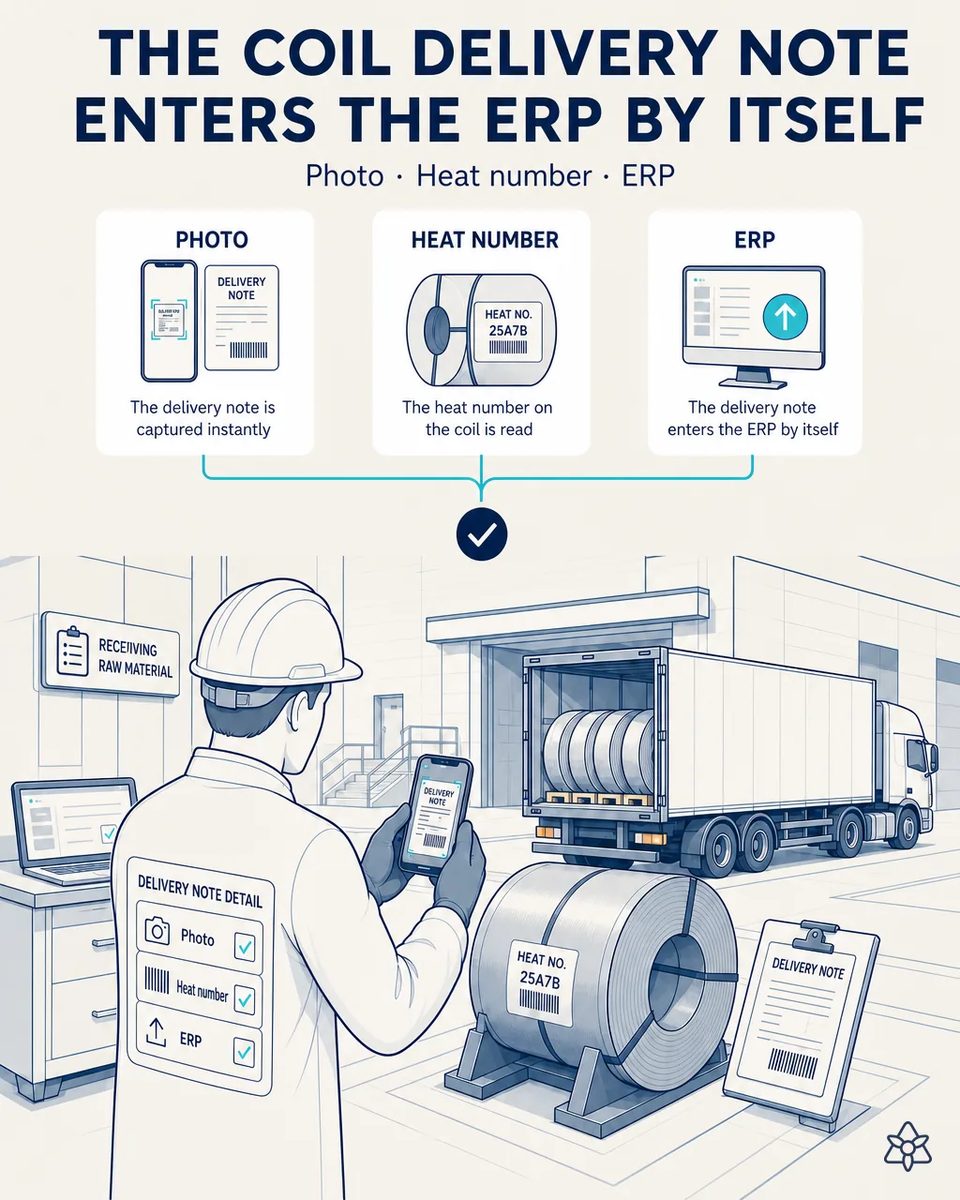
The truck arrives with the tinplate coil and the receiving lead has to type 12-20 delivery-note lines into the ERP while the carrier racks up demurrage. With iLEAN Connect, one photo of the note and another of the heat-number labels are enough.
The heat number is typed in a hurry, and it is the one that matters.
If data is typed fast to avoid demurrage, heat numbers get traced badly — surfacing weeks later as a non-conformity impossible to trace back to the origin coil.
- The truck arrives with tinplate or tin-free steel (TFS) coils and the receiving lead has to type 12 to 20 delivery-note lines into the ERP while the carrier waits.
- Typing fast avoids demurrage but traces heat numbers badly; typing carefully keeps the truck at the dock for 45 minutes.
- A wrong heat number does not show up that day. It surfaces weeks later as a nonconformity that cannot be traced back to the origin coil.
- And without the origin coil, an adhesion or corrosion problem at the packer client has no way back to the steel supplier. The supplier claim then rests on a hunch instead of a heat number.
Connect in photo-to-analog mode — delivery note, heat labels and one validation tap.
Connect photo-to-analog mode. Vision AI recognizes the delivery note's format without asking the supplier to change theirs, and reads GS1-128, QR, barcode or plain OCR on heat-number labels. Validation with one tap on an industrial tablet.
Traceability in metal packaging starts at the coil. If the heat number enters correctly at the dock, every run, sheet and pallet downstream inherits it; if it enters wrong, nothing later can fix it. That is why the dock, not the lab, is where coil traceability is won or lost.
Coil receiving typed at the dock versus coil receiving from a photo
| Aspect | Today | With iLEAN Connect |
|---|---|---|
| Truck at the dock | About 45 minutes | About 5 minutes |
| Heat number entry | Typed under time pressure | Read from GS1-128, QR, barcode or OCR |
| Hidden heat-number errors | Surface weeks later | Zero, checked before entry |
| Trace back to the origin coil | Broken when a digit is wrong | Complete, with photo and label attached |
| Steel mill delivery note format | Typed whatever the layout | Recognized without asking the supplier to change |
| Receiving module seats | Two or three in use | None for the lead, who validates on a tablet |
Truck 45 min → 5 min. Hidden heat-number errors → zero. Broken traceability → complete via photo and GS1 back to the origin coil.
Impact estimate — to be validated with your numbers.
The block below is an estimate to be validated against your plant's actual data. We put it forward so the committee has an order of magnitude; we refine it during the assessment.
- Estimated payback 3-8 months.
- 💰 CFO angle: the receiving module typically needs 2-3 licenses; with Connect the lead validates without entering the ERP — a typical 50-70% reduction in receiving and warehouse licenses.
- From 45 minutes of truck at the dock to 5, and carrier demurrage that stops accruing.
- Heat-number errors hidden in the ERP drop to zero, so a nonconformity can always be traced to its origin coil. And a claim to the steel supplier can be argued with the heat number and the photo of its label.
CFO angle: the receiving module typically requires 2-3 licenses; with Connect, only the lead validates without entering the ERP. Typical reduction of 50 to 70% in receiving/warehouse module licenses. Estimated payback of 3 to 8 months. Estimate to validate.
And the fair question from the production manager
“Every steel mill has its own delivery note — does it cope?” — yes, without asking any of them to change: vision recognizes the table structure of each format, and heat-number labels are read by GS1-128, QR or barcode where present and by OCR where not. It is an anchored task where the best models drop below 1.5% error [1], and the lead validates with one tap before anything enters. No supplier has to change a document, a label or a habit.
[1] OpenAI paper "Why Language Models Hallucinate", 2025 — on the reliability of AI in anchored tasks.
What people ask about receiving tinplate coils
Does it read the heat number from the coil label itself?
Yes. It reads the label symbology when there is one and falls back to optical recognition when there is not, then crosses it with the delivery note line. If the label is damaged, the field is flagged for the lead instead of being guessed.
Does it work for both tinplate and TFS coils?
Yes. What changes between them is the supplier and the label format, and the model recognizes both without a template per steel mill. A new supplier does not require any setup project; the first delivery note is read like the rest.
What if a heat number on the label does not match the delivery note?
The mismatch is highlighted on the tablet before the lead validates. Today nobody makes that cross-check with a carrier waiting. The lead decides whether to accept, correct or hold the coil, with both documents side by side.
Is a dedicated scanner needed at the dock?
No. A phone or industrial tablet photo is enough; existing scanners can still be used where the plant already has them. What matters is that the heat number is read, not typed.
How does it help with a complaint months later?
Because the run, the sheet and the pallet inherit a heat number that entered correctly, so the trace back to the origin coil holds up. That is the question that always comes up in a nonconformity, and today it is the hardest one to answer.
More cases from this series
- The lab spreadsheet stops living in a world apart from the ERPiLEAN absorbs the lab's varnish migration and adhesion spreadsheet and pushes it to the ERP after…
- A supplier alert that doesn't cost 90 minutes of stopped lineiLEAN reads a coil delay alert instantly and replans the work order before the lithography line stops.
- The curing curve, without touching the ovenAn external camera digitizes the varnish curing curve of an isolated vintage oven, with no replacement…
- Nothing enters the central system without human validationEvery iLEAN capture passes through a tablet with a visual summary before crossing into the ERP: the…
- Information that no longer dies at the end of the shiftWith a Bluetooth earpiece, the line manager dictates issues while walking and iLEAN structures and saves…
- A photo of the work order at run startupThe work order and the lithography spec sheet get digitized with a photo at startup, with no change to…
Tell us how long a coil truck waits at your dock today.
We work on your plant's real data, not ours. Assessment with no commitment.
Request estimated ROI within 48h ‹ See all cases of metal packaging See packaging