A supplier alert that doesn't cost 90 minutes of stopped line
A steel supplier's email warns of a 48-hour delay on a tinplate coil. The email lands in an inbox that's read late, once a work order is already planned around that coil. With iLEAN Connect, the system reads the email instantly, cross-checks active work orders in the ERP, and raises the concrete action to take.
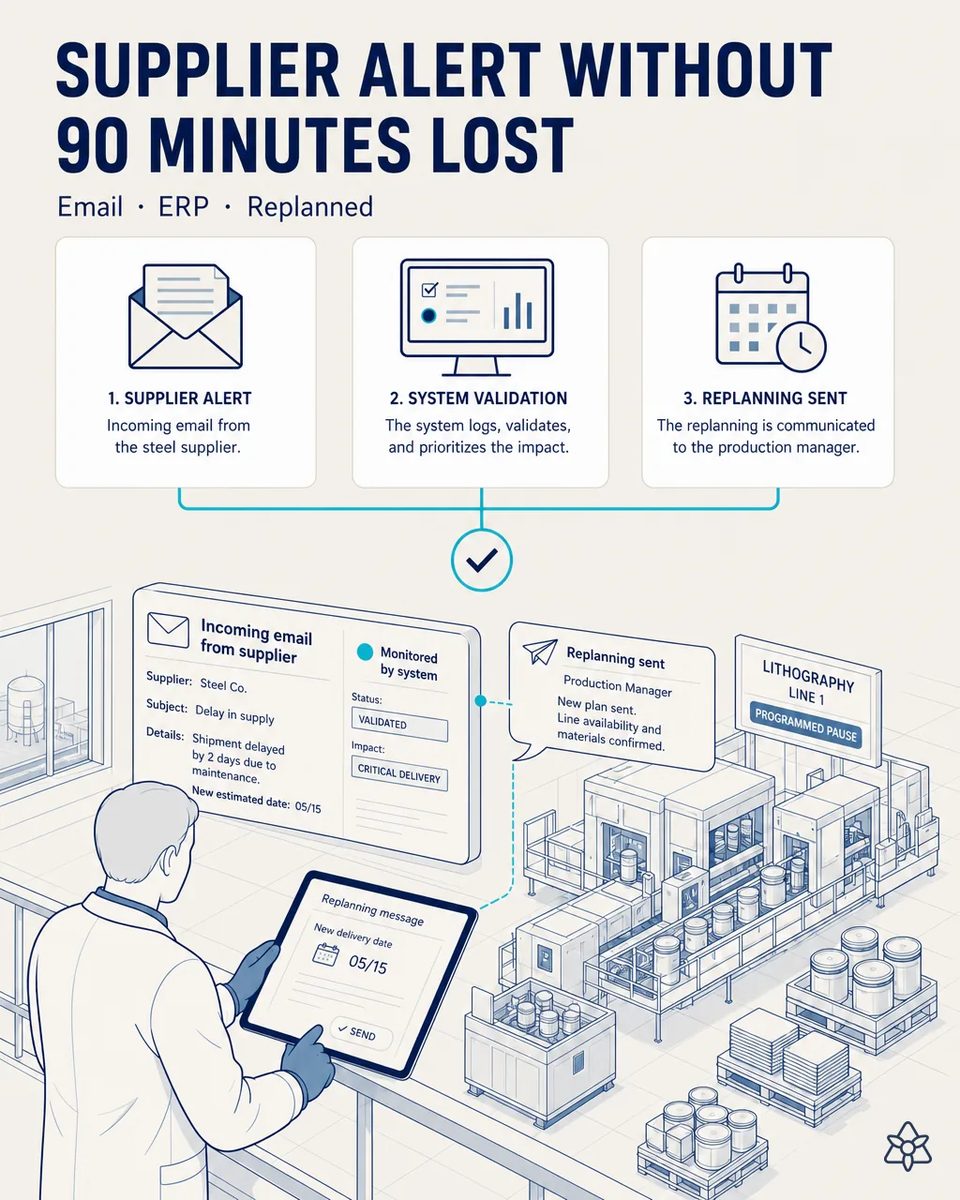
The coil delay arrives in time. Reading it does not.
Critical alerts from steel suppliers or packer clients arrive by email to specific people who can't watch the inbox in real time. By the time they're read, decisions already made get broken — and the lithography line stops for 90 minutes waiting for someone to decide.
- A steel supplier emails a 48-hour delay on a tinplate coil. The message lands in the inbox of one person who cannot watch it in real time.
- By the time it is read, the work order has already been planned around that coil and the litho press is being set up for it.
- The line then stops for 90 minutes waiting for somebody to decide which run to bring forward and whether the right gauge and varnish are in stock.
- Packer clients do the same: a format change or an urgent pull-in written in an email that sits among a hundred other messages.
Connect in chaotic-sources mode — a dedicated mailbox in silent copy, 24/7 in metal packaging.
Connect chaotic-sources mode. A dedicated mailbox in silent copy 24/7. An LLM extracts the intent (supply delay, spec change), the entities (supplier, coil, client, date) and cross-checks the ERP, returning the concrete action to the right role.
Finding out sooner is only half of it. The value is that the alert arrives already crossed with the work orders it breaks, addressed to the role that has to decide, with the concrete action on the table.
The coil alert in an inbox versus the coil alert crossed with the ERP
| Aspect | Today, in the inbox | With iLEAN Connect |
|---|---|---|
| Human latency on a critical email | 2-3 hours | Seconds |
| Work orders affected by a late coil | Worked out by hand | Listed with their run and client |
| Litho line while somebody decides | Stopped up to 90 minutes | Resequenced before it stops |
| Basis for the new sequence | A message read three hours late | Active work orders, in real time |
| Who gets it | Whoever the supplier wrote to | Planning, purchasing or quality, by intent |
| Final decision | Taken late | Taken by a person, on live data |
2-3 h of human latency → seconds. Replanning decisions based on real-time data, not on something read three hours earlier.
Impact estimate — to be validated with your numbers.
The block below is an estimate to be validated against your plant's actual data. We put it forward so the committee has an order of magnitude; we refine it during the assessment.
- Estimated payback 3-7 months, depending on how often critical alerts arrive.
- Unplanned stoppages of the litho line caused by missing information, avoided before they start.
- Replanning decided on real-time data instead of on a message read 2-3 hours after it arrived.
- And packer client changes reach planning at the moment they are sent, not when somebody gets back from the floor.
Estimated payback of 3 to 7 months depending on critical alert frequency, avoiding unplanned stoppages from missing information. Estimate to validate.
And the fair question from the production manager
“Will it read everyone's email?” — no. iLEAN sits in copy on a dedicated operational mailbox: it only sees what suppliers and clients send to that channel. Classifying an alert's intent and extracting supplier, coil, client and date is an anchored task where the best models drop below 1.5% error [1], and the replanning is approved by a person before anything moves on the line. If the model is unsure of the intent, the email is escalated as is to a person instead of being classified by guesswork.
[1] OpenAI paper "Why Language Models Hallucinate", 2025 — on the reliability of AI in anchored tasks.
What people ask about reading coil supplier alerts in metal packaging
Does it tell a coil delay from a specification change?
Yes. It classifies the intent of each message, so a supply delay goes to planning and purchasing, while a change in varnish or gauge goes to quality and the technical office. A routine confirmation of a shipment that is on time interrupts nobody.
How does it know which work orders depend on that coil?
It crosses the supplier, coil and dates in the email with the active work orders in the ERP and returns the affected runs with their client. It also shows which other coils of the same gauge and coating are in stock, so the alternative is on the table.
What about emails from packer clients?
They follow the same path: an urgent pull-in or a format change is extracted and crossed with the plan, so it does not wait for its recipient to open it. The client's message stays attached to the proposed change, so planning can see exactly what was asked.
Does it replan the litho line by itself?
No. It proposes the concrete action and the production manager confirms it. The decision stays with a person; what changes is that it is taken on live data. Every proposal and every decision is stored, which shows over time which alerts actually changed the plan.
Do steel suppliers have to use a template?
No. Steel mills and service centers write as they always do, in free text, and the model extracts the entities from each message as it arrives. Messages in another language, common with international steel mills, are handled the same way.
More cases from this series
- The lab spreadsheet stops living in a world apart from the ERPiLEAN absorbs the lab's varnish migration and adhesion spreadsheet and pushes it to the ERP after…
- The truck no longer waits while the delivery note is typedA photo of the delivery note and heat-number labels digitizes tinplate receiving and pushes it to the…
- The curing curve, without touching the ovenAn external camera digitizes the varnish curing curve of an isolated vintage oven, with no replacement…
- Nothing enters the central system without human validationEvery iLEAN capture passes through a tablet with a visual summary before crossing into the ERP: the…
- Information that no longer dies at the end of the shiftWith a Bluetooth earpiece, the line manager dictates issues while walking and iLEAN structures and saves…
- A photo of the work order at run startupThe work order and the lithography spec sheet get digitized with a photo at startup, with no change to…
Tell us which critical alerts get read too late in your plant today.
We work on your plant's real data, not ours. Assessment with no commitment.
Request estimated ROI within 48h ‹ See all cases of metal packaging See packaging