The lab spreadsheet stops living in a world apart from the ERP
The quality lead fills a spreadsheet with varnish test parameters every run. That spreadsheet lives in a folder the ERP never sees. iLEAN Connect reads it as soon as it's saved, structures it, and after validation pushes it automatically to the ERP.
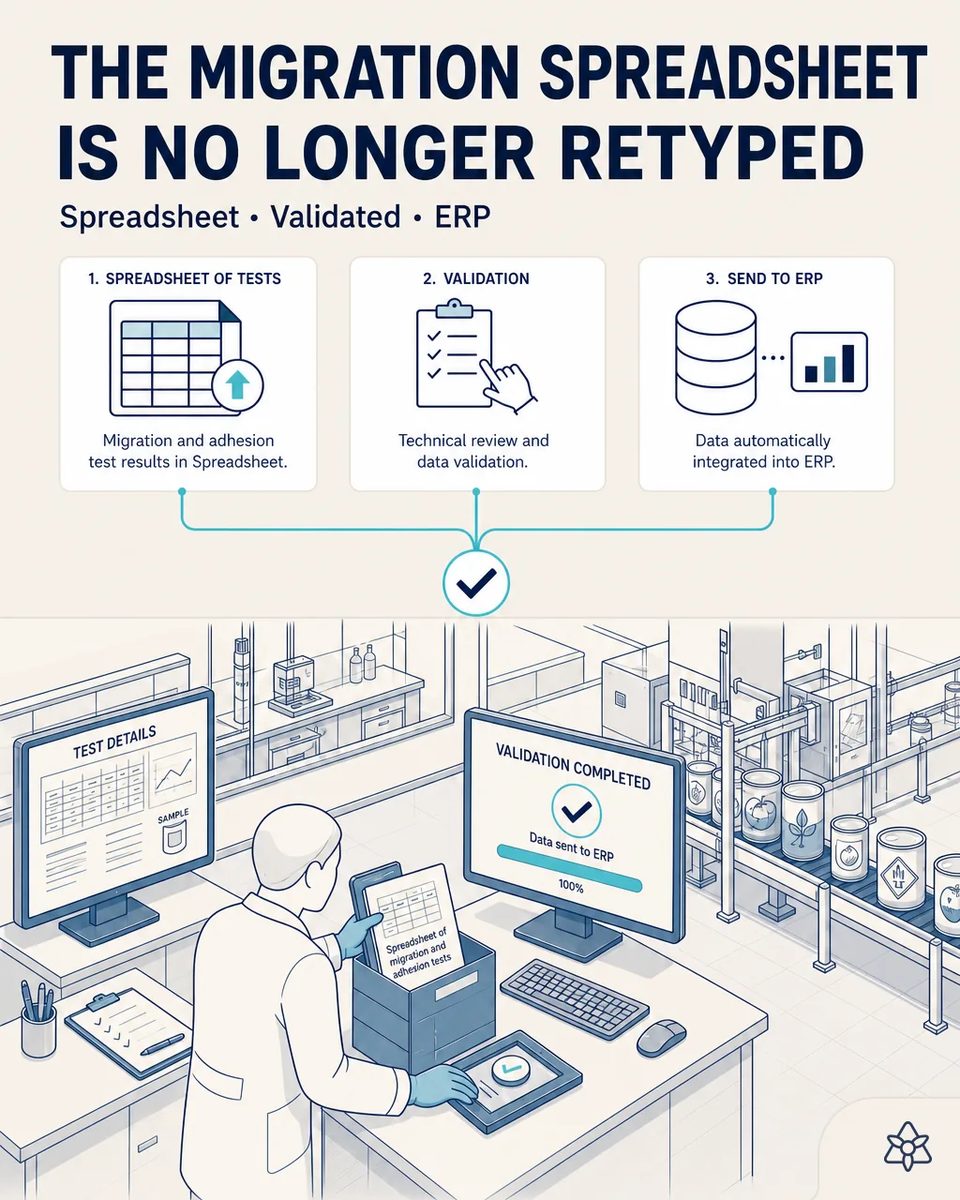
The migration data lives in one world and the ERP in another.
Two parallel worlds: the real spreadsheet, holding live migration and adhesion data, and the official ERP, with data retyped weeks late by someone spending half a day a month copy-pasting — and making mistakes in data a BRC auditor may request per run.
- Every run, the quality lead fills a spreadsheet with varnish test parameters: migration and adhesion results, cure checks, the BPA-NI status of the interior varnish.
- That spreadsheet lives in a shared folder the ERP never sees. The official system holds a copy retyped weeks late.
- Somebody spends half a day a month copying and pasting, and makes mistakes in exactly the data a BRCGS Packaging auditor may request per run.
- When a packer client asks for the migration result of a specific run, the answer is in the spreadsheet, not in the system that should hold it. And whoever answers has to trust that the version they open is the latest one.
Connect in inward-listening mode — it reads the shared folder, not the person.
Connect inward-listening mode: reads the shared folder (not the person), parses each cell with an anchored LLM as soon as the file is saved, and validates on screen before pushing to the ERP via API.
The lab keeps working in its spreadsheet and the ERP stops being weeks behind it. The migration result of each run is in the system on the day the technician saves it. That is what turns a packer client's question or an auditor's request into a query instead of a search through versions.
The lab spreadsheet in its own world versus the spreadsheet linked to the ERP
| Aspect | Today | With iLEAN Connect |
|---|---|---|
| Migration result in the ERP | Weeks behind the spreadsheet | Instant, after validation |
| Copy and paste by the lab | Half a day a month | None |
| Adhesion and cure results per run | Retyped with errors | Parsed cell by cell |
| BRCGS auditor asking per run | Data never cross-checked | Cross-checked automatically by run |
| Spreadsheet layout | Must not be touched | Read as the lab keeps it |
| Lab people logging into the ERP | Five, just to enter data | One, the validator |
Weeks of lag → instant. Half a day/month retyping → zero. BRC auditor facing uncross-checked data → automatic per-run cross-checking.
Impact estimate — to be validated with your numbers.
The block below is an estimate to be validated against your plant's actual data. We put it forward so the committee has an order of magnitude; we refine it during the assessment.
- Estimated payback 4-9 months.
- 💰 CFO angle: if five lab people log into the ERP just to enter data, that is five licenses; with Connect only the validator needs one — a typical 50-80% reduction in quality and lab module licenses.
- Half a day a month of retyping goes to zero, and the lag between spreadsheet and ERP goes from weeks to instant.
- And the auditor gets migration data already cross-checked per run instead of a spreadsheet and a printout that disagree.
CFO angle: if 5 lab people log into the ERP just to enter data today, that's 5 licenses; with Connect, only the validator needs one. Typical reduction of 50 to 80% in quality/lab module licenses. Estimated payback of 4 to 9 months. Estimate to validate.
And the fair question from the production manager
“That spreadsheet has been changed by several people for years — will it read it?” — that is the expected case. Parsing does not rely on fixed positions: it interprets columns, units and margin notes as they are. It is an anchored task where the best models drop below 1.5% error [1], and the validator checks the result on screen before anything is pushed to the ERP. And when the layout changes, the first parse of the new version is flagged for review instead of trusted blindly.
[1] OpenAI paper "Why Language Models Hallucinate", 2025 — on the reliability of AI in anchored tasks.
What people ask about the varnish migration spreadsheet
Does the lab have to adopt a new template in metal packaging?
No. iLEAN reads the spreadsheet the lab already uses, and keeps reading it when someone adds a column for a new simulant or test. Merged cells, units written in the header and notes in the margin are interpreted as they are.
Which tests does it pick up?
Whatever the spreadsheet holds per run: migration, adhesion, cure checks and the varnish reference, each tied to the run it belongs to. That link is what allows a packer client's question about a specific run to be answered from the ERP.
How is the license saving estimated?
Against your ERP contract: anyone who logs in only to type results stops needing a seat. That is why it is framed as an estimate to validate against last year's invoice. The calculation is done with you before deployment, so the saving is not a promise but a figure you check.
What if a migration value is out of specification?
It is highlighted in the validation summary before the push, so the out-of-spec result reaches the ERP flagged, not buried in a cell. Quality decides what happens to the run; the system only makes sure nobody misses it.
Is the folder read continuously?
The file is read each time it is saved. There is no tracking of who opens it or how long they work on it. The lab keeps its routine; what changes is that its work reaches the ERP without a second pair of hands.
More cases from this series
- The truck no longer waits while the delivery note is typedA photo of the delivery note and heat-number labels digitizes tinplate receiving and pushes it to the…
- A supplier alert that doesn't cost 90 minutes of stopped lineiLEAN reads a coil delay alert instantly and replans the work order before the lithography line stops.
- The curing curve, without touching the ovenAn external camera digitizes the varnish curing curve of an isolated vintage oven, with no replacement…
- Nothing enters the central system without human validationEvery iLEAN capture passes through a tablet with a visual summary before crossing into the ERP: the…
- Information that no longer dies at the end of the shiftWith a Bluetooth earpiece, the line manager dictates issues while walking and iLEAN structures and saves…
- A photo of the work order at run startupThe work order and the lithography spec sheet get digitized with a photo at startup, with no change to…
Tell us how many people log into your ERP today just to enter lab results.
We work on your plant's real data, not ours. Assessment with no commitment.
Request estimated ROI within 48h ‹ See all cases of metal packaging See packaging