The full system against the drum that fails in transit
The capital pain of any drum maker for dangerous goods is the same: zero nonconforming UN-rated drums shipped to a customer.
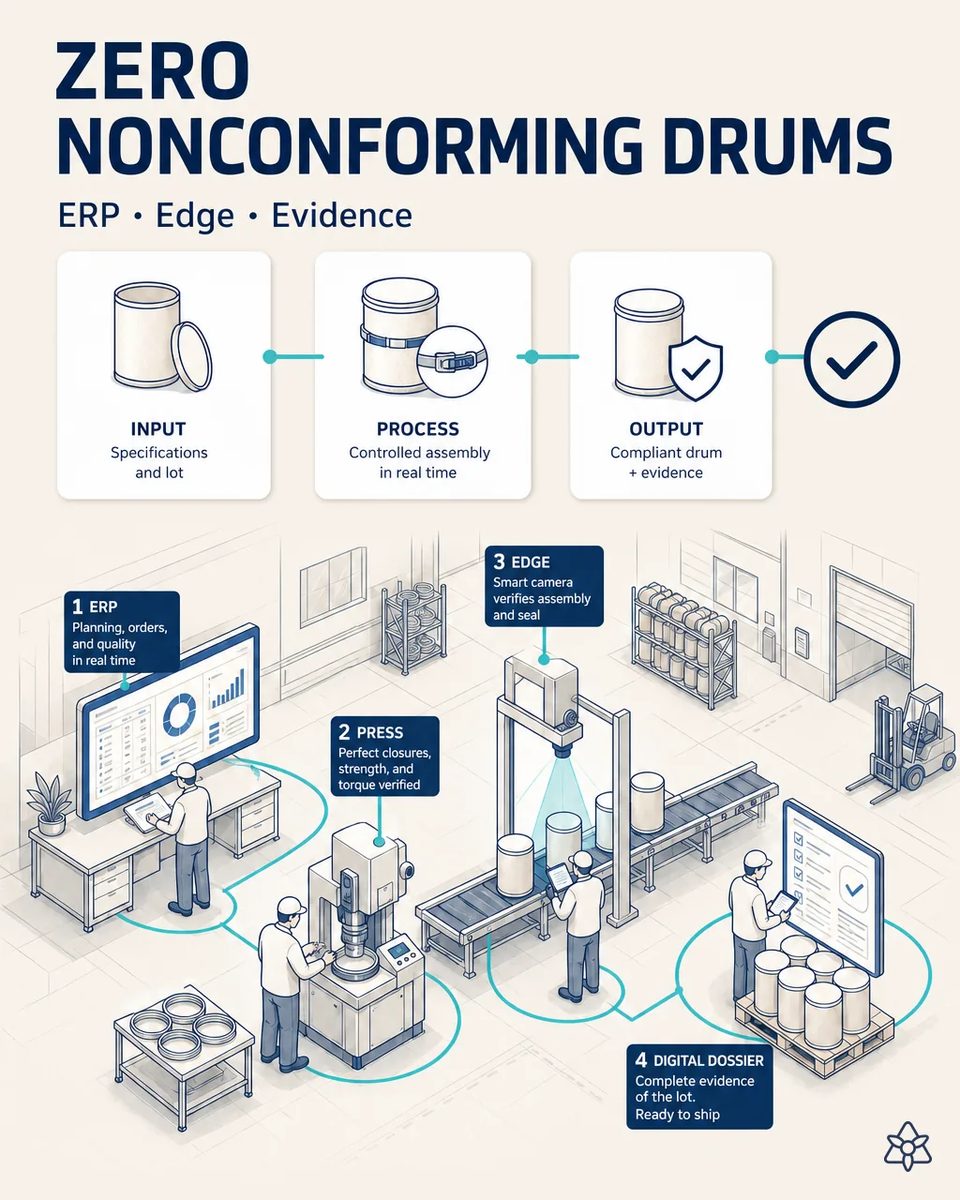
One drum that fails in transit can cost the rating itself.
The capital pain of any drum maker for dangerous goods is the same: zero nonconforming UN-rated drums shipped to a customer. A single drum that fails in transit — a closure that opens, a hoop that gives, leak-tightness that fails — can cause a chemical or pharma spill, with regulatory sanctions, loss of the rating and a broken customer relationship.
- The capital pain of any drum maker for dangerous goods is the same: zero nonconforming UN-rated drums shipped to a customer.
- A single drum that fails in transit — a closure that opens, a hoop that gives, leak-tightness that fails — can cause a chemical or pharma spill. The drum maker is the first one asked for evidence.
- The consequences go well beyond a claim: regulatory sanctions, loss of the rating and a broken customer relationship. For a drum maker, the rating is the license to sell to the customers that pay best.
- And the failure rarely has one cause: a wrong closure format, a badly calibrated change and a test signed in a hurry each pass their own control. Together, they make the drum that opens on a truck.
Cross-checking rings — the previous pieces, coordinated by Agents.
The iLEAN system coordinates the previous pieces into several cross-checking rings: the ERP's active order defines format and rating; that information travels automatically to the sister plant's closure press; the Edge camera on assembly validates that the fitted closure is correct, and if it doesn't match, JIDOKA AI stops the line; and every batch ships with a dossier cross-referencing the previous rings plus the test photo and quality sign-off. SMED AI speeds up format changes so the coordination doesn't hurt throughput.
No ring is new: each already exists in the earlier cases. The strength is in the cross-check, because a nonconforming drum gives itself away when the order, the closure, the line and the evidence stop agreeing. Each ring alone is a control that already exists somewhere; crossed, they leave a drum nowhere to hide.
The rings, and what each one closes
| Ring | Which cases it draws on | What it closes |
|---|---|---|
| 1 · Order | Customer alert (3) + batch startup (1) | Format and rating defined by the live order |
| 2 · Closure | Closure press (8) | The right closure format from the sister plant |
| 3 · Assembly | Closure defect (9) + verification tablet (5) | JIDOKA AI stops the line on a mismatch |
| 4 · Format change | Format change validation (10) | No startup without calibrated evidence |
| 5 · Dossier | Evidence pack (11) + lab spreadsheet (6) | Every batch ships with test photo and sign-off |
| 6 · Throughput | SMED AI on format changes | Coordination without losing output |
Before: risk of a nonconforming drum dependent on manual controls. After: discrepancies caught on the line, never at the customer.
Impact estimate — to be validated with quality and management.
The block below is an estimate to be validated against your plant's actual data. We put it forward so the committee has an order of magnitude; we refine it during the assessment.
- Estimated payback 6-12 months, measured against the first avoided nonconformity. One drum that does not fail in transit is the whole business case.
- It comes from protecting the rating and the customer relationship, which is what a drum maker for dangerous goods sells. Drums are the product; trust in the rating is what the customer buys. The rings protect that trust batch after batch.
- From the risk of a nonconforming drum depending on manual controls to discrepancies caught on the line, never at the customer.
- And SMED AI keeps format changes fast, so the extra checks do not cost throughput.
Estimated payback 6-12 months against the first avoided nonconformity, by protecting the rating and the customer relationship. Estimate to be validated with the quality lead and management.
And the fair question from the production manager
“Do we need all twelve cases before this works?” — no. The rings are built in layers and each case pays on its own; batch startup and the closure press already give you the first two. Cross-checking that the order, the fitted closure and the test record agree is an anchored task, where the best models drop below 1.5% error [1], and every block is confirmed by a person. Agents coordinate; people decide.
[1] OpenAI paper "Why Language Models Hallucinate", 2025 — on the reliability of AI in anchored tasks.
What people ask about the zero nonconforming drums system
Which ring should we build first in fiber drum making?
Usually the order ring, with batch startup and the customer alert: they have no dependencies and they define the rating everything else is checked against. Every later ring cross-checks against that order.
What does crossing the rings catch that single controls miss?
The chain of small deviations: a closure format that passes its own check, a calibration signed in a hurry, a test logged late. Together they make the drum that fails in transit. The rings see the chain because they compare sources that never met before.
Who stops the line when the rings disagree?
JIDOKA AI stops on a verifiable mismatch between sources. When the doubt is the model's, it goes to a person instead. The line does not stop on a hunch.
Does it slow down format changes?
That is why SMED AI is part of the system: it shortens the changeover so the added verification does not cost output. Faster changes leave room for the checks that protect the rating.
How do we estimate the return before committing?
With your claims history, the number of format changes and the value of the customers that depend on the rating, layer by layer. Each layer has its own estimate, so the order of deployment is a business decision.
More cases from this series
- The batch exists in the system from minute oneThe production sheet and the drum's control label, digitized with one photo at batch startup. No routine…
- The defective closure no longer reaches the customerAn Edge camera with a trained CNN detects a misaligned closure or off-center hoop in milliseconds and…
- The customer's email, read at zero latencyiLEAN silently monitors customer emails and flags the concrete action before the wrong batch gets made.
- No startup until the camera says it's calibratedEdge cameras and JIDOKA AI won't let a drum format change start until calibration is visually verified.
- The test spreadsheet stops living in a world of its owniLEAN absorbs the rating-test spreadsheet and syncs it to the validated ERP, cutting quality-module…
- Two taps before any data reaches the ERPNothing iLEAN captures reaches the ERP without a human confirming it with 2 taps on a line-side tablet.
Book the AI Discovery session to design the full system against your capital pain.
We work on your plant's real data, not ours. Assessment with no commitment.
Request estimated ROI within 48h ‹ See all cases of fiber drums See packaging