The vintage winder, finally digitized without touching it
An external camera points at the kraft fiber winder's panel. The machine itself is never touched — only observed.
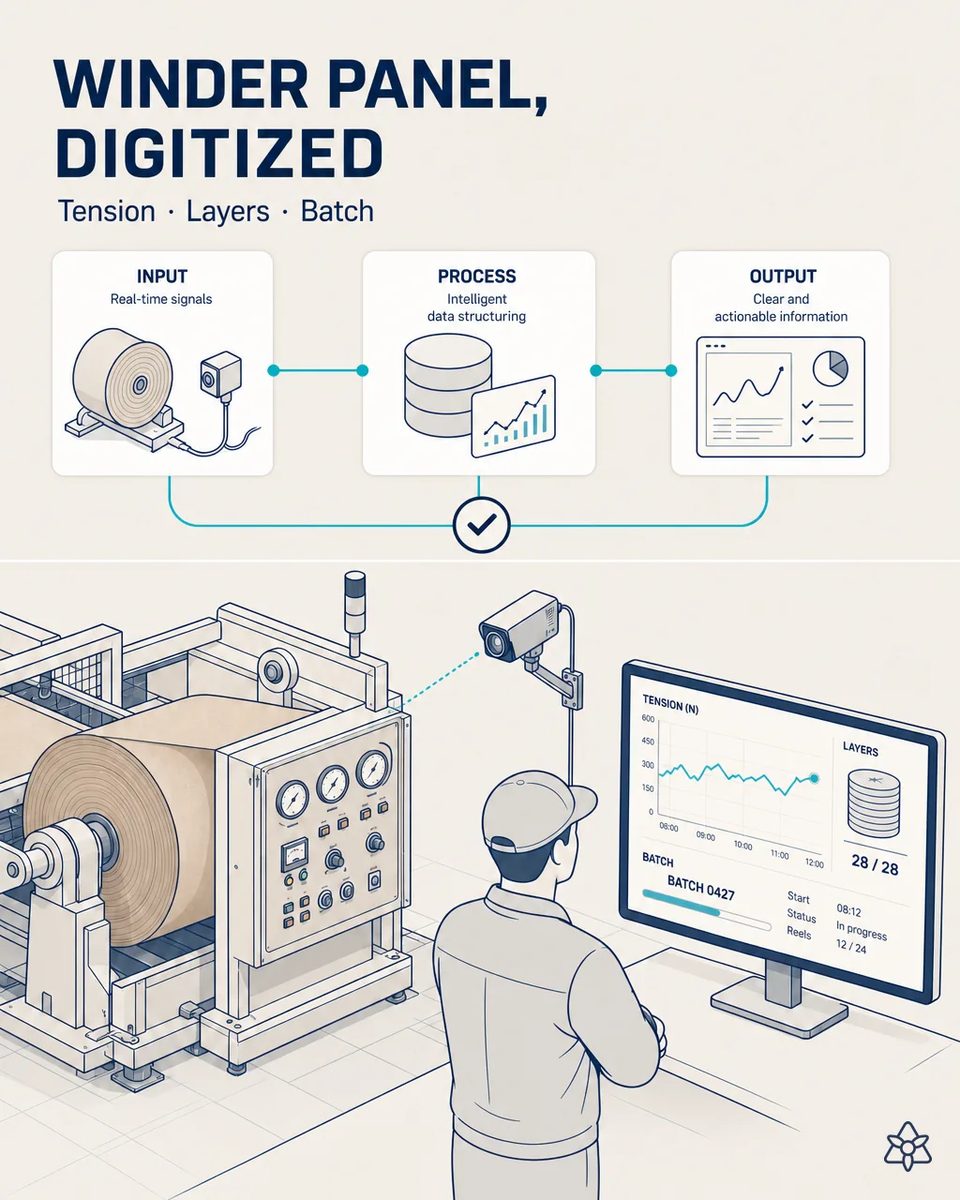
The three numbers that decide the drop test vanish at every batch change.
The machine that winds kraft paper into the drum body is typically 10 to 20 years old, with a proprietary panel showing paper tension, winding speed and layer count. These are exactly the three parameters that decide whether the drum will survive its rating's drop test. Replacing the winder costs several hundred thousand euros and weeks of downtime — yet today that critical data dies on screen every time the batch changes, leaving no trail to correlate against test failures.
- The tube winder that turns kraft paper into the drum body is typically 10 to 20 years old, with a proprietary panel and no data port anyone dares to open. The manufacturer may not even exist any more, or supports it only by phone.
- That panel shows paper tension, winding speed and layer count: exactly the three parameters that decide whether the drum survives its rating's drop test. Get one wrong and the drum body looks fine but gives way when it hits the ground.
- Replacing the winder costs several hundred thousand euros and weeks of downtime, so it keeps running — and its data dies on screen every time the batch changes.
- When a batch fails the drop test, there is no trail to correlate the failure with how that body was wound: too few layers, tension drifting, a speed pushed to catch up.
Connect reading the panel from outside — the winder is observed, never touched.
An external camera points at the panel; the machine itself is never touched, only observed. iLEAN Connect reads the panel with OCR and an anchored LLM, structures the reading per batch, and cross-references the ERP to know which batch was being wound at each moment.
Nothing is installed on the winder, no wiring is opened and the manufacturer's warranty stays intact. The camera reads what the operator already sees, and the value appears the first time a drop test fails and someone can actually answer why. Without the winding data, that question ends in a guess; with it, it ends in a parameter and a batch.
Today's winder panel versus the winder panel being read
| Aspect | Today | With iLEAN Connect |
|---|---|---|
| Paper tension per batch | Seen on screen, then lost | Recorded and tied to the batch |
| Layer count of the drum body | Assumed from the recipe | Read from the panel |
| Drop test failure analysis | No winding data to look at | Root cause per batch in minutes |
| Which batch was on the mandrel | Reconstructed from memory | Crossed with the ERP automatically |
| Intervention on the winder | — | None: an external camera |
| Winder replacement | On the capex list | Deferred with data to back it |
Before: zero correlation between winding data and test failures. After: a root-cause analysis per batch in minutes, with no machine replacement.
Impact estimate — to be validated with your numbers.
The block below is an estimate to be validated against your plant's actual data. We put it forward so the committee has an order of magnitude; we refine it during the assessment.
- Estimated payback 5-10 months.
- Plus the avoided capex of replacing a winder that still winds well, which is the larger figure in most plants.
- From zero correlation between winding data and test failures to a root-cause analysis per batch in minutes.
- And drift in paper tension shows up as a trend before it turns into a batch that fails the drop test.
Estimated payback 5-10 months, plus avoided winder-replacement CAPEX. Estimate to be validated.
And the fair question from the production manager
“Can a camera really read an old panel with gauges and small digits?” — yes, because the task is anchored: the panel never moves, each value sits in a known position and has a physically possible range, and there the best models drop below 1.5% error [1]. A reading outside the possible range is discarded rather than stored, so a reflection never becomes a data point. The image behind every stored value is kept, so any reading can be checked by a person.
[1] OpenAI paper "Why Language Models Hallucinate", 2025 — on the reliability of AI in anchored tasks.
What people ask about reading the tube winder panel
Does the winder manufacturer have to be involved?
No. Nothing is connected to the machine and no software is touched, so there is nothing for the manufacturer to approve or support. The winder keeps running exactly as it does today, with the same operator and the same recipe.
Does it read analog gauges as well as digital displays?
Yes. Both are read from the image; the model is configured for your panel layout during commissioning, needle by needle and digit by digit. Lighting and reflections are handled at installation, which is why the camera position is chosen on site.
How does it know which batch was being wound?
It crosses the timestamp of each reading with the active order in the ERP, so every value lands on the right batch without anyone typing it. A batch change on the winder is detected from the ERP, not from someone pressing a button.
Can it link a drop test failure to a winding parameter?
That is the purpose. With the history per batch, you can see whether failed drums share low tension, fewer layers or a higher speed than the ones that passed. That comparison is impossible today because the winding data simply does not exist after the shift.
Does it help with board moisture problems too?
Indirectly: if the paper arrives with different moisture, tension readings usually move first. Crossing that with the reel batch makes the pattern visible. It is often the first explanation for a run of drop test failures that nobody could link to the winder.
More cases from this series
- The batch exists in the system from minute oneThe production sheet and the drum's control label, digitized with one photo at batch startup. No routine…
- The defective closure no longer reaches the customerAn Edge camera with a trained CNN detects a misaligned closure or off-center hoop in milliseconds and…
- The customer's email, read at zero latencyiLEAN silently monitors customer emails and flags the concrete action before the wrong batch gets made.
- No startup until the camera says it's calibratedEdge cameras and JIDOKA AI won't let a drum format change start until calibration is visually verified.
- The test spreadsheet stops living in a world of its owniLEAN absorbs the rating-test spreadsheet and syncs it to the validated ERP, cutting quality-module…
- Two taps before any data reaches the ERPNothing iLEAN captures reaches the ERP without a human confirming it with 2 taps on a line-side tablet.
Tell us which vintage panel holds the data you most need today.
We work on your plant's real data, not ours. Assessment with no commitment.
Request estimated ROI within 48h ‹ See all cases of fiber drums See packaging