Rating evidence, downloadable instantly
A chemical or pharma customer asks for evidence that a specific batch meets its UN rating.
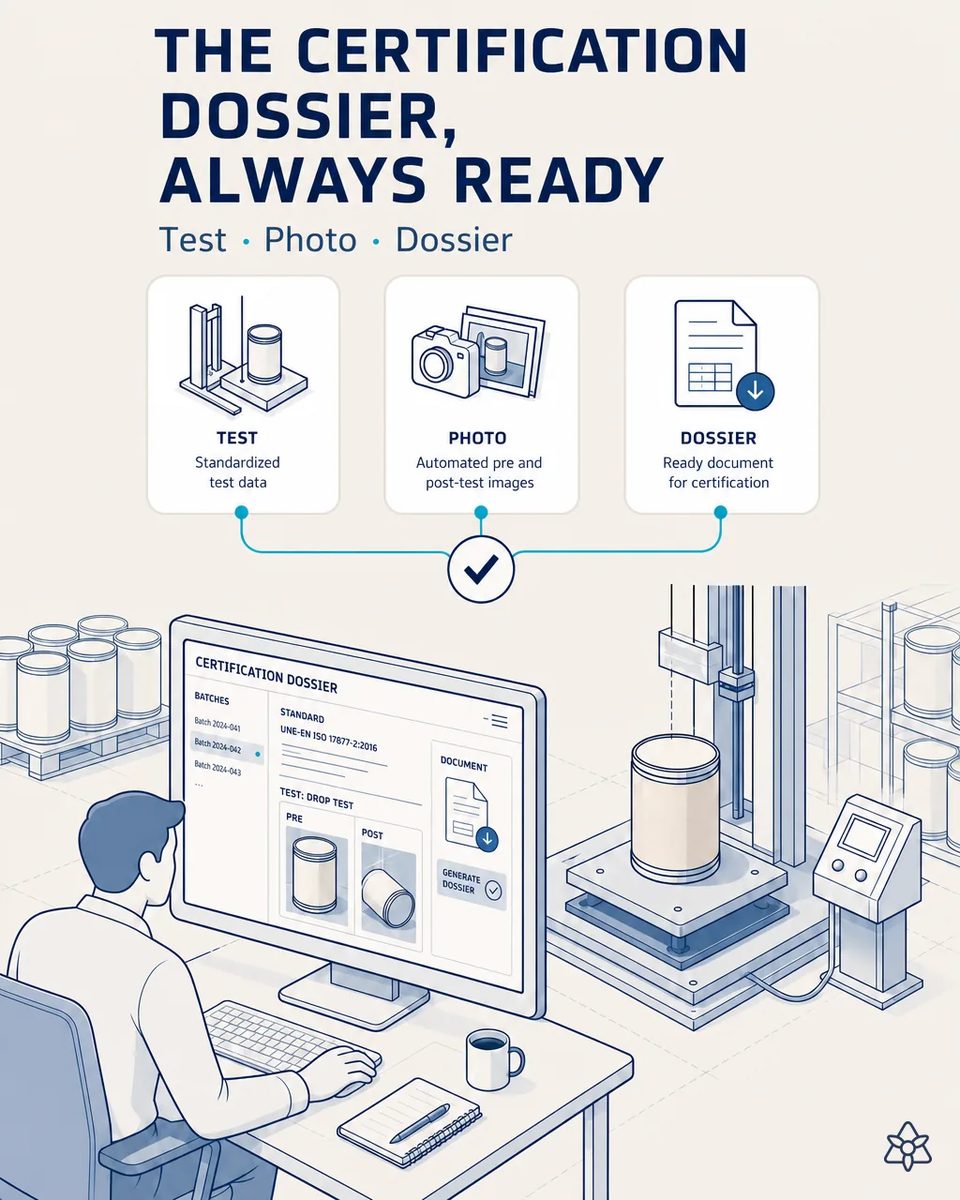
Proving a batch meets its UN rating takes days of digging through paper.
A chemical or pharma customer asks for evidence that a specific batch meets its UN rating. Today someone spends days rebuilding what test was run, when, and with what result, from loose paperwork that breeds distrust whenever there are gaps.
- A chemical or pharma customer asks for evidence that a specific batch meets its UN rating. Often before awarding the next order, sometimes after an incident in their own plant.
- Someone then spends days rebuilding which test was run, when, and with what result. The work falls on quality, usually on top of everything else that week. And the customer waits, wondering why proof takes so long.
- The sources are loose: test sheets, photos on a phone, a signature in a notebook, an email from the lab. None of them were designed to be put together afterwards.
- Every gap in that reconstruction breeds distrust with exactly the customers a drum maker for dangerous goods can least afford to worry.
Edge captures each test as it happens; Agents files it by batch and standard.
With Edge + Agents, every critical test — drop, stacking, leak-tightness — automatically generates pre/post photos, a timestamped decision log, organized by batch and standard. The customer or auditor logs into the web and downloads the batch's evidence pack.
The evidence is never rebuilt, because it is never scattered: each drop, stacking or leak-tightness test leaves its photos and log on the batch the moment it is run. A customer request becomes a download instead of a project. And quality stops spending its week reconstructing what it already did.
Rebuilding UN evidence today versus the dossier built as tests run
| Aspect | Today | With iLEAN Edge + Agents |
|---|---|---|
| Answering a customer's evidence request | Days of reconstruction | An instant download |
| Drop test photos | On someone's phone, if anywhere | Pre and post, filed by batch |
| Stacking and leak-tightness results | In separate sheets | In the same dossier |
| Timestamp and who signed | Inferred afterwards | Logged at the moment |
| Organized by standard | By hand, each time | Automatically |
| Auditor access | Emailed files | A scoped web view to download |
Before: days spent rebuilding evidence for every customer request. After: instant download, no post-hoc human work.
Impact estimate — to be validated with your numbers.
The block below is an estimate to be validated against your plant's actual data. We put it forward so the committee has an order of magnitude; we refine it during the assessment.
- Estimated payback 6-12 months, depending on how often customers request evidence.
- It comes from continuously protecting relationships with dangerous-goods customers, not from a one-off saving. Those relationships are where a drum maker's margin lives. Every request answered in minutes reinforces them.
- From days spent rebuilding evidence for every request to an instant download with no post-hoc human work. The same dossier serves the customer, the certification body and your own quality reviews.
- And a gap in the evidence is noticed when the test is run, not when the customer asks. Missing photos or an unsigned test raise a flag the same day. Quality fixes the gap while the drums are still in the plant.
Estimated payback 6-12 months depending on request frequency, from continuously protecting relationships with dangerous-goods customers. Estimate to be validated.
And the fair question from the production manager
“Will an auditor accept evidence filed by AI?” — the AI files, it does not judge: the result is the test rig's and the sign-off is the quality lead's. Matching each photo and log to its batch and standard is an anchored task, where the best models drop below 1.5% error [1], and the dossier keeps the original images so anyone can check them. The dossier shows the evidence; it does not replace it. An auditor sees exactly what the rig recorded and who signed it.
[1] OpenAI paper "Why Language Models Hallucinate", 2025 — on the reliability of AI in anchored tasks.
What people ask about the UN certification evidence pack
Which tests end up in the dossier?
The critical ones for the rating: drop, stacking and leak-tightness, each with pre and post photos, a timestamped log and the quality sign-off. The dossier also notes the test rig and the standard applied. Nothing has to be added by hand afterwards.
Can a customer see only their own batches?
Yes. Access is scoped by customer and period, so each one downloads the evidence for their batches and nothing else. Nobody gets into your systems; they see a view prepared for them.
Does it organize the evidence by standard?
Yes. The same test can be indexed against the standard each customer or auditor asks about, without duplicating work. What changes between requests is the index, not the evidence.
What happens to the tests we ran before installing it?
They stay where they are. The dossier builds from the first captured test onward; older records can be added if you want them. Most plants start forward and backfill only the batches customers ask about.
Does it need the format change and closure cases first?
No. It works on its own from the test rig. If those cases are deployed, their images can be added to the same dossier. Each piece adds evidence; none is a prerequisite.
More cases from this series
- The batch exists in the system from minute oneThe production sheet and the drum's control label, digitized with one photo at batch startup. No routine…
- The defective closure no longer reaches the customerAn Edge camera with a trained CNN detects a misaligned closure or off-center hoop in milliseconds and…
- The customer's email, read at zero latencyiLEAN silently monitors customer emails and flags the concrete action before the wrong batch gets made.
- No startup until the camera says it's calibratedEdge cameras and JIDOKA AI won't let a drum format change start until calibration is visually verified.
- The test spreadsheet stops living in a world of its owniLEAN absorbs the rating-test spreadsheet and syncs it to the validated ERP, cutting quality-module…
- Two taps before any data reaches the ERPNothing iLEAN captures reaches the ERP without a human confirming it with 2 taps on a line-side tablet.
Ask to see a complete evidence pack generated from one of your real tests.
We work on your plant's real data, not ours. Assessment with no commitment.
Request estimated ROI within 48h ‹ See all cases of fiber drums See packaging