The truck no longer waits for someone to type
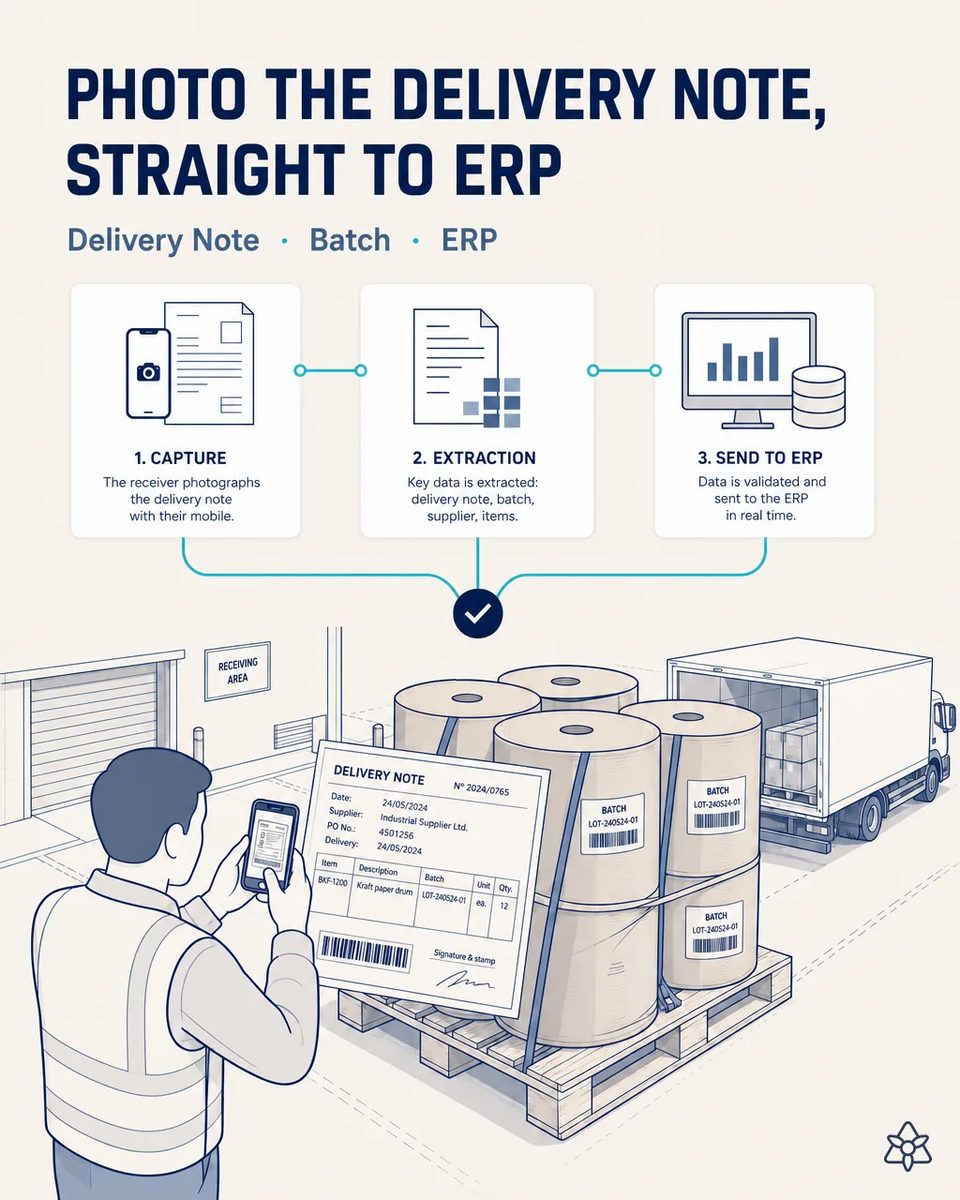
The truck unloads kraft paper reels or metal sheet for the closures, with a paper delivery note and batch labels on each reel.
Reel-to-drum traceability starts with someone typing at the dock.
The truck unloads kraft paper reels or metal sheet for the closures, with a paper delivery note and batch labels on each reel. Today the receiving lead types every line into the ERP while the truck waits racking up demurrage — or rushes it and batches end up poorly logged, which surfaces weeks later when someone needs to trace which reel went into which drum batch.
- The truck unloads kraft paper reels or metal sheet for the closures, with a paper delivery note and a batch label on each reel. A single delivery can carry many reels from several paper batches.
- The receiving lead types every line into the ERP while the truck waits, racking up demurrage. The driver watches the clock and so does the carrier's invoice. Meanwhile the next truck queues at the gate.
- Or it gets rushed, and batches end up poorly logged — with the material certificate, where grammage and moisture are declared, left in a tray. A batch typed with one digit wrong looks perfectly valid in the system.
- That surfaces weeks later, when someone needs to trace which reel went into which drum batch after a test failure or a complaint. By then the delivery note is in a binder and the reel has long been wound into drums.
Connect in photo mode — delivery note and reel labels, one tap to the ERP.
One photo of the delivery note and another of the reel labels (GS1-128, QR, barcode or plain OCR) extracts batch, quantity, supplier and material certificate in seconds. After a single validation tap on a tablet, everything flows into the ERP via API.
The reel's batch and its certificate are linked from the moment it comes off the truck. That is what turns "which paper was this drum wound from?" into a query instead of a search through delivery notes. And the truck leaves the dock without waiting for anyone to finish typing.
Today's reel receiving versus receiving by photo
| Aspect | Today | With iLEAN Connect |
|---|---|---|
| Truck waiting at the dock | While every line is typed | Unloaded and released quickly |
| Reel batch labels | Copied by hand | Read from GS1-128, QR, barcode or OCR |
| Paper certificate | Filed loose | Linked to the reel batch |
| Reel → drum batch link | Rebuilt after a failure | Complete from receiving |
| Poorly logged batches | Surface weeks later | Caught at validation |
| Warehouse module licenses | Several users | One: the lead who validates |
Before: a parked truck racking up demurrage, hidden batch errors. After: fast receiving, full reel-to-drum traceability via photo and GS1.
Impact estimate — to be validated with your numbers.
The block below is an estimate to be validated against your plant's actual data. We put it forward so the committee has an order of magnitude; we refine it during the assessment.
- 💰 CFO angle: typical 50-70% reduction in receiving and warehouse module licenses, because the lead validates without logging into the ERP. The saving recurs every year and is checked against your current contract.
- Estimated payback 3-8 months.
- Faster receiving and less truck demurrage, delivery after delivery. The receiving lead spends the time checking the reels instead of typing about them.
- And full reel-to-drum traceability via photo and GS1, which is what holds up when a batch fails its drop test. Knowing which paper batch went into which drums bounds the problem to the drums that actually share it.
CFO angle: typical 50-70% reduction in receiving/warehouse module licenses (the lead validates without logging into the ERP). Estimated payback 3-8 months. Estimate to be validated.
And the fair question from the production manager
“Every paper mill prints a different delivery note — will it cope?” — yes, without asking any supplier to change anything: reading the table of a delivery note and a reel label is an anchored task, where the best models drop below 1.5% error [1]. Labels are read by their barcode where they have one, and the receiving lead validates before anything enters. Over time, each supplier's layout is recognized at the first photo. A delivery note that disagrees with the purchase order is highlighted before validation.
[1] OpenAI paper "Why Language Models Hallucinate", 2025 — on the reliability of AI in anchored tasks.
What people ask about booking in kraft paper reels
Does it work for closure sheet as well as paper reels?
Yes. The document format changes between suppliers, not the method: delivery note plus labels, read and linked to the batch. The same validation step covers both, so the receiving lead learns one routine.
Are the values on the paper certificate kept?
Yes, and they matter: grammage and moisture declared by the mill are often the first thing checked when a batch underperforms. Having them on the reel batch saves a search through filed paper.
What if a reel label is torn or unreadable?
The summary flags the missing batch before validation, so the lead can type that one field instead of the whole delivery note. Everything else is already filled in.
Do we need handheld scanners at the dock?
No. A phone or tablet photo is enough. If you already have scanners that work, they can stay. The photo also keeps an image of the delivery note, which a scanner does not.
Can it follow a reel all the way to the drum batch?
Yes, once receiving and batch startup are both captured: the reel batch consumed at the winder links to the drum batch produced. That chain is what lets you answer which drums used a suspect paper batch.
More cases from this series
- The batch exists in the system from minute oneThe production sheet and the drum's control label, digitized with one photo at batch startup. No routine…
- The defective closure no longer reaches the customerAn Edge camera with a trained CNN detects a misaligned closure or off-center hoop in milliseconds and…
- The customer's email, read at zero latencyiLEAN silently monitors customer emails and flags the concrete action before the wrong batch gets made.
- No startup until the camera says it's calibratedEdge cameras and JIDOKA AI won't let a drum format change start until calibration is visually verified.
- The test spreadsheet stops living in a world of its owniLEAN absorbs the rating-test spreadsheet and syncs it to the validated ERP, cutting quality-module…
- Two taps before any data reaches the ERPNothing iLEAN captures reaches the ERP without a human confirming it with 2 taps on a line-side tablet.
Measure how much truck demurrage manual receiving is costing you today.
We work on your plant's real data, not ours. Assessment with no commitment.
Request estimated ROI within 48h ‹ See all cases of fiber drums See packaging