Loose knots in solid pine: what breaks a bunk bed is not what you see on the inspection table.
In solid pine youth furniture, a loose knot caught after routing is scrap — and a loose knot that reaches the customer's home is a safety incident. iLEAN Vision reads the board before cutting with machine vision (CNN), flags loose knots, resin pockets and splits, and proposes scrapping or repurposing. The person signs. It runs on the line itself, with no network.
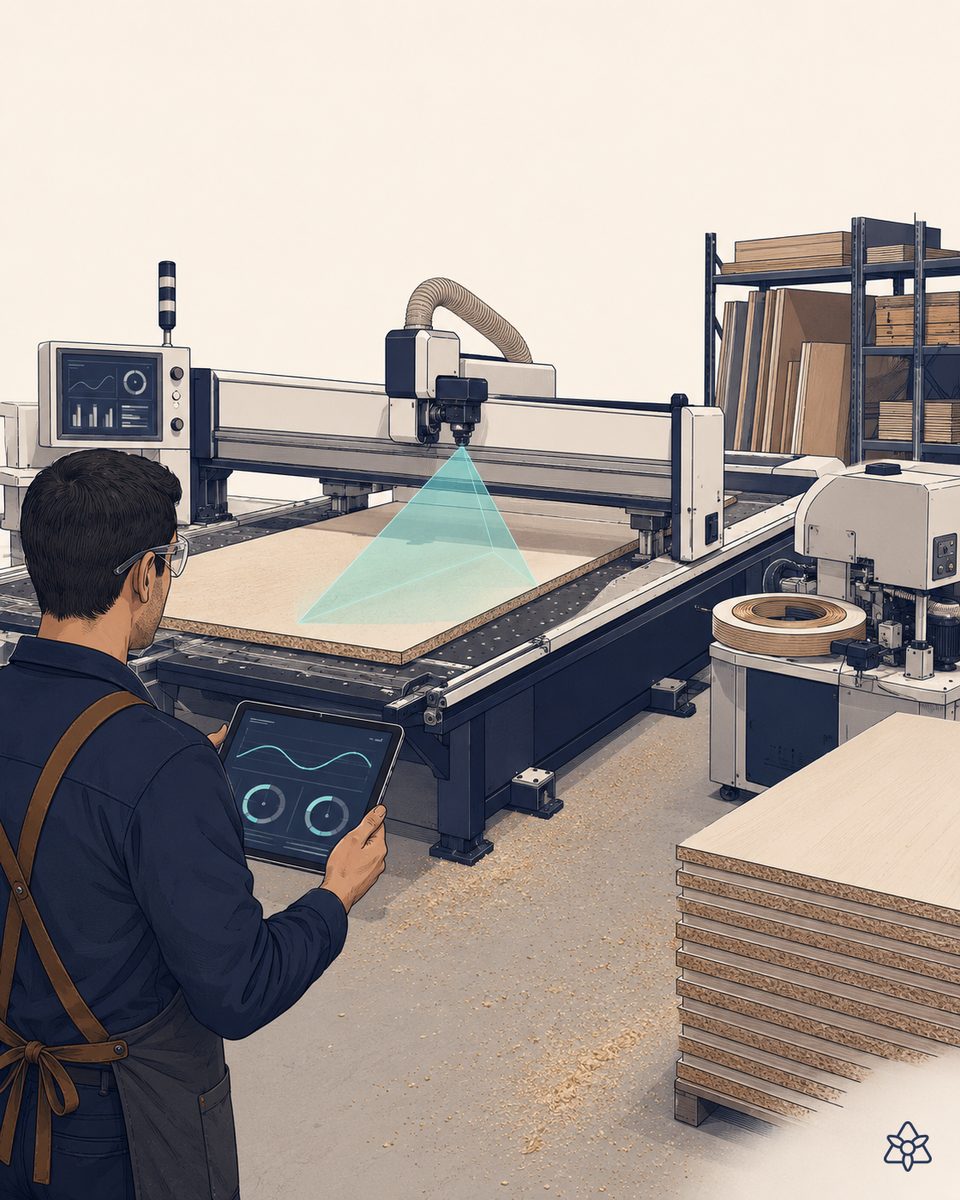
The knot that gets past the line is the one that breaks the headboard at home.
In a solid pine youth furniture plant, the critical defect is not decided at the inspection table — it is decided on the board, before cutting. The quality manager knows it: a sound knot gives the furniture character, and it is part of the product's visual language. A loose knot, on the other hand, is a breakage waiting to happen.
The classic way of doing it rests all the weight on one person:
- The veteran operator looks at the board, picks out loose knots by eye, marks resin pockets with chalk and decides which part goes on and which one goes back to the stack. He does it well — the problem is that there is only one of him and he works one shift.
- Downstream inspection sees the part already routed or already sanded: by then the cost of pulling it has already been spent, and the defect may have been hidden under the finish.
- The customer complaint closes the loop: the child's bunk bed arrives home with a knot that falls out the first time. Hard replacement cost, brand cost, and a scare nobody measures.
The veteran's eye works 99% of the time. That 1% is what reaches after-sales — and in youth furniture, one safety complaint weighs more than ten finish complaints.
iLEAN Vision does not replace the veteran — it captures his eye and keeps it working all three shifts.
The loose knot problem is not a lack of judgment — the quality manager has it. It is that this judgment lives in a single head and is only available when he is on the line. iLEAN acts as the putty that seals that crack: the intelligence stays in the plant, in a box with a camera, 24 hours a day.
Edge sees the board before cutting. The CNN is trained on the quality manager's criteria. If confidence drops below the threshold, the part goes back to his table — it is not decided on its own. The person signs; the line does not move forward with doubts.
The iLEAN pieces applied to loose knot detection in solid pine:
- Edge (iLEAN Vision) — a terminal with machine vision (CNN) over the sawing or cutting line. It reads the board in milliseconds, classifies every defect (sound knot, loose knot, resin pocket, split, pith, pin knot) with its confidence level, and triggers the actuator (ejector or inkjet marking). It works without a network: if the plant loses WiFi, inference keeps running on the device.
- Connect — captures the quality manager's judgment when he labels a doubtful part on screen. Every validation or correction enters the system and refines the model. The veteran's eye stops being a fragile asset and becomes a permanent capability of the factory.
- Agent — cross-references the stream of detections with the order book (which parts are needed today and for which SKU) and decides to repurpose a board with a loose knot toward a non-visible part (wardrobe back panel, internal batten) instead of scrapping it. Less scrap, same quality level. The person validates the repurposing.
Human visual inspection vs. iLEAN Vision on the line
| Aspect | Human inspection + chalk | With iLEAN Vision + agent |
|---|---|---|
| Shift coverage | Only when the veteran is there | Three shifts, with no lapses in attention |
| Knot classification | Sound/loose by eye | Sound, loose, black, resin pocket, split, pith |
| Repurposing | Hard — not cross-referenced with the order book | The agent proposes an alternative part based on the day's SKU |
| Capturing the judgment | It leaves with the veteran when he retires | The model learns the criteria and they stay in the plant |
| Scrap traceability | End-of-shift tally | Every board with a photo, a classification and a signature |
| Operation without a network | Yes, but with no record | Yes, with a local record that syncs afterwards |
Impact estimate for your plant — to be validated with your numbers.
The block below is an estimate to be validated with the specific data of your plant. We put it forward so the committee has an order of magnitude; we refine it during the diagnostic.
- Mid-sized solid pine youth furniture plant, one main sawing/cutting line carrying most of the scrap Pareto.
- Edge pilot on that line (camera over the board + marking actuator or ejector + integration with the ERP/MES for the order book). First value expected within a few weeks.
- Reduction of scrap from loose knots and resin pockets in the order of ≥30% conservatively, with combined levers: repurposed parts, boards not routed in vain, complaints avoided.
- Indicative payback between 4 and 9 months, depending on volume and SKU mix. The hard lever is the avoided cost of a safety complaint in youth furniture.
And the quality manager's reasonable doubt
“What if the AI marks as sound a knot the veteran would have rejected?” — hallucination is a problem of free generation, not of anchored tasks. Classifying a knot in an image against trained criteria is an anchored task: the best models brought the error below 1.5% [1]. And even so, when confidence does not reach the threshold, iLEAN does not decide alone: the board goes back to the quality manager's table. The person signs.
[1] OpenAI paper “Why Language Models Hallucinate”, 2025 — on the reliability of AI in anchored tasks.
What people ask about knot detection in pine for youth furniture
Which defects have to be detected in solid pine for youth furniture?
In solid pine youth furniture the critical defect is not cosmetic, it is a safety issue: a loose knot that drops out of a bunk bed or a headboard, a resin pocket that stains the lacquer a few months later, an internal split that opens the part up after cutting. iLEAN Vision reads the board in line with machine vision (CNN) and separates a sound knot (stable) from a loose knot (dark collar, shrinkage ring), a resin pocket (glossy patch with a halo), splits and black knots.
How does iLEAN Vision tell a sound knot from a loose knot?
The CNN is trained on boards from your own plant, labeled by the quality manager. It learns the visual cues the veteran operator recognizes at a glance: the dark collar around the knot, the shrinkage ring, the color difference against the surrounding wood, the symmetry. When the model's confidence falls below the threshold, the system does not decide on its own: it flags the board as doubtful and shows it to the operator on the line screen. That way the veteran's knowledge becomes a permanent capability of the plant — it does not walk out the day he retires.
Can it read resin pockets and cracks at the same time as knots?
Yes. The same camera and the same Edge terminal run several detection heads in parallel — knots, resin pockets, longitudinal splits, pith, pin knots. Every detection travels with its confidence level and its classification. The agent decides what to do with each defect according to the target part: a board headed for a wardrobe back panel tolerates a small sound knot; one headed for a visible headboard does not. Quality sets the rule, not the model.
Does it work if the sawing line loses network connectivity?
Yes. iLEAN Edge is a physical terminal installed on the line itself — inference runs on the device, not in the cloud. If the plant loses WiFi, loses Internet or loses the connection to the ERP, as long as the cabinet has power the read, classify and go/no-go cycle keeps running. What is critical on the shop floor cannot depend on connectivity. When the network comes back, it syncs the records with the ERP/MES.
How long does it take to deliver first value in a youth furniture plant?
What we see in comparable plants (sawing line + board handling + cutting) is first value in a few weeks: one camera, the Edge terminal, the marking actuator or ejector, and an agent that writes to the ERP. The pilot is measured on a Pareto line — the one that concentrates the bulk of the scrap — and it expands when the numbers add up. Estimate to be validated with your plant's data. We send you the estimated ROI in 48h.
More cases in other sectors
- FSC traceability in office furniture chipboard — the batch dossier for the auditor, automatically.iLEAN Tracer builds the FSC chain of custody of chipboard in an office furniture plant with auditable…
- Your flat-pack kitchen is not judged in the factory — it is judged by the fitter in the customer's home.How iLEAN coordinates just-in-sequence assembly of flat-pack kitchen furniture with an agent that…
- The hinge cup works loose two months after installation — and nobody knows why.How iLEAN Brain infers the root cause of loose hinge cups in kitchen cabinets by cross-referencing board…
- Capturing the master carpenter's knowledge before retirement — the day he leaves, half the plant leaves with him.iLEAN Connect digitizes the master carpenter's knowledge before retirement: selection criteria,…
- Melamine facing scrap reduction on chipboard — a defect found after the cut is a whole module in the bin.iLEAN Vision spots bubbles, lifted edges and press marks on the melamine facing line over chipboard. It…
- Your multi-opening board press has no API — and your ERP needs the data anyway.How iLEAN captures the analog panel of a multi-opening board press without replacing PLC or SCADA: a…
Tell us your case and in 48h we'll send you the estimated ROI of this AI project for your youth furniture factory.
We work on your plant's real data, not ours. Diagnostic with no commitment.
Request estimated ROI in 48h See wood furniture