The hinge cup works loose two months after installation — and nobody knows why.
A loose hinge cup in kitchen cabinets is the nastiest after-sales return there is: the end customer calls months later, the cause was born in the plant, and nobody knows which one it is because the data lives on six different islands. iLEAN Brain cross-references MDF batch, driver torque, routing depth, board moisture and hinge supplier, and proposes a root-cause hierarchy with the evidence behind it. The quality person signs — the agent thinks, it does not decide alone.
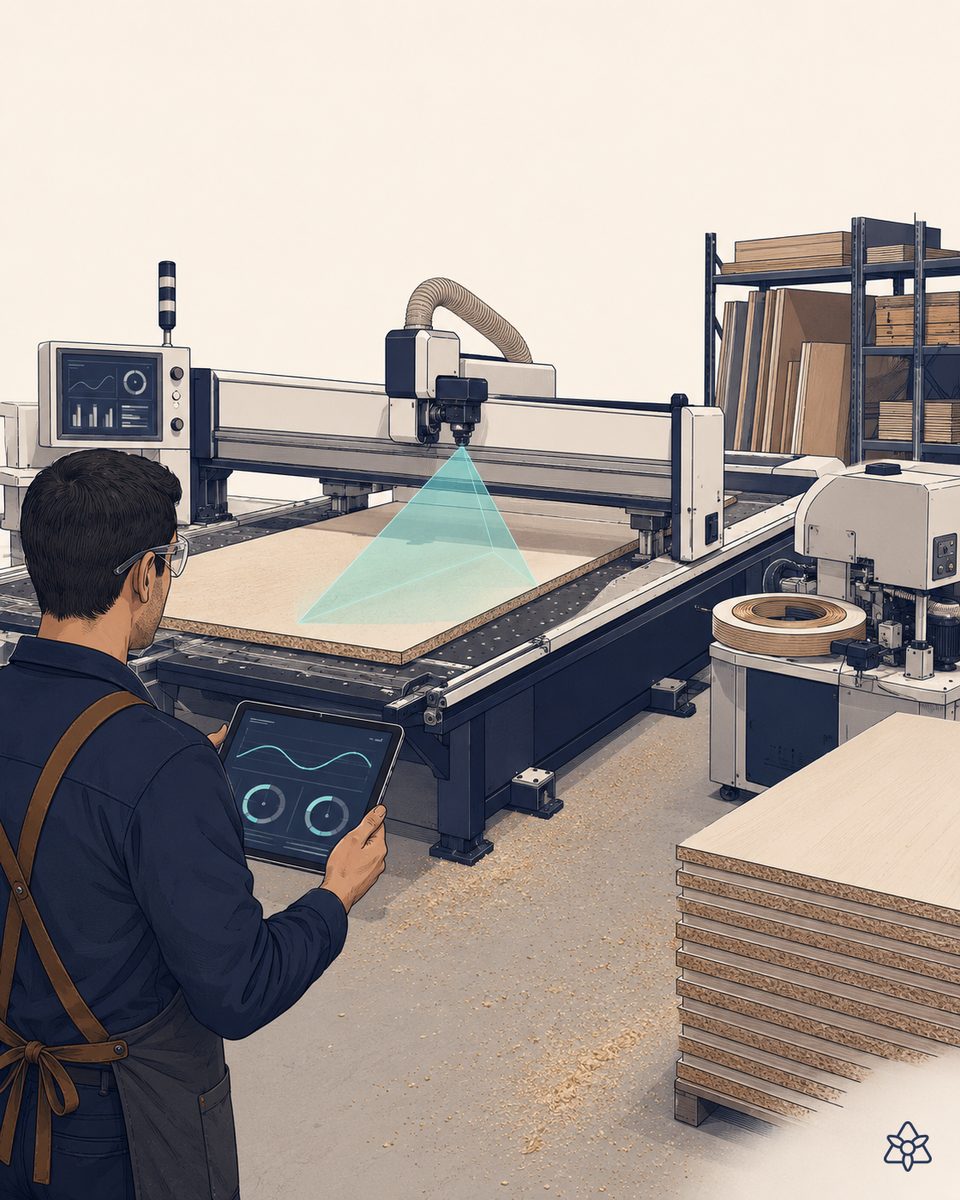
Six islands, one return and nobody able to cross-reference them.
The loose hinge cup is one of the costliest defects a kitchen cabinet plant can have: it is born in the plant but shows up months later in the customer's home, once the kitchen has been installed and used. When the return arrives, the quality manager looks at:
- The MDF batch — in the ERP / the supplier's delivery note.
- The torque of the hinge driver on the line — in the head's PLC, if it stores it.
- The depth and diameter of the cup routing — in the CNC, if it was recorded.
- Board moisture at the moment of assembly — in a lab spreadsheet.
- The hinge batch — on the hardware supplier's delivery note.
- The customer return — in the CRM or in an after-sales spreadsheet, with the date and the comment.
Cross-referencing all of that for one return costs a morning of office work. For the 300 returns of the year, nobody does it. The quality manager suspects that February's MDF moisture ran high, or that driver X drifted out of calibration for a month, or that a hinge batch came in with a different tolerance. There is no time to prove it. The corrective action stays at the level of intuition — and the pattern comes back, in another SKU, another season.
iLEAN Brain does not diagnose alone — it proposes hypotheses and evidence so the person can decide.
The loose hinge cup is the textbook example of the syllogism of the two missing pieces: the data lived on islands nobody cross-referenced (because reconciling heterogeneous formats used to cost a fortune), and even if you did cross-reference them, there was nobody to reason over the result (because there was no librarian). AI now brings both pieces: it recontextualizes formats at near-zero cost, and it enables agents that reason over the whole picture.
Connect captures what was missing. iLEAN Brain reasons over what has been joined. The person validates and signs the corrective action.
The iLEAN pieces applied to root-cause inference for loose hinge cups in kitchen cabinets:
- Connect — capturing what goes unrecorded today. If the driver does not store the torque, Connect reads the panel and stores it. If board moisture sits in a lab spreadsheet, Connect integrates it. If the returns live in a CRM, Connect matches the codes. The minimum requirement for an agent to reason is that the data exists — an agent without capture is a librarian without a library.
- iLEAN Brain — the brain that reasons over the joined islands. It cross-references MDF batch, driver torque, routing depth, board moisture, hinge batch, shift operator and customer return. It does not produce a single cause: it produces a hierarchy of hypotheses with their evidence. "Hypothesis 1: MDF moisture >9% in this specific batch. Hypothesis 2: low torque on head 3 during week 7. Hypothesis 3: tolerance on hinge batch X wider than usual."
- The three rings — the agent proposes, the person decides. The agent does not act on the line: it sends the hypothesis to the quality manager as signed JSON in the middle ring. The corrective action (recalibrate the driver, dry the MDF batch, return the hinges to the supplier) is always signed by a person. And the next cycle confirms or rejects the hypothesis with real data — jidoka in two beats: first detect the pattern, then close the loop.
Root cause by gut feel vs. inferred by iLEAN Brain
| Aspect | The quality lead's hunch | With iLEAN Brain + Connect |
|---|---|---|
| Coverage of returns analyzed | The noisiest ones, by eye | All of them, automatically |
| Time per return | A morning of office work | The agent does it continuously |
| Capture of driver torque | "We don't store it" | Connect reads it even if the machine exports nothing |
| Capture of board moisture | Lab spreadsheet | Connect ties it to the batch at second zero |
| Diagnosis | A single, intuitive hypothesis | A hierarchy of hypotheses with evidence |
| Who decides the corrective action | The quality manager, alone | The quality manager, with the agent alongside |
Impact estimate for your plant — to be validated with your numbers.
The block below is an estimate to be validated with the specific data of your plant. We put it forward so the committee has an order of magnitude; we refine it during the diagnostic.
- Mid-sized kitchen cabinet plant, several lines, multi-SKU, returns for loose hinge cups documented in the CRM or the after-sales system.
- Connect + Brain pilot: capture of driver torque, routing depth and board moisture; the Brain agent cross-references them with the returns. First value within a few weeks: the first hierarchy of hypotheses with evidence.
- Indicative payback between 4 and 9 months, depending on cabinets per month and the current cost of returns for this defect.
- Hard levers: ≥ 30% reduction in returns for loose hinge cups once the corrective action is applied, cost avoided from brand damage, the quality lead's knowledge captured as permanent data.
And the quality lead's reasonable doubt
"What if the agent blames my operator for a false correlation?" — by design, it accuses nobody: it proposes hypotheses with evidence and leaves the decision to the person. The task is anchored (cross-referencing batches, torques, moisture readings, returns), not free generation. The best models brought error below 1.5% in anchored tasks [1]. And, most importantly: the agent does not write the non-conformity report. The manager writes it, over the draft the agent puts in front of them. Fight the problem, never the person.
[1] OpenAI paper “Why Language Models Hallucinate”, 2025 — on the reliability of AI in anchored tasks.
What people ask about the root cause of loose hinge cups in kitchen cabinets
Why do hinge cups work loose in kitchen cabinets?
Almost never for a single reason. The usual causes are routing that is too deep or too wide (the 35 mm cup does not grip), badly calibrated driving torque on the line (the screw either tears the MDF fiber or fails to bite into it), board moisture outside the recipe (the MDF swells and the hole goes oval), a hinge batch with a different tolerance, and the most hidden factor of all: door vibration under heavy use, which loosens whatever was already born loose. The end customer feels it 2-3 months after the kitchen is installed, when nobody is watching the line anymore.
Why is the root cause so hard to find by hand?
Because every piece of data lives on a different island: the MDF batch in the ERP, the driver torque in the line PLC, the routing depth in the CNC, the board moisture in a lab spreadsheet, the hinge batch on the supplier's delivery note, the customer return in the CRM or in an after-sales spreadsheet. Cross-referencing them by hand for one return costs a morning of office work; for the 300 returns of the year, nobody does it. The operator "suspects" but cannot prove.
How does iLEAN Brain infer the root cause across hundreds of returns?
iLEAN Brain (part of the iLEAN Agents family) is the brain that cross-references every island. Given the list of returns for loose hinge cups, it looks for correlations between MDF batch, hinge batch, torque recorded by the driver, routing depth, board moisture on that day and the shift operator. It does not produce a single cause — it produces a hierarchy of hypotheses with the evidence behind each one. The quality person validates the hypothesis and decides the corrective action. The agent thinks; the person signs.
What if the torque or routing data was never captured?
That is exactly why iLEAN includes Connect: if the driver or the router held no data, it gets captured now. Connect reads the machine panel (even an analog one) with vision, reads the old PLC, reads the lab spreadsheet where moisture is written down. Connect carries, the Agents decide, the person signs. An agent without capture is a librarian without a library: without that piece first, root-cause inference cannot stand up.
How much does root-cause inference cost on a kitchen cabinet line?
The pilot covers capturing the variables that go unrecorded today (Connect on the driver, the router and the lab), a channel into the CRM/after-sales system, and the Brain agent in Central. First value expected within a few weeks: the first root-cause hypotheses over the most recent batch of returns. Indicative payback between 4 and 9 months, depending on cabinets per month and the current cost of returns (reverse logistics, replacement, brand damage). The hard lever is eliminating the pattern before it happens again. We ask for your plant's data and send you the estimated ROI in 48h.
More cases in other sectors
- EUDR forest certificate OCR for tropical veneer — the premium door will not be lacquered if the paperwork does not close.iLEAN Connect reads forest certificates and EUDR due diligence for tropical veneer in premium doors. It…
- FSC traceability in office furniture chipboard — the batch dossier for the auditor, automatically.iLEAN Tracer builds the FSC chain of custody of chipboard in an office furniture plant with auditable…
- Your flat-pack kitchen is not judged in the factory — it is judged by the fitter in the customer's home.How iLEAN coordinates just-in-sequence assembly of flat-pack kitchen furniture with an agent that…
- Loose knots in solid pine: what breaks a bunk bed is not what you see on the inspection table.How iLEAN Vision detects loose knots and resin pockets in solid pine before cutting, preventing rejected…
- Capturing the master carpenter's knowledge before retirement — the day he leaves, half the plant leaves with him.iLEAN Connect digitizes the master carpenter's knowledge before retirement: selection criteria,…
- Melamine facing scrap reduction on chipboard — a defect found after the cut is a whole module in the bin.iLEAN Vision spots bubbles, lifted edges and press marks on the melamine facing line over chipboard. It…
Tell us your case and in 48h we'll send you the estimated ROI of the Brain agent for your loose-hinge-cup returns.
We work on your plant's real data, not ours. Diagnostic with no commitment.
Request estimated ROI in 48h See furniture and wood