EUDR forest certificate OCR for tropical veneer — the premium door will not be lacquered if the paperwork does not close.
EUDR requires a due diligence statement for every batch of tropical veneer that reaches the European market — species, country, geolocation, risk, mitigation. iLEAN Connect captures the certificate through whatever channel it arrives on, extracts the fields with anchored OCR, cross-references the country risk database and links the paper to the physical batch sitting in the plant. If the data does not close, the batch does not go into the door line. The responsible person signs — the system sends nothing to the authority on its own.
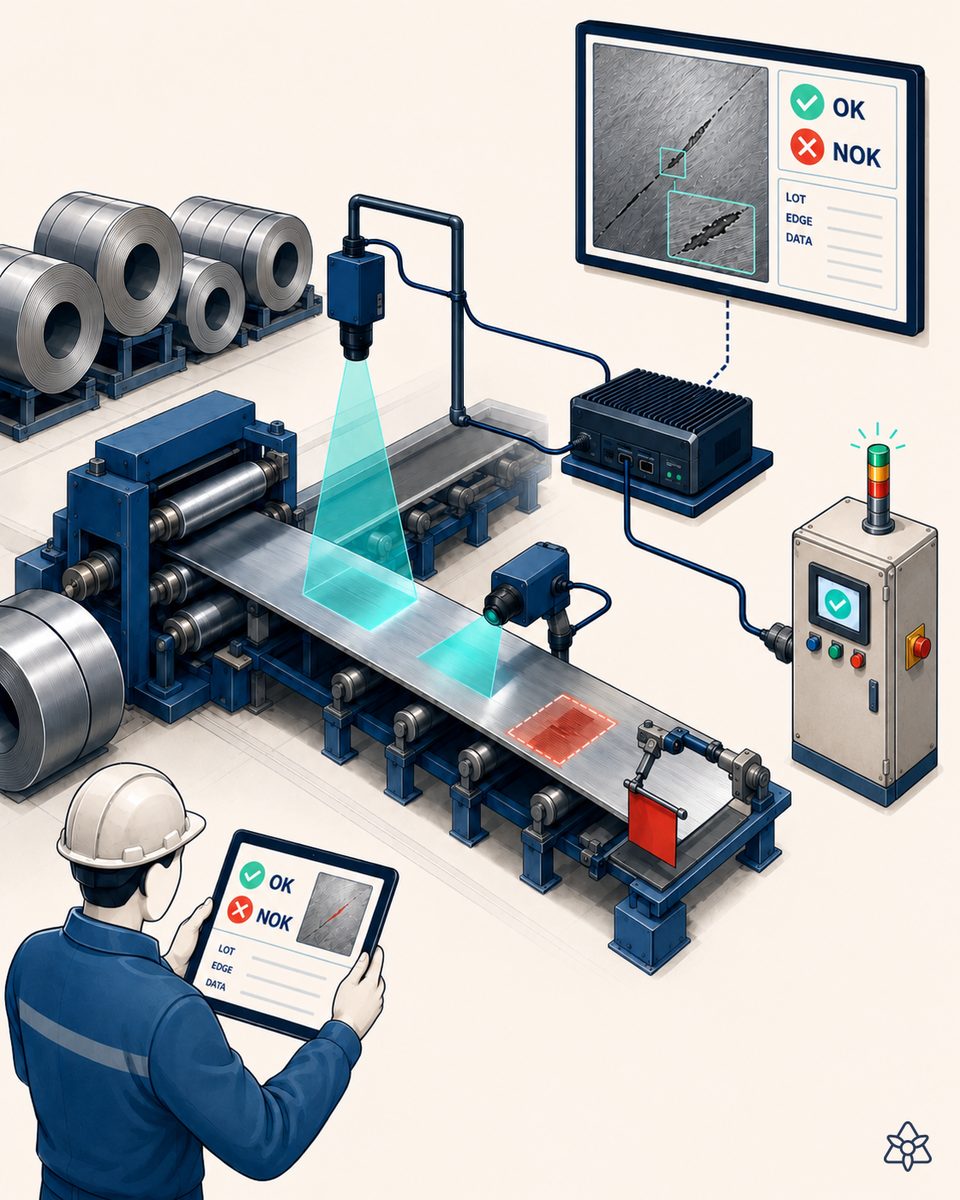
The line does not go down because of the wood — it goes down because of the papers behind it.
A maker of premium doors with tropical veneer (sapele, iroko, wenge, CITES rosewood) has a pain that did not exist five years ago: EU Regulation 2023/1115 (EUDR) on deforestation-linked products. The obligation is threefold for every batch that enters the plant and ends up in a door placed on the European market:
- Product information — species, country and geolocation of origin, volume, supplier identity.
- Risk assessment for post-2020 deforestation based on data for the country and the specific region.
- Risk mitigation whenever the risk is not negligible — and with tropical veneer, it almost never is.
The bottleneck is not in the plant — it is in the paperwork. The certificates backing the origin (FSC, PEFC, CITES permits, country permits, invoices with species and volume) arrive in heterogeneous formats: a scanned PDF, a photo of a stamp on official letterhead, a spreadsheet from the exporter, an email from the sales agent. The purchasing manager receives them across every channel, files them and then, when the physical batch arrives, somebody has to link each paper to the pallet, manually extract the fields for the EUDR statement and sign it.
When orders go up, that work piles up. When the order is premium and has to ship on time, the pressure shifts to the quality team. The classic system works 99% of the time. That 1% is the EUDR statement filed incomplete, and the competent authority opening a case.
iLEAN Connect does not replace the purchasing manager — it seals the cracks between the certificate, the batch and the EUDR statement.
The problem is not a lack of information: it is information living on islands — in an inbox, in an ERP folder, in a WhatsApp photo — that at the critical moment (the batch already unloaded at the plant, waiting to go into the veneer line) does not reach the format the regulation asks for. iLEAN acts as the putty between the supplier's email, the ERP, the purchasing folder and the physical pallet, without asking you to change a thing.
Connect reads the certificate through whatever channel it arrives on. Edge links the paper to the pallet at receiving. The agent cross-references EUDR country risk and prepares the draft statement. The person signs — never the other way round. The authority receives what the person approved, not what the AI inferred on its own.
The iLEAN pieces applied to EUDR due diligence for tropical veneer:
- iLEAN Connect — captures the certificate whether it comes from the supplier's email, the sales agent's WhatsApp, the photo the purchasing manager took of a stamp on official letterhead, or the shared ERP folder. It goes through anchored OCR/extraction and fills in the predefined fields: certificate number, species (CITES or not), country and region of origin, geolocation if it is there, volume, identity of the operator at origin, validity. If extraction confidence is low, it flags it for human review.
- Edge at receiving — captures the physical pallet coming in (label, QR code, photo) and links it to the extracted certificate. If the pallet arrives before the paper, it holds it in a quarantine area until the documentation closes. If the paper arrives before the pallet, it waits for both.
- EUDR due diligence agent — cross-references the data extracted from the certificate with the EUDR country and region risk database, identifies the risk level, proposes mitigation measures where applicable and builds the draft statement for the batch. It leaves it in the purchasing or quality manager's queue for review and signature. The veneer line will not lacquer anything until that signature exists.
Manual OCR + a due diligence spreadsheet vs. a live EUDR flow with iLEAN Connect
| Aspect | Manual + spreadsheet | With iLEAN Connect + Edge + Agent |
|---|---|---|
| Inbound channel for the certificate | Email, WhatsApp, photo — depends on who passes the word | Connect picks up every channel at second zero |
| Extraction of EUDR fields | Manual reading + typing into a spreadsheet | Anchored OCR with a confidence level per field |
| Linking paper ↔ physical pallet | Handwritten notes, depends on who receives it | Edge at receiving links them automatically |
| Country/region risk assessment | From memory or an outdated offline table | The agent cross-references a live database per batch |
| Due diligence statement | A document put together under last-minute pressure | Automatic draft per batch, to review and sign |
| Batch without closed paperwork | Sometimes goes into the line so as not to stop | Held in quarantine until it closes |
Impact estimate for your plant — to be validated with your numbers.
The block below is an estimate to be validated with the specific data of your plant. We put it forward so the committee has an order of magnitude; we refine it during the diagnostic.
- Premium door maker using tropical veneer (sapele, iroko, wenge or similar), suppliers in Africa and/or Southeast Asia, fully exposed to EUDR.
- Connect pilot (certificate OCR + country risk database + link to the pallet) plus a minimal Edge at receiving. First value expected within a few weeks, with the first EUDR statement draft generated automatically.
- Indicative payback between 4 and 9 months, depending on monthly tropical veneer volume, the purchasing/quality hours spent today on manual due diligence work, and the regulatory risk attached to an incomplete statement.
- The hard lever combines time recovered (days per month the manager spent on EUDR instead of anything else) and risk avoided from an enforcement case. Expected reduction in EUDR statement preparation time ≥ 30% against the baseline.
And the purchasing manager's reasonable doubt
“What if the AI misreads a species or a country on the certificate?” — hallucination is a problem of free generation, not of anchored tasks. Reading a certificate and filling in predefined fields is the anchored task par excellence: the best models brought the error below 1.5% [1]. And even so, what is critical is never decided alone: iLEAN holds the batch if confidence is low and the person signs the statement. The three safety rings exist precisely for this.
[1] OpenAI paper “Why Language Models Hallucinate”, 2025 — on the reliability of AI in anchored tasks.
What people ask about forest certificate OCR and EUDR for tropical veneer
What does EUDR require from a premium door maker using tropical veneer?
EU Regulation 2023/1115 (EUDR) on deforestation-linked products requires the operator placing timber/veneer on the European market to submit a due diligence statement per batch, with three blocks: (1) information — species, country and geolocation of origin, volume, supplier identity; (2) risk assessment for post-2020 deforestation based on data for the country and the region; (3) risk mitigation if the risk is not negligible. Without that statement a shipment can be held by the competent authority and the operator penalized. With tropical veneer (sapele, iroko, wenge, rosewood), the underlying risk is almost never negligible, so the per-batch file has to be solid.
Why does EUDR due diligence fall apart on the paperwork side?
Because the forest certificates backing the origin (FSC, PEFC, a CITES permit where applicable, the source country's permit, the supplier invoice with species and volume) arrive in heterogeneous formats: a scanned PDF from the supplier, a photo of a stamp on official letterhead, a spreadsheet exported from the exporter's system. The purchasing manager receives them by email or WhatsApp, files them, and then, when the physical batch arrives, they have to be linked to the pallet and to the door SKU. The bottleneck is not the plant — it is the manual effort of pulling the data out of every certificate and building the EUDR statement. When orders go up, it piles up and falls behind.
What does iLEAN Connect do with forest certificate OCR?
iLEAN Connect captures the certificate through whatever channel it arrives on — email, WhatsApp, a photo from the purchasing manager, a shared ERP folder. It goes through anchored OCR/extraction and pulls the fields EUDR asks for: certificate number, species (CITES or not), country and region of origin, geolocation if it is there, volume, identity of the operator at origin, validity. Connect cross-references the country risk database, links it to the physical pallet arriving at the plant and prepares the draft due diligence statement for the batch. The responsible person reviews and signs; the system sends nothing to the authority without that signature.
What if the AI misreads the certificate?
Hallucination is a problem of free generation, not of anchored tasks. Reading a certificate and filling in predefined fields (species, country, volume) is an anchored task — the best models brought the error below 1.5% in this kind of extraction [1]. And even so, what is critical is never decided alone: iLEAN holds the batch if the extraction lacks sufficient confidence or if the country risk database flags it as high, and the person signs. If a certificate is not valid, the veneer does not go into the premium door line until the paperwork closes. It is the three-rings principle applied to documents.
How much does it cost and how soon do you see first value?
The order of magnitude of a Connect pilot for forest certificate OCR covers the anchored extraction module, integration with the inbound channels (email, ERP folder, WhatsApp), the EUDR country risk database and the link to the physical batch, plus the license. First value expected within a few weeks, with the first EUDR statement draft generated automatically. Indicative payback between 4 and 9 months, adjusted for purchasing/quality hours saved, the volume of tropical veneer processed and the regulatory risk avoided. We send you the estimated ROI in 48h using your plant's data.
More cases in other sectors
- The panel saw does not break down during the service window — it breaks down in the middle of peak season.How iLEAN Edge analyzes spindle vibration to anticipate failure on a CNC panel saw in a furniture…
- A loose cup hinge is not visible in the factory — it shows up in the customer's kitchen.How iLEAN Vision inspects cup hinge boring and assembly in volume-produced kitchen cabinets — before the…
- E1 formaldehyde control in CARB 2 export MDF — customs holds the shipment, the plant pays for it.How iLEAN Edge inspects E1 formaldehyde emissions in MDF exported to the US under CARB 2 and holds the…
- FSC traceability in office furniture chipboard — the batch dossier for the auditor, automatically.iLEAN Tracer builds the FSC chain of custody of chipboard in an office furniture plant with auditable…
- Your flat-pack kitchen is not judged in the factory — it is judged by the fitter in the customer's home.How iLEAN coordinates just-in-sequence assembly of flat-pack kitchen furniture with an agent that…
- The hinge cup works loose two months after installation — and nobody knows why.How iLEAN Brain infers the root cause of loose hinge cups in kitchen cabinets by cross-referencing board…
Tell us your case and in 48h we'll send you the estimated ROI of this AI project for your premium door plant working with tropical veneer.
We work on your plant's real data, not ours. Diagnostic with no commitment.
Request estimated ROI in 48h See wood furniture