E1 formaldehyde control in CARB 2 export MDF — customs holds the shipment, the plant pays for it.
Every batch of MDF loaded for the US has to meet CARB 2 and carry the TSCA Title VI label. iLEAN Edge inspects the press cycle in line — temperature, pressure, fiber moisture, UF resin recipe — and holds the pallet before palletizing if the real curve drifts from the recipe validated by the lab. The quality person signs; the line never releases on its own.
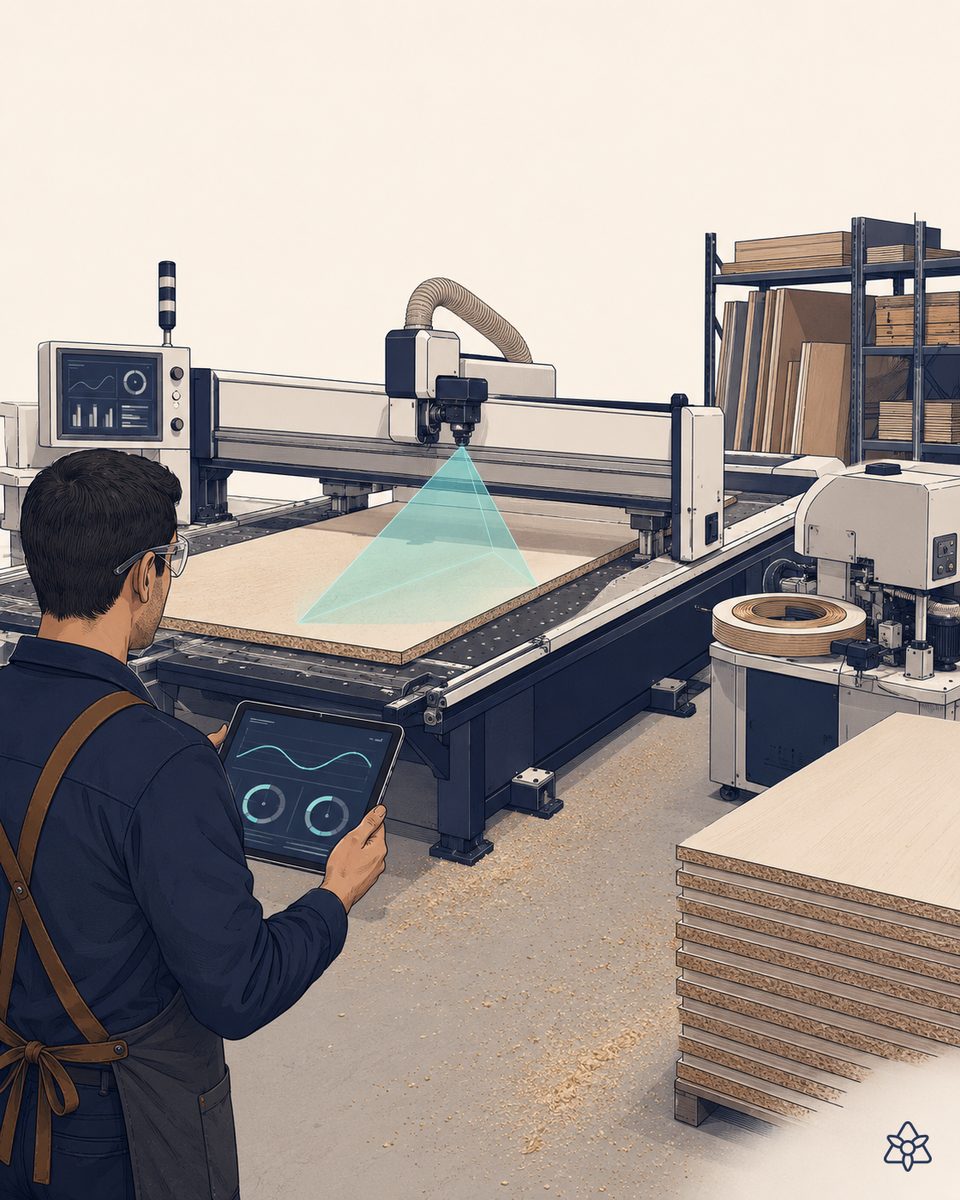
The press complies almost every time — and "almost" does not clear customs.
A shipment of MDF for US furniture that reaches the port without meeting CARB 2 is not an incident: it is a container sitting idle, reverse logistics, destruction or rework, and a distributor customer rethinking the contract. The CARB 2 rule came out of California first; TSCA Title VI replicated it at the federal level, and the EPA requires a label, the manufacturer's certification number (TPC) and batch traceability on every shipment.
The problem in the plant is rarely the formula. The urea-formaldehyde recipe is validated by the external lab, the technicians know the correct molar ratio, and the hot press starts every shift with the signed curve. The problem is three realities coexisting that almost never appear on the same screen:
- The recipe the lab signed off — the UF molar ratio that meets E1 in a climate chamber, official paperwork.
- The real curve of each press cycle — temperature, pressure, incoming fiber moisture, cycle time. It sits in the press SCADA, but few plants cross-reference it board by board with the recipe.
- The label and the export dossier — TPC number, batch, date, destination. It lives in another spreadsheet and gets filled in at the end.
The quality lead knows all this, but cannot be in three places at once. A recipe change — a new resin batch with a different molar ratio, fibers with higher moisture after unexpected rain — is exactly the most vulnerable moment. The classic system works 99% of the time. And that 1% is the container stuck in Long Beach.
iLEAN does not replace the lab — it seals the cracks between recipe, press and export dossier.
The problem is not a lack of information: it is information living on islands that, at the critical moment (a resin batch change, a swing in fiber moisture, a borderline press cycle), does not reach the person who signs in time. iLEAN acts as the putty that fills the gaps between the lab, the press SCADA and the export dossier, without asking you to change anything.
Edge watches the press cycle in line. Connect reads the batch recipe wherever it lives. The agent cross-references it against the validated recipe and CARB 2/TSCA, and if the curve drifts, it holds the pallet. The person signs — never the other way round.
The iLEAN pieces applied to E1 formaldehyde control in export MDF:
- Edge — a terminal with machine vision (CNN) and sensor capture over the hot press. It reads the real curve (temperature, pressure, moisture, time), compares it with the recipe validated by the lab and fires the actuator (light stack, hold code on the pallet) if the press cycle does not fit. It works without a network: if the plant loses WiFi, Edge keeps inspecting and holding, because what is critical cannot depend on connectivity.
- Connect — it captures the batch recipe whether it comes from the LIMS, from the MES, or from the spreadsheet the lab technician updated this morning. It also captures what arrives from outside (a molar-ratio change from the resin supplier by email, an alert about a high-moisture fiber shipment over WhatsApp) at second zero, with nobody having to forward anything.
- Agent — it cross-references the validated recipe, the real press curve, the line's history, the CARB 2/TSCA rule and the manufacturer's TPC number. If there is a deviation, it does not send an email at the end of the shift: it holds the pallet, marks the code and alerts the quality manager on whatever channel they use. The person validates and signs; the pallet does not board the container on its own.
Signed recipe + sampling at the end vs. in-line cross-checking with iLEAN
| Aspect | Signed recipe + sampling at the end | With iLEAN Edge + Connect + Agent |
|---|---|---|
| Reading the press cycle | SCADA shows values but nobody checks them against the recipe | Real curve checked against the validated recipe in line |
| UF resin batch change | Spreadsheet updated, depends on whoever remembers to tell | Connect picks up the change at second zero |
| Abnormal fiber moisture | Detected at final sampling, batch already pressed | Seen before the press cycle even starts |
| Batch outside E1 | Customer claim or hold at a US port | Pallet held in the plant before palletizing |
| Operation without a network | n/a | Edge keeps running on the power in the cabinet |
| CARB 2/TSCA dossier per batch | Rebuilt by hand after the fact | Automatic dossier with label, TPC and curve |
Impact estimate for your plant — to be validated with your numbers.
The block below is an estimate to be validated with the specific data of your plant. We put it forward so the committee has an order of magnitude; we refine it during the diagnostic.
- MDF plant with one or two hot press lines, a mix of domestic market and US export under CARB 2/TSCA Title VI.
- Edge pilot on the press line (terminal with vision and SCADA capture + integration with the LIMS/lab recipe and the export dossier). First value expected within a few weeks, with the first press cycle held in the plant.
- Indicative payback between 4 and 9 months, depending on the historical frequency of shipments held at the port, containers committed and the share of exports in the total.
- The hard lever is a single shipment not held at US customs: container sitting idle, reverse logistics, destruction or rework, damage with the US distributor. One avoided shipment pays for the pilot. Expected reduction in labeling/dossier incidents ≥ 30% over the baseline.
And the quality manager's reasonable doubt
"What if the AI gets it wrong and lets a pallet outside E1 through?" — hallucination is a problem of free generation, not of anchored tasks. In tasks where the AI merely recontextualizes a piece of data from one system to another (reading the SCADA curve and comparing it with the validated recipe), the best models brought error below 1.5% [1]. And even so, what is critical is never decided alone: iLEAN holds the pallet and the person signs. The three safety rings exist precisely for this.
[1] OpenAI paper “Why Language Models Hallucinate”, 2025 — on the reliability of AI in anchored tasks.
What people ask about E1 formaldehyde control in CARB 2 MDF
What is CARB 2 and why does it affect MDF exported to the US?
CARB 2 is phase 2 of California's Airborne Toxic Control Measure, which limits formaldehyde emissions from medium-density fiberboard (MDF), particleboard and plywood sold in the US. For MDF the ceiling is 0.11 ppm. The federal TSCA Title VI rule mirrored those limits: every batch entering through US customs must carry a CARB/TSCA label, the manufacturer's certification number and batch traceability. A shipment without those papers, or with values outside E1, is held at the port — and the buyer does not pay for it, the exporter does.
How do you inspect formaldehyde in line without stopping the press?
What happens in the plant is not a climate-chamber test (that lives in the external certification lab). What iLEAN Edge inspects is the combination of conditions that determine whether the press cycle meets E1: hot press temperature and pressure, urea-formaldehyde resin mix (UF molar ratio), incoming fiber moisture, cycle time. An in-line terminal with vision and sensor capture compares the real curve against the recipe validated by the lab, and if the press cycle drifts, it holds the stack for targeted sampling before palletizing.
What does iLEAN Edge do when it detects a press cycle outside the E1 recipe?
It triggers a physical actuator — a light stack, an ejector or a signal to the cabinet — and marks the pallet with a hold code. The operator does not have to remember the rule; the system applies it. It works without a network: if the plant loses connectivity, Edge keeps reading the press and holding batches, because what is critical cannot depend on WiFi. The held stack goes to targeted sampling by the internal lab; if the value is confirmed outside E1, the batch never enters the export container.
What happens if a batch already loaded reaches US customs without meeting CARB 2?
Customs (CBP) has authority to hold the shipment, and the EPA can penalize both the manufacturer at origin and the importer. The hard cost is not only the fine: it is the container sitting idle, the reverse logistics, the destruction or rework, and the damage with the US distributor's own end customer. That is why the economics of a system like iLEAN are clear: a single shipment held at the port pays for the pilot. The classic system (signed recipe + sampling at the end) works almost every time — and that "almost" is the expensive part.
How much does it cost and when do you see the first value in an MDF plant?
The order of magnitude of an Edge pilot on an MDF press line is close to that of any Edge pilot in an industrial plant: an initial investment covering the terminal, camera and sensors, integration with the press SCADA and the batch recipe, plus an annual license. First value expected within a few weeks, with the first press cycle held. Indicative payback between 4 and 9 months, depending on the historical frequency of port holds, containers committed and export volume. We send you the estimated ROI in 48h with your plant's data.
More cases in other sectors
- The AI Act and automated inspection in furniture — relax: your camera looks at boards, not people.Visual product inspection is minimal risk under the AI Act when there is human oversight: the camera…
- The panel saw does not break down during the service window — it breaks down in the middle of peak season.How iLEAN Edge analyzes spindle vibration to anticipate failure on a CNC panel saw in a furniture…
- A loose cup hinge is not visible in the factory — it shows up in the customer's kitchen.How iLEAN Vision inspects cup hinge boring and assembly in volume-produced kitchen cabinets — before the…
- EUDR forest certificate OCR for tropical veneer — the premium door will not be lacquered if the paperwork does not close.iLEAN Connect reads forest certificates and EUDR due diligence for tropical veneer in premium doors. It…
- FSC traceability in office furniture chipboard — the batch dossier for the auditor, automatically.iLEAN Tracer builds the FSC chain of custody of chipboard in an office furniture plant with auditable…
- Your flat-pack kitchen is not judged in the factory — it is judged by the fitter in the customer's home.How iLEAN coordinates just-in-sequence assembly of flat-pack kitchen furniture with an agent that…
Tell us your case and in 48h we'll send you the estimated ROI of this AI project for your MDF plant.
We work on your plant's real data, not ours. Diagnostic with no commitment.
Request estimated ROI in 48h See furniture and wood