The AI Act and automated inspection in furniture — relax: your camera looks at boards, not people.
If you have already put — or are about to put — machine vision on your finishing, edging or hardware line, the short answer is this: product inspection sits in the minimal or limited risk band of the European AI Regulation, because it does not assess or classify people. What anyone who asks will want — a large customer, an audit, an authority — are two things: transparency about what the system decides and effective human oversight over every decision. Which is, literally, how iLEAN is built: the camera proposes, the person validates and signs, and the dossier of decisions stays traceable part by part.
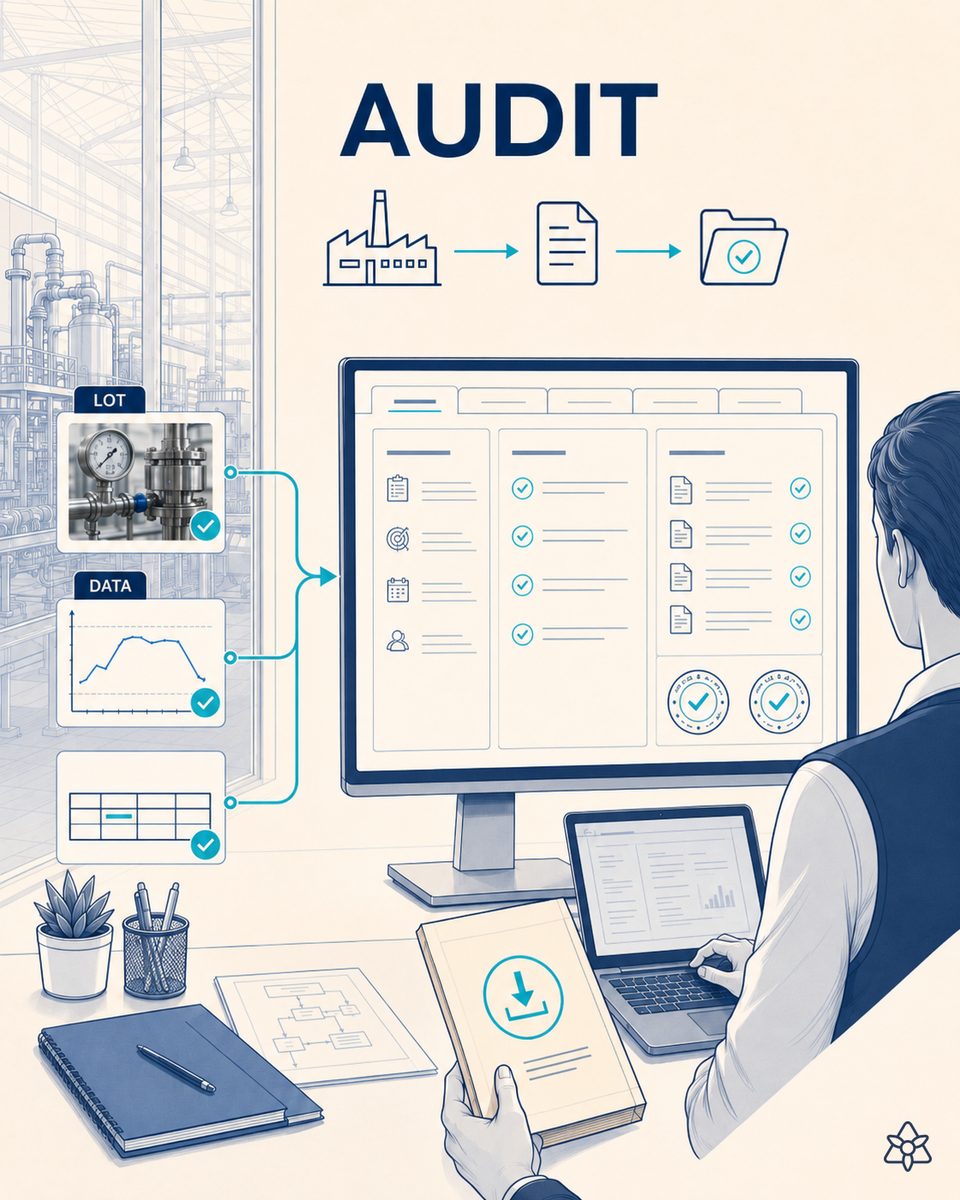
Nobody has told you that you can't — they have told you to prove it.
The scene repeats itself in furniture plants across Europe. Quality has spent months fighting returns over finish: sags that show up in the customer's home, edges that lift at the corner of a module, hinge cups badly seated that only get caught during installation. Someone proposes putting an AI camera on the line. The project moves forward. And then comes the question that freezes everything:
“Doesn't this drag us into the AI Act? Do we have to certify something? And what if a big customer audits us?”
From that point on the project drifts into limbo. Not because there is a bad answer, but because nobody has the answer and getting it wrong looks expensive. Meanwhile, the line keeps producing with the same percentage of returns and the same visual check by eye, shift after shift.
It helps to separate three things that get mixed up in committee conversations and are not the same:
- What the Regulation actually regulates — Regulation (EU) 2024/1689 orders AI systems by the risk they pose to people: health, safety and fundamental rights. High risk means biometrics, hiring processes, educational assessment, access to credit, or safety components of regulated products. A varnish defect classifier is not on that list.
- What does apply to a product inspection — the minimal or limited risk band, where the Regulation does not require a conformity file but good practice: knowing what the system does, informing whoever interacts with it, and keeping a person with real power to review and override. Not much, but not nothing.
- What the market will ask for before the regulator does — this is the part that surprises people most. Long before any authority knocks on your door, it will be the large kitchen retailer or the hospitality contract buyer asking you in writing how your automated quality control works. And there, “we have an AI camera” is not enough: you need the dossier.
The good news is that the work that saves you the regulatory argument and the work that saves you the returns are the same work: recording what was inspected, against what criterion, what the system proposed and what the person signed.
iLEAN did not adapt to the AI Act — it was born this way because nothing else works on a shop floor.
There are two ways to build automated inspection. One is for the machine to decide and pull parts on its own, and then try to document it afterwards. The other is for the machine to propose and the person to close. The second is slower to design and vastly easier to defend — in front of an auditor, in front of a customer, and in front of your own line lead, who is the one who has to trust the system for the system to be worth anything.
The camera proposes and explains which pattern it flagged the part against. The operator validates on the tablet and signs. The agent assembles the dossier of decisions. No step is closed by an AI.
The three iLEAN pieces, applied to a furniture plant:
- iLEAN Edge — a machine vision terminal (CNN) over the critical point on the line: the finishing booth exit, the edge bander exit, or the hardware pre-assembly station. It classifies part by part at line speed, marks the specific area and shows which pattern it flagged it against. Works with no network: as long as the terminal has power, inference is local and the alert reaches the operator in milliseconds. A WiFi outage does not stop inspection.
- iLEAN Connect — puts what the camera sees into context. Which batch it is, which customer it is going to, which finish it carries and what tolerance you agreed with that specific customer. It also captures what today lives outside the system: the retailer's specification in a PDF, the contract customer's complaint by email, the historical drift of the booth. The forgotten spreadsheet becomes usable data.
- iLEAN Agents — the agent cross-references the camera's proposal, the operator's validation and the batch's destination, and assembles the dossier of decisions: which parts were inspected, which were flagged, who validated each one, how many were overridden and why. The agent does not sign: it prepares the file and hands it to the quality manager, who is the one who signs. The three safety rings are there precisely to protect that boundary.
The practical consequence is that the answer to “how do you control your AI?” stops being a verbal explanation and becomes a document that already exists, generated on its own, with nobody having had to rebuild anything after the fact.
A camera that decides alone vs. the iLEAN propose-and-sign model
| Aspect | “Closed” automatic inspection | With iLEAN Edge + Connect + Agents |
|---|---|---|
| Who decides about the part | The system pulls and blocks on its own | The system proposes; the operator validates on a tablet and signs |
| Fit with the European AI Regulation | Human oversight hard to evidence | Effective human oversight, by design and on record |
| Defect criterion | Closed recipe from the equipment vendor | Defined by your quality team, versioned and consultable |
| Record of decisions | Technical log with no traceability to a person | Dossier by part, batch, criterion and signature |
| Operator overrides | Lost or left outside the system | Recorded, and they adjust the criterion |
| Answer to a customer running an audit | A verbal explanation and screenshots | Dossier generated by the agent, signed by quality |
| Operation without network | Depends on the central server | Local inference; syncs when the network returns |
Impact estimate for your plant — to be validated with your numbers.
The block below is an estimate to be validated with the specific data of your factory. We put it forward so the committee has an order of magnitude; we refine it during the diagnostic.
- A furniture or wood component manufacturer with one finishing line and one edge bander, a mix of part numbers and a percentage of finish-related returns documented over recent years.
- Edge pilot on a single point — the one generating the most returns today: camera with dedicated lighting + Edge terminal + tablet validation for the operator. First value expected within a few weeks, with the first parts flagged and recovered before leaving the line.
- Expected reduction in finish-related returns of ≥ 30% against the baseline, and in the quality hours spent rebuilding the history of a complaint of ≥ 50%. Indicative payback between 4 and 9 months, depending on volume, the average cost of a return and the historical frequency of finish complaints.
- The hard lever is returns avoided: every door front that does not come back from the customer pays for itself. The dossier of decisions is the free side effect — you get it ready-made for the next audit or the next tender.
And the committee's reasonable doubt
“What if the AI invents a defect or, worse, lets a real one through?” — hallucination is a problem of free generation, not of anchored tasks. Marking candidate areas on a lacquered door front and comparing them against the reference of the master part is an anchored task: the best models brought error below 1.5% [1]. And even so, the system does not decide — it proposes, flags, records. The operator's and the quality manager's signatures stay exactly where they belong. That is the underlying reason this model fits without friction with what the European Regulation asks: you do not have to bolt human oversight on afterwards, because human oversight is the design itself.
[1] OpenAI paper “Why Language Models Hallucinate”, 2025 — on the reliability of AI in anchored tasks.
What people ask about the AI Act and automated inspection in furniture
What does the AI Act require of a product inspection system?
Regulation (EU) 2024/1689 classifies AI systems by the risk they pose to the health, safety and fundamental rights of people. A camera looking at a cabinet door front to decide whether the varnish has a sag is not assessing anyone: it is assessing a part. That is why the real regulatory burden on a finish inspection is low, and it concentrates on two very reasonable things: transparency (that people know there is an automatic system classifying, and on what criterion) and effective human oversight (that a person can review, correct and override the proposal). What is worth being clear about is where product inspection ends and something else would begin: if the same camera were used to assess the performance of individual operators, the framing changes completely. This is practical guidance, not legal advice — your legal counsel is the one who settles the final classification.
Why is finish inspection considered minimal risk?
Because the Regulation reserves the high-risk category for uses such as biometrics, access to employment, education, credit, essential services, or safety components of products covered by harmonized legislation. A classifier of varnish defects, badly bonded edges or wrongly seated hinge cups falls into none of those categories: it makes no decisions about people and does not act as a safety component of the furniture. It falls in the minimal or limited risk band, where the Regulation does not impose a full risk management system but voluntary good practice and a duty to inform when someone interacts directly with the system. In practice: you can deploy machine vision on your finishing line without opening a high-risk conformity file, as long as the use stays the one you have described.
What documentation is worth having ready?
Even though minimal risk does not require a formal file, the folder that saves you arguments with a large customer, with a quality audit or with a market surveillance authority is always the same one, and it is short: description of the use (what the camera looks at, at which point on the line, what it decides and what it does not), classification criterion (what counts as a critical defect and what as cosmetic, and who defined it), evidence of human oversight (who validates, how they override the proposal and where that is recorded), a record of decisions with date, part, batch and person, and data management (that the images are of product, how long they are kept and who has access). The iLEAN agent prepares that dossier from what is already recorded on the line; the quality manager reviews it and signs it.
How does the human oversight in the iLEAN model fit in?
iLEAN was not designed to comply with the AI Act — it was designed this way from day one because nothing else works on a shop floor, and it happens to match what the Regulation asks for. The Edge camera proposes: it flags the part, points to the area and explains which pattern it flagged it against. The operator sees it on the tablet, accepts or rejects it, and that validation is signed with their identity. The line does not pull a part or block a batch on its own without a person behind it. Every human override also feeds the history: if your team systematically rejects one type of alert, that shows up in the dossier and the criterion is adjusted. Effective human oversight is not a panic button in a manual — it is a system built so that the person is always the last step.
Does it work for a varnishing line and for edging too?
Yes, and the regulatory reasoning is identical in both cases because both inspect product, not people. What changes is the engineering: in varnishing and lacquering you work with grazing light to catch craters, sags, dust and orange peel, plus reflective lighting for gloss variation and insufficient coating. In edge banding the camera looks for glue lines, edges lifted at the corner, misalignment against the board and uneven trimming. In hardware, it checks the presence, position and orientation of hinge cups, runners and screws. The architecture, the tablet validation flow and the dossier of decisions are the same; what changes is what gets trained and the optics. It is usual to start with a single point — the one generating the most returns today — and expand once there is confidence.
Related: UV varnish defects on lacquered doors · Cup hinge inspection · PVC edging batch traceability
More cases in other sectors
- Void detection in XLPE insulation with AI — a dielectric failure is not a warning, it is a breakdown.How iLEAN Vision detects voids and bubbles in XLPE insulation as it leaves the extruder, before curing,…
- A FAI eats up days per partiLEAN runs FAI with 3D vision + a virtual CMM and generates the AS9102 report automatically.
- Furniture and wood — the defect that gets past the saw ships as a finished part.Documented iLEAN cases in furniture and wood: board defects, FSC/PEFC and EUDR traceability, pressing…
- The panel saw does not break down during the service window — it breaks down in the middle of peak season.How iLEAN Edge analyzes spindle vibration to anticipate failure on a CNC panel saw in a furniture…
- A loose cup hinge is not visible in the factory — it shows up in the customer's kitchen.How iLEAN Vision inspects cup hinge boring and assembly in volume-produced kitchen cabinets — before the…
- E1 formaldehyde control in CARB 2 export MDF — customs holds the shipment, the plant pays for it.How iLEAN Edge inspects E1 formaldehyde emissions in MDF exported to the US under CARB 2 and holds the…
Tell us about your finishing line and in 48h we'll send you the estimated ROI of this AI project for your plant.
We work on your factory's real data, not ours. Diagnostic with no commitment.
Request estimated ROI in 48h See other sectors