Recalling a PVC edge band batch: either you know which projects carry it, or you stop everything.
In modular office furniture, a defective batch of PVC edge banding or a melamine-faced board with formaldehyde out of spec is spread across dozens of projects. Without batch-to-project traceability, the only safe answer is to recall it all. iLEAN Tracer links edge band roll, board, work order and customer project — so you recall only what is affected, in minutes. The person signs.
Three pieces of data the ERP never saw together.
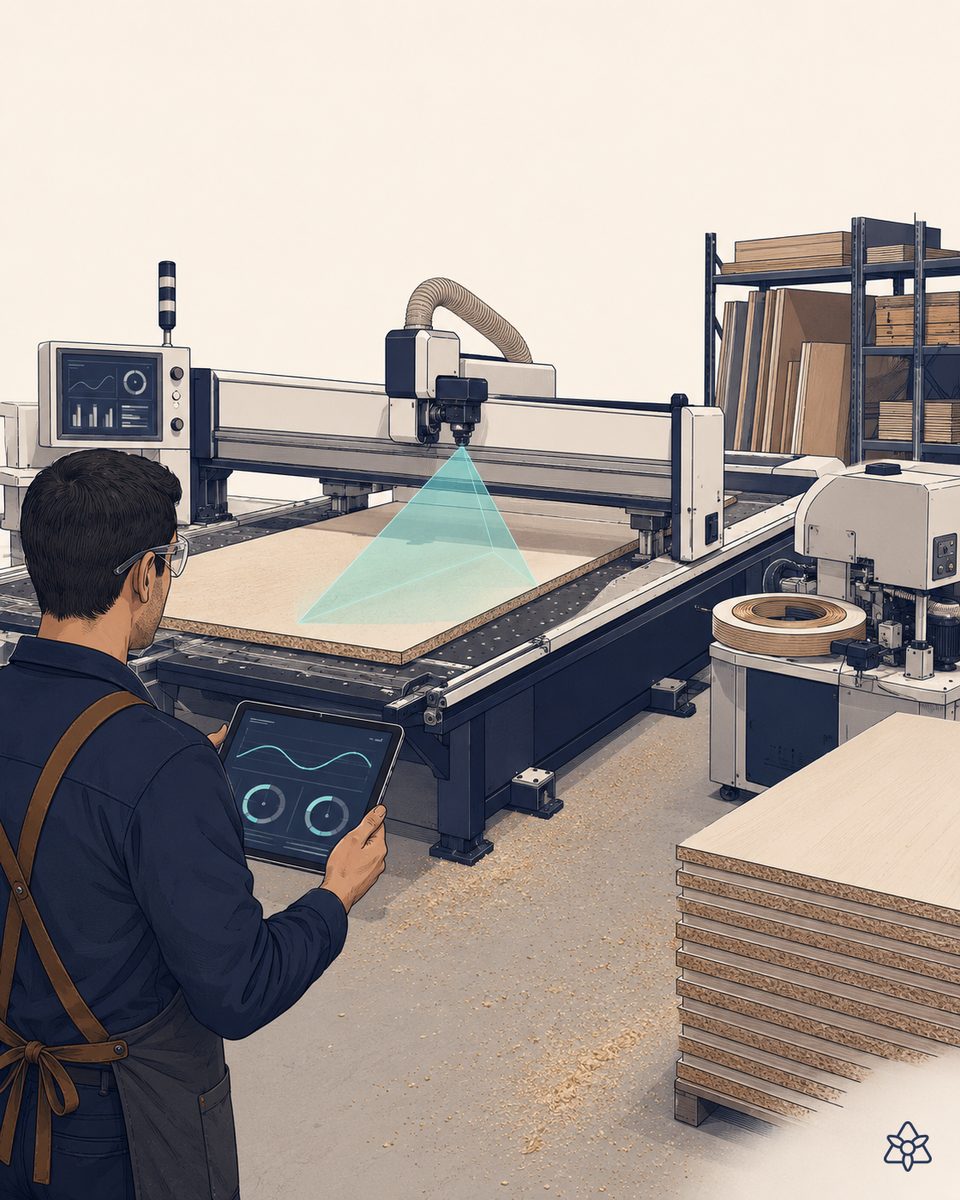
In a modular office furniture plant, a single finished part carries three batches that the ERP rarely sees joined up:
- The PVC edge band roll the edgebander was running that shift — its color, its thickness, its manufacturer's batch. It lives on a sticker on the roll itself and in the head of the operator who loaded it.
- The melamine-faced board the cut part comes from — its supplier batch, its emission class (E1, CARB2), its decor. It lives on the inbound delivery note and in a stack in the warehouse.
- The end-customer project that work order is assigned to — which office, which account, which delivery date. It lives in the commercial ERP.
The day an edge band supplier calls to say: “batch XYZ from last month has an adhesive problem, take it off the market”, the question is brutal and simple: which projects carry that batch? Without traceability, the safe answer is every project this month. That means stopping lines, pulling back entire orders, and arguing with accounts that never had the problem. Hard cost and brand damage at the same level.
iLEAN does not add another ERP — it seals the crack between the systems you already have.
The batch data already exists — on the roll, on the delivery note, in the ERP. The problem is that it never reaches the same place in the same second. iLEAN acts as the putty that joins those islands, without asking you to change the ERP, the MES or the edgebander.
Connect captures the roll batch as it is loaded. Connect reads the board delivery note on arrival. The agent cross-references it with the work order and assigns it to the project. If there is a recall tomorrow, in minutes you know which projects carry that batch — not which whole shift.
The iLEAN pieces applied to batch traceability in office furniture:
- Connect (iLEAN Tracer) — captures the batch code of the edge band roll when it is loaded onto the edgebander (photo + OCR, a read from the local panel, or direct integration depending on the age of the machine). It also captures the melamine-faced board's delivery note when it enters the warehouse. Graded capture: manual / local panel / integrated, according to what you have. It does not force you to change the machine.
- Agent — weaves the batch-part-project graph in real time. When a work order reaches the MES, the agent assigns it the active edge band batch, the board batch from the warehouse and the project from the ERP. Every finished part carries its three batches and its project, without the operator typing anything.
- Project dossier — the agent generates the traceability file per project in minutes. For a selective recall, for a key account tender, for an after-sales warranty claim. A vision with no example sounds like a sales pitch; an example with no vision sounds like just a tool. Here you get both.
Traceability by shift vs. traceability by batch and project
| Aspect | Spreadsheet + delivery note + the operator's memory | With iLEAN Tracer + agent |
|---|---|---|
| Edge band roll changeover | The operator loads it — the ERP never finds out | Connect reads the batch at second zero |
| Board delivery note | Paper in a binder, batch in the storekeeper's head | OCR of the delivery note + link to the cutting order |
| Recall granularity | By week or by shift | By batch and by project |
| Rebuilding it for the auditor | Days, with arguments | Project dossier, automatic |
| Operation with no network | n/a | Edge/Connect keep capturing and sync afterwards |
| The veteran operator's knowledge | Walks out the day they retire | Captured as a pattern inside the agent |
Impact estimate for your plant — to be validated with your numbers.
The block below is an estimate to be validated with the specific data of your plant. We put it forward so the committee has an order of magnitude; we refine it during the diagnostic.
- Mid-sized modular office furniture plant, 2-3 edgebanders, several decors in stock, multi-project mix.
- Connect pilot on one edgebander + delivery note reading in the warehouse + an agent that cross-references with the ERP/MES. First value expected within a few weeks: the first project dossier comes out before the first month is over.
- The cost of a mass recall over a defective edge band batch vs. the cost of a selective recall by project: the difference pays for the pilot. Indicative payback between 4 and 9 months.
- Reduction in response time to a supplier alert of ≥30%, conservatively. Reduction of scrap from mixed edge band batches in assembly, likewise.
And the IT director's reasonable doubt
“What if the delivery note OCR fails and puts the wrong batch into the system?” — hallucination is a problem of free generation, not of anchored tasks. Reading a batch code off a delivery note and comparing it with the supplier catalog is an anchored task — the best models brought error below 1.5% [1]. Even so, what is critical goes through the three safety rings: the data enters ring 3 at speed, it is validated in ring 2 against the catalog and the history, and only when the signed JSON passes into ring 1 is it considered traceability data. The person signs where it matters.
[1] OpenAI paper “Why Language Models Hallucinate”, 2025 — on the reliability of AI in anchored tasks.
What people ask about batch traceability in office furniture
Why do you need to trace the PVC edge band batch in office furniture?
In modular office furniture, PVC edge banding and melamine-faced board are bought in large batches and spread across end-customer projects. When an edge band batch turns out to be defective — adhesive that does not hold, color that shifts under UV, formaldehyde above E1 — the question is not “what do we do”, it is “which projects have it”. Without batch traceability, the answer is recall everything made in those weeks. With traceability, you recall only the affected projects — minutes instead of days.
How does iLEAN Tracer link the edge band batch to the customer project?
iLEAN Tracer captures three things at second zero: the batch code of the edge band roll the operator loads onto the edgebander (a photo of the roll or a read of the code), the work order running in the ERP/MES, and the customer project that work order is assigned to. The agent weaves the three into a batch-by-project graph. If tomorrow the supplier flags a fault in batch XYZ, in seconds you know which projects carry parts made with that roll, which plant they are in and which customer they went to.
Do I need to replace the edgebander for this?
No. iLEAN Connect has graded capture: if the edgebander is modern and has an interface, direct integration over OPC-UA or an API; if it has an old, isolated local computer, we connect to it and extract the data; if it only has an analog panel, a camera photographs the roll when it is loaded and reads the code by OCR. We do not force you to replace the machine. We fit the data in as it is.
And the melamine board — is it traced by batch too?
Yes — the same mechanism. Melamine-faced board arrives with its supplier delivery note and a manufacturing batch; iLEAN Connect reads the delivery note (PDF or paper, via a photo), captures the batch and associates it with the cutting order. From then on, every cut part inherits the board batch and, when it is joined to the edge band, it also inherits the edge band batch. Cross-traceability of both materials through to the end-customer project builds itself.
What happens when the end customer asks for a batch certificate?
The agent generates the project batch dossier in minutes, not weeks: which board, which edge band, which adhesive, which shift processed them, which checks they passed, a photo of the edge band roll as loaded. For the corporate office buyer (a key account, a retailer, a public administration) that dossier is what closes tenders. For you, it is the boring file that saves you an argument when a project comes back under warranty.
More cases in other sectors
- The PEFC audit is not won during the audit — it is won in the dossier for every batch.How iLEAN Writer assembles the PEFC dossier for the supply chain of veneered MDF interior doors with an…
- Flatness and thickness in phenolic plywood — an out-of-tolerance panel is a permanent imprint on an exposed concrete wall.iLEAN Vision validates the flatness and thickness of every phenolic plywood panel with 3D vision at end…
- Phenolic plywood formwork inspection — a defect that transfers to exposed concrete is an urgent replacement on site.iLEAN Vision inspects surface defects in phenolic plywood formwork for civil works. It holds the panel…
- Every split board is direct scrap — and almost always you could see it coming in the humidity curve.How iLEAN Edge measures relative humidity inside the sawn timber drying kiln in real time to prevent…
- Shop-site coordination for custom wood-aluminum windows — a measurement that arrives late is a part already cut that starts over.iLEAN Agents coordinate the joinery shop and the job site for custom wood-aluminum windows. They capture…
- UV varnish defect detection on lacquered doors — a crater spotted after the UV tunnel is another full booth cycle.iLEAN Edge detects UV varnish defects (craters, dust, sags, low film build) on lacquered doors in line,…
Tell us your case and in 48h we'll send you the estimated ROI of this AI project for your office furniture plant.
We work on your plant's real data, not ours. Diagnostic with no commitment.
Request estimated ROI in 48h See furniture & wood