UV varnish defect detection on lacquered doors — a crater spotted after the UV tunnel is another full booth cycle.
In the UV lacquering of a premium door, a defect (crater, sag, embedded dust, low film build) caught after the UV tunnel is no longer nothing: it is full sanding, putty and another complete booth cycle. iLEAN Edge sees it before curing, while the piece can still be recovered with a blast of air, a scraper or a quick touch-up — no sanding, no second pass through UV. The person signs.
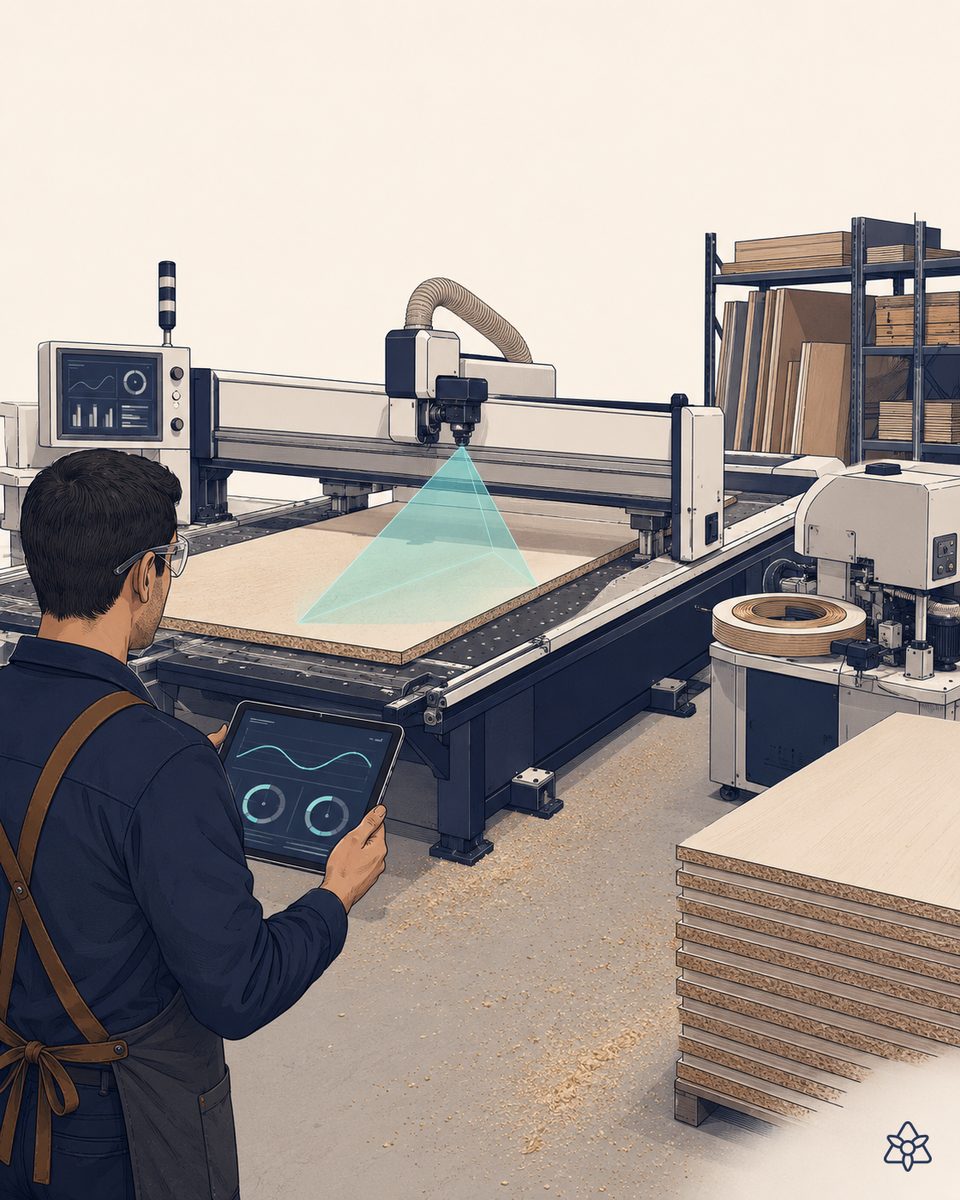
UV varnish is irreversible — before the tunnel everything is fixable; after it, everything is rework.
UV lacquering on a premium door is the finish where a single speck of dust, a silicone crater or the smallest sag is not an incident: it is a rejection from a meter away. The line usually runs: preparation → spray or curtain coating → flash-off table → UV tunnel → inspection. On the table between coating and the tunnel, the varnish is still wet: a blast of air removes the speck of dust, a scraper corrects the sag, a touch-up compensates for low film build. Any defect is recoverable.
The problem starts when the door enters the UV tunnel. The lamps cure the varnish in seconds and the film ends up like glass. After the tunnel, recovering a crater or a sag means full sanding, putty where needed, repainting and another complete booth cycle. The compound cost:
- Booth labor — the operator who sands, putties and repaints an already cured door.
- UV lamp life and the consumables of the second cycle.
- The risk of going too far with the sanding: if you break through the base coat, the whole door is scrap — and on a premium lacquered door with fine veneer underneath, that scrap is expensive.
- Delay to the customer — booth capacity is limited and reworks eat whole shifts.
Classic inspection at the end of the line (an operator with a lamp after the tunnel) works 99% of the time, but when it does catch a defect it is already too late to avoid the rework. The useful inspection is precisely the one done before the tunnel.
iLEAN Edge is not one more final inspection — it is the eye right before the point of no return.
The problem is not a lack of inspection: your quality team knows perfectly well what counts as a rejectable crater and what is a normal pattern of the lacquer. The problem is that the useful inspection has to happen before the UV tunnel, at conveyor speed, in a booth full of varnish fumes, and no person can hold that for eight hours. iLEAN acts as the putty between the booth lead's criteria and the reality of each door, without asking you to change the booth or the UV cycle.
Edge sees every door before the tunnel, with your team's criteria. Connect reads the batch destination and the color. The agent alerts the operator, logs the defect and proposes the pre-UV rework. The person signs — never the other way round.
The iLEAN pieces applied to UV varnish defect detection on lacquered doors:
- iLEAN Edge — a terminal with machine vision (CNN) and an industrial camera with combined lighting (grazing light to pick up craters, sags and dust + reflected light to pick up low film build and gloss variation). Positioned between the flash-off table and the entrance to the UV tunnel. It alerts the operator in milliseconds, without stopping the conveyor: the operator steps in, blows off the dust, sands if needed, and the door carries on. It works without a network: as long as the terminal has power, the CNN keeps classifying.
- Connect — it reads the batch destination (premium high-gloss white vs. standard matte lacquer, retailer A vs. retailer B) and the booth's drift history (aging UV lamp, new varnish batch, booth temperature). It also captures what comes from outside: the kitchen distributor's specification, the demands of a bespoke furniture manufacturer.
- Agent — it cross-references the image of each door, the batch destination and the booth history. If the booth builds up an abnormal pattern (more craters than usual, gloss drift), it does not wait until the end of the shift: it alerts the booth lead on whatever channel they use, with a proposed check (paint filters, lamp, temperature). The operator validates the proposal and signs.
Final inspection after the UV tunnel vs. in-line detection with iLEAN Edge
| Aspect | Manual final inspection | With iLEAN Edge + Connect + Agent |
|---|---|---|
| Moment of inspection | After the UV tunnel, varnish cured | Before the UV tunnel, varnish still wet |
| Action possible on a defect | Sanding, putty, repainting, second UV pass | Air blast, scraper, touch-up — no second UV pass |
| Coverage | Whatever the operator happens to see | 100% of the doors, both faces |
| Relief defects (crater, sag) | Only those visible from a meter away | CNN over dedicated grazing light |
| Film build and gloss defects | Subjective | CNN over reflected light |
| Operation without a network | n/a | Edge keeps alerting on the power in the cabinet |
| Traceability per door | Batch level, no detail | Before/after photo + classification + reason |
Impact estimate for your plant — to be validated with your numbers.
The block below is an estimate to be validated with the specific data of your plant. We put it forward so the committee has an order of magnitude; we refine it during the diagnostic.
- Premium lacquered door manufacturer with one UV lacquering booth, a mix of finishes (high-gloss white, matte lacquer, color), rework rate documented over recent years.
- Edge pilot between the flash-off table and the entrance to the UV tunnel (camera with dedicated lighting + Edge terminal with CNN + alert to the operator + integration with the booth SCADA). First value expected within a few weeks, with the first doors detected and recovered before the UV tunnel.
- Indicative payback between 4 and 9 months, depending on volume, the historical frequency of booth reworks and the average cost of a full repainting cycle.
- Expected reduction in post-UV reworks ≥ 30% over the baseline. The hard lever is every booth cycle saved + every door not delivered defective to the end customer.
And the booth lead's reasonable doubt
"What if the AI flags a normal variation of the lacquer as a crater and we stop the line for nothing?" — hallucination is a problem of free generation, not of anchored tasks. In tasks where the AI merely compares an image against closed criteria learned from your quality team, the best models brought error below 1.5% [1]. And even so, the line never stops on its own: the system alerts the operator, the operator decides whether to step in or carry on, and signs. The three safety rings exist precisely for this.
[1] OpenAI paper “Why Language Models Hallucinate”, 2025 — on the reliability of AI in anchored tasks.
What people ask about UV varnish defect detection on lacquered doors
What defects typically show up in the UV lacquering of a premium lacquered door?
The typical defects in UV lacquering on a lacquered door are: craters and fisheyes from silicone or oil contamination, sags on edges and vertical areas, embedded dust in the varnish while it is still wet before curing, low film build (areas with less thickness than specified), drag marks from the conveyor table, and gloss variation between batches caused by drift in the varnish or in the UV lamp. On a premium lacquered door with a high-gloss white or highly saturated finish, any one of them, seen from a meter away, is a rejection by the end customer.
Why is catching the defect before the UV tunnel the difference between nothing and a full rework?
Before the UV tunnel the varnish is still wet — a localized defect can be recovered with a blast of air, a scraper or a quick touch-up before curing, without entering the tunnel and without burning UV lamp life. Caught after the UV tunnel, the varnish is cured and irreversible: the only fix is fully sanding the affected face, putty where needed, repainting and another complete booth cycle. The difference between the two scenarios is straight booth labor cost + scrap if the sanding goes through the film thickness.
How does iLEAN Edge tell a real crater from a normal pattern of the lacquer?
iLEAN Edge is a terminal with machine vision (CNN) trained on the real patterns of your booth — the defects your quality team already marks as critical are labeled critical; the cosmetic ones as cosmetic. An industrial camera with grazing light to pick up craters and sags, and reflected light to pick up low film build and gloss variation. The CNN classifies door by door at conveyor speed and raises the alert to the operator before the UV tunnel — the line does not decide on rework by itself, the person signs.
Does iLEAN Edge work without a network in the lacquering booth?
Yes. iLEAN Edge is designed so that the critical cycle does not depend on the internet or on the central SCADA. As long as the terminal has power, the CNN infers locally and alerts the booth operator before the UV tunnel. When the network comes back, it syncs the history with the central agent and traceability is rebuilt door by door. In a booth with back-to-back painting lines and high booth costs, this is the only defensible architecture — detection cannot stop because WiFi dropped.
How much does it cost and when do you see the first value?
The order of magnitude of an Edge pilot on a UV door lacquering line covers an industrial camera with dedicated lighting (grazing + reflected), an Edge terminal with GPU, integration with the booth SCADA and the MES for traceability door by door, plus the license. First value expected within a few weeks, with the first doors detected and recovered before the UV tunnel. Indicative payback between 4 and 9 months, depending on volume, the historical frequency of booth reworks and the average cost of a full repainting cycle. We send you the estimated ROI in 48h with your plant's data.
More cases in other sectors
- Recalling a PVC edge band batch: either you know which projects carry it, or you stop everything.How iLEAN Tracer links PVC edge band batch, melamine board and office project for precise recalls…
- Every split board is direct scrap — and almost always you could see it coming in the humidity curve.How iLEAN Edge measures relative humidity inside the sawn timber drying kiln in real time to prevent…
- Shop-site coordination for custom wood-aluminum windows — a measurement that arrives late is a part already cut that starts over.iLEAN Agents coordinate the joinery shop and the job site for custom wood-aluminum windows. They capture…
- Helicopter MRO with AI — the aircraft does not fly again until the Form 1 adds up.How iLEAN cross-references visual inspection, NDT, OEM manuals and airworthiness directives to return…
- ITAR/EAR aerospace with AI — a part shipped without a license is a federal crime in the US.iLEAN classifies ECCN/USML, screens restricted-party lists and traces ITAR/EAR licenses for every…
- Landing gear control with AI — the pattern is already proven at an aeronautical Tier 1.How iLEAN combines vision, traceability OCR, operator voice assistance and dossier agents to certify…
Tell us your case and in 48h we'll send you the estimated ROI of this AI project for your UV lacquering booth.
We work on your plant's real data, not ours. Diagnostic with no commitment.
Request estimated ROI in 48h See furniture and wood