Every split board is direct scrap — and almost always you could see it coming in the humidity curve.
Drying sawn timber is a race against the internal stress of the board: if the kiln dries too fast, you get checks and end splits; if it dries too slowly, the cycle stretches out and your m³ per year fall. iLEAN Edge installs probes and an on-board model that reads the relative humidity curve in real time and proposes a correction before the crack is born. The person signs — the operator corrects, the kiln obeys.
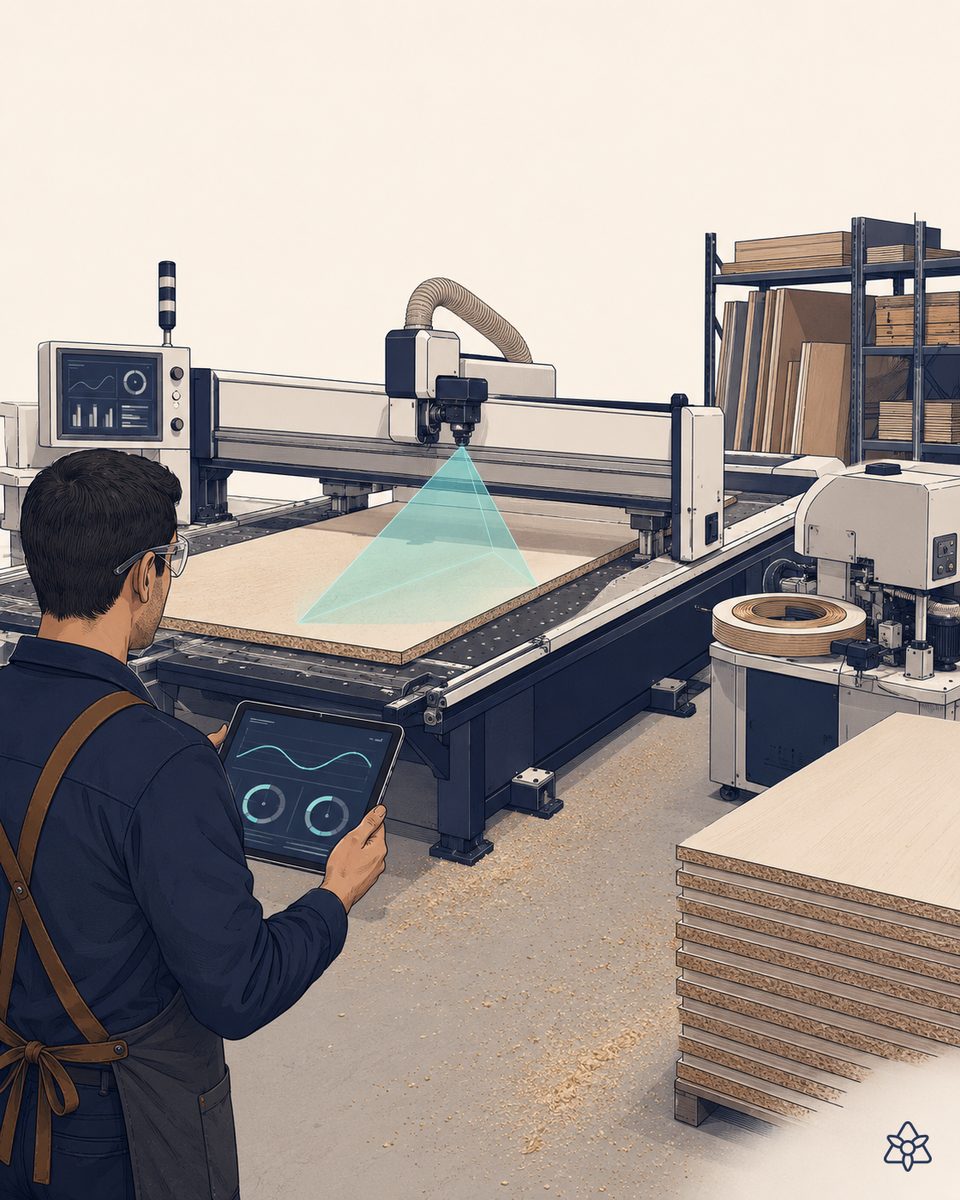
The drying curve gets drawn at the end — when it can no longer be corrected.
A sawn timber drying kiln works with three realities at once:
- The actual load — species, board thickness, initial moisture content, density. It is almost never 100% homogeneous: the oak from the previous run and the pine in the current one do not dry the same way.
- The relative humidity curve inside the kiln — the one that decides whether the face of the board loses water faster than the core. If that difference gets out of hand, the internal stress opens the wood up.
- The kiln lead's schedule — years of craft, a handwritten sheet with the schedule for each species and thickness, and a safety margin that stretches the cycle out.
The operator checks the kiln two or three times per shift, looks at the wall hygrometer and decides by eye. And when the kiln is opened at the end of the cycle, they discover stacks with end splits or warped boards. The defect could be seen coming hours earlier in the curve — but the curve gets drawn on paper, afterwards. Without real-time capture no agent is worth anything: joined-up data with no agent is a library with no librarian.
iLEAN Edge sees the curve live — and warns before the board breaks.
The problem with drying is not a lack of technology in the kiln: the burner, the fans and the spray control are fine. The problem is that nobody is reading the curve in real time and cross-referencing it with the actual load. iLEAN acts as the putty between what the kiln does and what the operator knows: an Edge terminal with probes and a model that proposes corrections before the damage happens.
Edge sees the curve live. The on-board model anticipates the check. The operator corrects from the same panel as always. The kiln itself is left untouched.
The iLEAN pieces applied to humidity control in a sawn timber drying kiln:
- Edge — the eyes inside the kiln. A terminal with relative humidity and temperature probes distributed through the kiln. It reads the curve in real time at a useful frequency (not once per shift) and an on-board model compares it with the schedule for that load (species, thickness, initial moisture). It works with no network: if the plant loses WiFi, Edge keeps reading and proposing corrections on the kiln's own power.
- Connect — capture from the kiln's PLC/SCADA. If the kiln already has a PLC with burner, fan and setpoint data, Connect integrates it without touching anything. If it does not, the Edge probes are enough. The capture level adapts to whatever kiln you have.
- Agent — the kiln lead's knowledge, captured. Every cycle that ends well becomes permanent data. The model learns which curve worked with which load, and that library of real schedules replaces the handwritten sheet. The day the kiln lead retires, their veteran eye is already inside the system.
Drying by eye vs. a kiln with an iLEAN edge sensor
| Aspect | Hygrometer + handwritten schedule | With iLEAN Edge on the kiln |
|---|---|---|
| Humidity reading frequency | Two or three times per shift | Continuous, probe by probe |
| Deviation detection | When the kiln is opened at the end | Hours earlier, during the cycle |
| Drying schedule | Handwritten sheet, in the lead's head | Library of real captured curves |
| Safety margin | A cycle longer than it needs to be | Curve tuned to the actual load |
| Operation with no network | n/a | Edge keeps going on the kiln's own power |
| Changes to the kiln PLC/SCADA | n/a | Zero — a proposal to the operator |
Impact estimate for your plant — to be validated with your numbers.
The block below is an estimate to be validated with the specific data of your plant. We put it forward so the committee has an order of magnitude; we refine it during the diagnostic.
- Sawmill or drying facility with 1-3 kilns, mixed species (pine, oak, eucalyptus) and thicknesses between 25 and 50 mm.
- Edge pilot on one kiln: distributed probes, on-board model, dashboard for the operator. First value within a few weeks: deviations anticipated inside the cycle.
- Indicative payback between 4 and 9 months, depending on m³ dried per year and the current end-split rate documented at unloading.
- Hard levers: reduction of split timber ≥ 30%, shorter cycle with no added risk (more turns per year through the kiln), and the kiln lead's knowledge captured as permanent data.
And the kiln lead's reasonable doubt
“What if the AI tells me to correct, gets it wrong, and wrecks the run?” — the decision is always signed by the person. The on-board model proposes; the kiln lead decides whether to apply it. And because the task is anchored (read a probe, compare it with the schedule) rather than free generation, the best models brought error below 1.5% [1]. What changes is not that the AI decides on its own; it is that the kiln lead walks in at 8 a.m. and already has, on the desk, the real curve from the night shift and a concrete proposal. A warm bed.
[1] OpenAI paper “Why Language Models Hallucinate”, 2025 — on the reliability of AI in anchored tasks.
What people ask about humidity sensors in a sawn timber drying kiln
What causes checks and end splits in sawn timber during drying?
The moisture difference between the core and the surface of the board. If the kiln dries too fast, the face loses water before the core does and the internal stress opens the wood up — the check is the crack you can see, the end split is the opening at the end grain. The ideal kiln curve depends on the species (pine vs. oak vs. eucalyptus), board thickness, initial moisture content and kiln load. When it is done by eye, the operator plays it safe and stretches cycles out — or overshoots and the board splits. Both fail for the same reason: nobody is reading the curve in real time.
How does an iLEAN edge humidity sensor differ from a conventional hygrometer?
The edge sensor is a terminal with one or several relative humidity and temperature probes distributed through the kiln — plus an on-board model that reads the curve, cross-references it with the drying schedule and the actual load (species, thickness, initial moisture) and proposes corrections to the operator. A conventional hygrometer gives you one point and one value; the edge gives you a curve, a deviation and a proposal. And all of it with no network — it runs on the kiln's own power, because what is critical cannot depend on WiFi.
Do I have to replace the kiln or the existing control system?
No. iLEAN does not replace the kiln's PLC or SCADA. The Edge terminal is installed in parallel, reads through its own probes (or, where they exist, through the PLC's probes via Connect) and proposes adjustments that the operator applies from the same panel as always. The kiln, the burner, the fan — everything stays where it is. Without throwing away anything you already have, the problem of drying by eye goes away.
Does it work with every species (pine, oak, eucalyptus, beech)?
Yes, because the model does not assume a universal curve — it learns from your kiln's history. The drying schedule for 50 mm oak is not the one for 25 mm radiata pine, and nobody knows that better than your kiln lead. What iLEAN does is capture that knowledge as permanent data: the curves that work in your kiln with your product become the base the model works from. The day the kiln lead retires, the knowledge does not walk out with them.
How much does it cost to implement the edge sensor in a drying kiln?
A typical pilot covers one Edge terminal, relative humidity and temperature probes for one kiln, integration with the existing PLC/SCADA and a dashboard for the operator. First value expected within a few weeks. Indicative payback between 4 and 9 months, depending on the volume of m³ dried and the current loss rate from checks and end splits. The hard lever is twofold: scrap avoided (every damaged m³ is direct scrap) and a shorter cycle with no added risk (more turns per year through the kiln). We ask for your plant's data and send you the estimated ROI in 48h.
More cases in other sectors
- Flatness and thickness in phenolic plywood — an out-of-tolerance panel is a permanent imprint on an exposed concrete wall.iLEAN Vision validates the flatness and thickness of every phenolic plywood panel with 3D vision at end…
- Phenolic plywood formwork inspection — a defect that transfers to exposed concrete is an urgent replacement on site.iLEAN Vision inspects surface defects in phenolic plywood formwork for civil works. It holds the panel…
- Recalling a PVC edge band batch: either you know which projects carry it, or you stop everything.How iLEAN Tracer links PVC edge band batch, melamine board and office project for precise recalls…
- Shop-site coordination for custom wood-aluminum windows — a measurement that arrives late is a part already cut that starts over.iLEAN Agents coordinate the joinery shop and the job site for custom wood-aluminum windows. They capture…
- UV varnish defect detection on lacquered doors — a crater spotted after the UV tunnel is another full booth cycle.iLEAN Edge detects UV varnish defects (craters, dust, sags, low film build) on lacquered doors in line,…
- Helicopter MRO with AI — the aircraft does not fly again until the Form 1 adds up.How iLEAN cross-references visual inspection, NDT, OEM manuals and airworthiness directives to return…
Tell us your case and in 48h we'll send you the estimated ROI of the edge humidity sensor for your kiln.
We work on your plant's real data, not ours. Diagnostic with no commitment.
Request estimated ROI in 48h See furniture & wood