Phenolic plywood formwork inspection — a defect that transfers to exposed concrete is an urgent replacement on site.
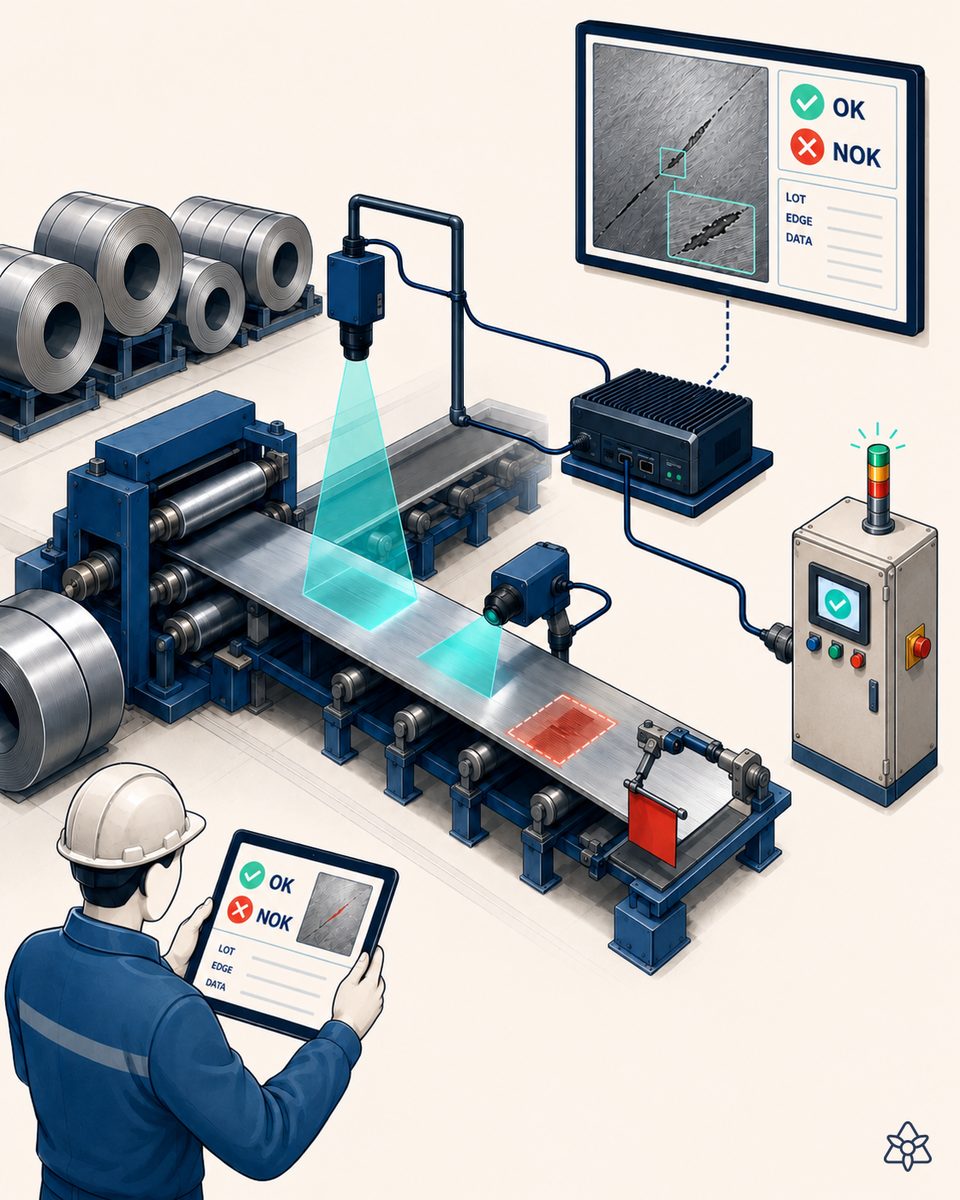
In phenolic plywood formwork, the defects that matter are the ones that transfer to the concrete: bubbles, delamination, scratches, badly executed patches. iLEAN Vision is an Edge terminal with a CNN trained on your quality team's real criteria, which classifies panel by panel at the press outfeed and holds the ones that do not meet spec for rework or class B. The person signs — the pallet does not leave for the site on its own.
The site customer does not see the statistics — they see the specific panel, from 50 meters away.
A phenolic plywood formwork panel lives four lives: you press it, you ship it, it travels to the site, it is assembled as formwork and, once the forms come off, its imprint stays in the concrete. If everything goes well, it lasts dozens of cycles. If a defect slipped past manual sampling, it shows up when the wall is standing and the civil works customer (general contractor, site engineer, owner) points at it from 50 meters away: there is an adhesive mark here, a raised blemish there, and over there you can see the wrinkles in the phenolic film.
Classic inspection works statistically — targeted sampling, the operator's eye, the quality manager's judgment — and that is usually enough for 99% of the panels. The problem is that with exposed concrete the remaining 1% is not an incident: it is an urgent replacement on site, with a compound cost:
- The product received on site that gets rejected at stripping, with reverse transport or destruction.
- The formwork assembled with that panel, concrete poured, defect invisible until the mold is removed.
- The urgent replacement with stock product or prioritized production, to keep the site from stopping.
- The damage to the account — the general contractor who asks for different terms on the next contract, or switches supplier.
Sampling is not the problem; the problem is that sampling lets through whatever goes onto the pallet between samples, and that pallet is hundreds of kilometers away before anyone finds out. Inspecting 100% in line changes the economics of shipping.
iLEAN Vision does not replace the quality manager — it seals the cracks between his judgment and each specific panel.
The problem is not a lack of judgment: your quality manager knows perfectly well which defects to reject. The problem is that one person cannot look at every panel, panel by panel, face A and face B, across three shifts. iLEAN acts as the putty between quality's criteria and the line, without asking you to change the press or the sander.
Vision sees every panel with your team's criteria. Connect reads the batch's destination (exposed concrete formwork vs. standard formwork). The agent classifies, holds the critical ones and leaves the dossier behind. The person signs — never the other way round.
The iLEAN pieces applied to phenolic plywood inspection:
- iLEAN Vision (Edge) — a terminal with machine vision (CNN) and industrial cameras with grazing light (to capture relief in the phenolic surface) and reflected light (to capture adhesion and adhesive marks). It classifies panel by panel, face A and face B, labels each defect critical/cosmetic/acceptable according to your team's real criteria, and triggers the diverting actuator. It works without a network: as long as the terminal has power, the CNN runs inference locally.
- Connect — reads the batch's destination in the MES or ERP (exposed concrete formwork vs. standard formwork) and applies the right acceptance threshold. It also captures what arrives from outside the system (a site customer's specification by email, a change of criteria for fine-finish concrete) at second zero.
- Agent — cross-references the panel image, the batch destination, the customer's criteria and the line's history. It builds the per-pallet dossier with a photo of every panel and the reason for its classification; if the line builds up an anomalous pattern (more bubbles than usual, a lighting drift), it alerts the shift lead on whatever channel he uses. The person validates the borderline cases and signs; the pallet does not leave on its own.
Manual sampling + operator judgment vs. 100% inspection with iLEAN Vision
| Aspect | Manual sampling | With iLEAN Vision + Connect + Agent |
|---|---|---|
| Inspection coverage | Targeted sampling, borderline cases by eye | 100% of the panels, face A and face B |
| Critical vs. cosmetic defect | Judgment of the operator on shift | CNN trained on the quality team's criteria |
| Adapting to the batch destination | Written procedure, depends on who passes the word | Connect reads the destination and applies the threshold |
| Detection before shipping | At the final pallet or on return from site | In line, panel by panel |
| Operation without a network | n/a | Vision keeps classifying as long as the cabinet has power |
| Evidence for the contractor | Manual reconstruction of the pallet | Photo per panel + classification + reason |
Impact estimate for your plant — to be validated with your numbers.
The block below is an estimate to be validated with the specific data of your plant. We put it forward so the committee has an order of magnitude; we refine it during the diagnostic.
- Phenolic plywood plant with one press+sanding line, a mix of standard formwork and formwork for exposed concrete, with documented returns from sites over recent years.
- Vision pilot at the press or sander outfeed (industrial camera with dedicated lighting + Edge terminal with CNN + sorting actuator + integration with the MES). First value expected within a few weeks, with the first run classified automatically.
- Indicative payback between 4 and 9 months, depending on volume, the historical frequency of on-site replacements and the share of production destined for exposed concrete.
- The hard lever is every urgent replacement avoided: product pulled from the site, reverse transport, schedule stoppage, risk to the account. Expected reduction of returns for visible-face defects ≥ 30% against the baseline.
And the quality manager's reasonable doubt
“What if the AI approves a panel with a critical defect?” — hallucination is a problem of free generation, not of anchored tasks. In tasks where the AI merely compares an image against closed criteria learned from your team, the best models brought the error below 1.5% [1]. And even so, what is critical is never decided alone: iLEAN holds the borderline cases and the person signs. The three safety rings exist precisely for this.
[1] OpenAI paper “Why Language Models Hallucinate”, 2025 — on the reliability of AI in anchored tasks.
What people ask about phenolic plywood formwork inspection
Which defects matter in phenolic plywood for formwork?
The defects that matter in phenolic plywood formwork are the ones that transfer to exposed concrete: bubbles, wrinkles or delamination in the phenolic surface film, scratches or cuts that break the film, adhesive squeeze-out marks along the edges, badly executed repair patches and flatness defects that leave their imprint on the visible face of the concrete. On standard formwork the waste is lost service cycles; on a civil works project with exposed concrete it is a panel of wall that the end customer sees from 50 meters away — and demands to have replaced.
How does iLEAN Vision tell a critical defect from a cosmetic one?
iLEAN Vision is an Edge terminal with machine vision (CNN) trained on real patterns from your plant — the defects your quality team already flags as critical are labeled critical; the cosmetic ones as cosmetic. An industrial camera with grazing light to capture surface relief and reflected light to capture adhesion, over the outfeed belt of the press or the sander. The CNN classifies panel by panel and sends to the actuator only those that meet the criteria — the rest go to class B, rework or scrap, with a photo and a recorded reason. The line does not decide alone: the operator reviews the borderline cases.
Why automatic inspection on phenolic formwork instead of manual sampling?
Manual sampling works statistically, but the civil works customer does not see the statistics — they see the specific panel. And phenolic formwork panels travel in pallets of dozens of units to sites hundreds of kilometers away. Catching the defect in the plant, before shipping, avoids the compound cost: product received on site, formwork assembled, concrete poured, defect found at stripping, urgent replacement, schedule damage. Inspecting 100% in line changes the economics of shipping.
Does iLEAN Vision work with no network in the plant?
Yes. iLEAN Edge is designed so that the critical cycle does not depend on the internet or on the central SCADA. As long as the terminal has power, the CNN runs inference locally and triggers the actuator. When the network comes back, it syncs the history with the central agent and per-pallet traceability is rebuilt. In a plywood plant with back-to-back shifts and sites waiting for delivery, this is not an option — it is the only defensible architecture to avoid absurd stoppages because the WiFi went down.
How much does it cost and how soon do you see first value?
The order of magnitude of a Vision pilot on a phenolic plywood line covers an industrial camera with dedicated lighting, an Edge terminal with a GPU, a sorting actuator, integration with the MES and per-pallet traceability, plus the license. First value expected within a few weeks, with the first run of panels classified automatically. Indicative payback between 4 and 9 months, depending on volume, the historical frequency of on-site replacements and the share of production destined for exposed concrete. We send you the estimated ROI in 48h using your plant's data.
More cases in other sectors
- Detecting delamination in OSB before the hot press — a badly formed mat is a pallet of scrap.iLEAN Vision detects delamination in OSB before the hot press and holds the stack to avoid structural…
- The PEFC audit is not won during the audit — it is won in the dossier for every batch.How iLEAN Writer assembles the PEFC dossier for the supply chain of veneered MDF interior doors with an…
- Flatness and thickness in phenolic plywood — an out-of-tolerance panel is a permanent imprint on an exposed concrete wall.iLEAN Vision validates the flatness and thickness of every phenolic plywood panel with 3D vision at end…
- Recalling a PVC edge band batch: either you know which projects carry it, or you stop everything.How iLEAN Tracer links PVC edge band batch, melamine board and office project for precise recalls…
- Every split board is direct scrap — and almost always you could see it coming in the humidity curve.How iLEAN Edge measures relative humidity inside the sawn timber drying kiln in real time to prevent…
- Shop-site coordination for custom wood-aluminum windows — a measurement that arrives late is a part already cut that starts over.iLEAN Agents coordinate the joinery shop and the job site for custom wood-aluminum windows. They capture…
Tell us your case and in 48h we'll send you the estimated ROI of this AI project for your phenolic plywood plant.
We work on your plant's real data, not ours. Diagnostic with no commitment.
Request estimated ROI in 48h See wood furniture