The panel saw does not break down during the service window — it breaks down in the middle of peak season.
In a furniture factory, the spindle of the CNC panel saw starts to fail long before the operator can hear it. The vibration signature changes, the current goes up, the bearing temperature drifts — and nobody sees it until the line stops at the worst possible moment. iLEAN Edge learns the healthy signature of YOUR saw and alerts the maintenance technician with enough margin to stop when it suits. The person decides.
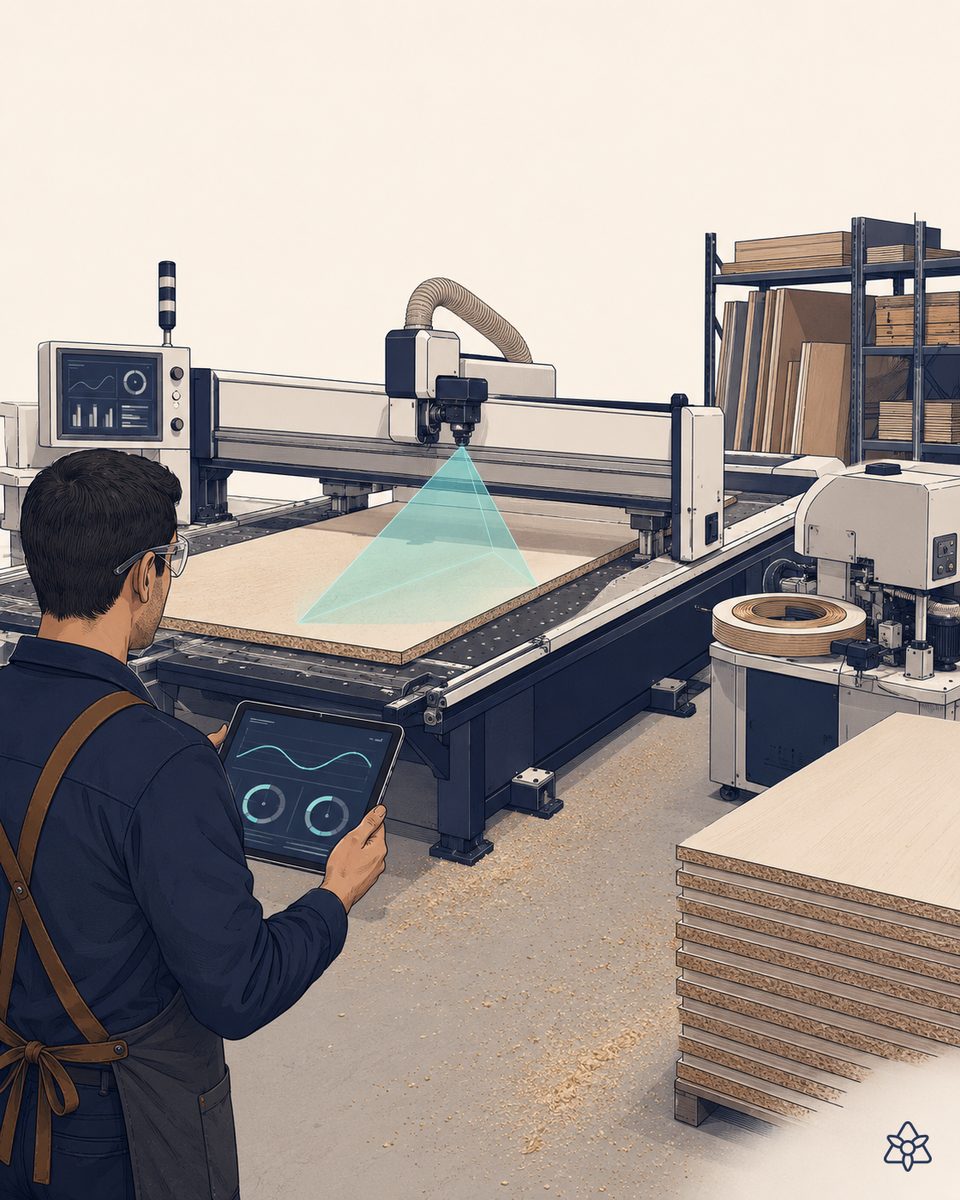
Spindle failure sends signals — but through channels nobody is listening to.
The CNC panel saw is the nuclear piece of a furniture factory — if it stops, the two or three lines that depend on it stop too. The spindle has been giving an early warning for months, sometimes years, that almost nobody is listening to:
- The vibration changes. The bearing starts to wear, the spectral signature in the high band rises. To the operator, the machine sounds “the way it always does”. The change is real, but the human ear only notices it late.
- The motor current rises. The blade loses its edge, the spindle pushes harder to hold speed. The cabinet records it — the ERP never sees it.
- The bearing temperature drifts. Two or three degrees, over several hours, before the breakdown. Nobody with a thermometer was standing next to it.
Corrective maintenance closes the loop at the worst possible cost: the stoppage lands in peak season, when there is a big order and no spare capacity. Urgent bearing repair, a blade broken as the spindle goes, an entire line down for a day or two, a discount for the customer who was waiting for delivery. And a maintenance technician left feeling that “there was nothing to be done” — when there was.
iLEAN does not replace the maintenance technician — it gives him the ears the human ear does not have.
The problem is not a lack of judgment on the technician's part — it is a lack of signal on the channel where he works. iLEAN acts as the putty that connects the vibration sensor with the CNC hour counter, with the blade change schedule and with the order calendar. What is critical — the stoppage — depends on cross-referencing those islands.
Edge listens to the spindle all the time. Connect reads the CNC counter and the blade changes. The agent cross-references the peak season calendar and proposes the optimal stoppage window to the technician. The person decides when and how.
The iLEAN pieces applied to CNC panel saw failure prediction:
- Edge (iLEAN Edge) — a terminal with an accelerometer on the spindle + a temperature sensor + a current reading from the cabinet. A local CNN that learns the healthy signature of your specific saw — not the one from a generic manual. It detects drift in hours, not in days. It works without a network: if the plant loses the internet, the model keeps running on the device and records locally.
- Connect — captures the CNC hour counter, the blade change schedule (the technician's spreadsheet, paper in the office, or the CMMS if there is one), and the operator's informal alerts by WhatsApp (“the saw threw a couple of cuts with an odd mark today”). It all comes in at second zero.
- Agent — cross-references the drifting vibration signature with spindle hours, the change history and the peak season calendar. It proposes the optimal window to the technician: “stop for inspection before the next shift, tomorrow's load is light”. It does not stop the machine on its own. It proposes — the person decides.
Corrective maintenance vs. predictive maintenance with iLEAN
| Aspect | Corrective only + the operator's ear | With iLEAN Edge + agent |
|---|---|---|
| Detecting the wear | Once the spindle already sounds odd | As soon as the vibration signature starts to drift, hours earlier |
| Alerting the technician | “The saw sounds funny” — in person | A notification with a chart and a proposed window |
| Stoppage window | Forced by the breakdown | Chosen in a gap in peak season |
| Blade broken as it fails | High risk when the bearing goes | Changed before the blade suffers |
| Cost of the stoppage | Urgent spare part + downstream line stopped + customer discount | Planned stoppage in a gap |
| The technician's knowledge | It leaves with him | The pattern is captured by the model and shared |
Impact estimate for your plant — to be validated with your numbers.
The block below is an estimate to be validated with the specific data of your plant. We put it forward so the committee has an order of magnitude; we refine it during the diagnostic.
- Furniture plant with one or two CNC beam saws, mixed maintenance (preventive by hours + corrective). Pareto: one saw carries the bulk of the cutting.
- Edge pilot on that saw (accelerometer + temperature + current reading + terminal). First value expected within a few weeks: the healthy signature is learned in a month and the first useful alert comes out within weeks.
- Reduction of unplanned downtime hours in the order of ≥30% conservatively. Every stoppage avoided in peak season pays for the sensor several times over.
- Indicative payback between 4 and 9 months, depending on volume, the age of the machine fleet and the average cost of a stoppage documented over recent years.
And the maintenance director's reasonable doubt
“What if the AI raises a false alarm and stops the saw for nothing?” — hallucination is a problem of free generation, not of anchored tasks. Classifying a vibration signature against a learned pattern is an anchored task — the best models brought the error below 1.5% [1]. And even so, iLEAN does not stop the saw on its own: it proposes a window to the technician, with a chart and a comparison against the healthy signature. The person validates and signs. The saw does not stop on the model's whim.
[1] OpenAI paper “Why Language Models Hallucinate”, 2025 — on the reliability of AI in anchored tasks.
What people ask about CNC panel saw failure prediction
Why does a CNC panel saw fail in a furniture factory?
Because of three things combined: spindle bearings that wear down with cutting hours (a vibration signature that changes long before the operator can hear it), a blade that loses its edge and forces the spindle to push harder, and board dust that gets in where it should not. When maintenance is purely corrective, the stoppage arrives at the worst possible moment — peak season, an order to deliver, a stand-in for the shift lead.
What exactly does iLEAN Edge measure on the panel saw?
It measures spindle vibration with an accelerometer (spectral signature, high band for bearings), motor current where the machine allows it (a symptom of growing load), and temperature near the bearing. The Edge terminal runs the model locally: it learns the healthy signature of YOUR saw (not the one from a generic manual) and raises an alert when it drifts. It also captures, through Connect, the CNC hour counter and the blade change log.
Is it a retrofit on the current CNC saw or do I need a new machine?
A retrofit. iLEAN Edge is installed as a kit on the machine you already have — one or two accelerometers on the spindle, a connection to the cabinet for current, a temperature sensor. The Edge terminal runs inference locally. The saw is still yours; your maintenance technician is still the owner. It fits machines from Holzma, Schelling, Biesse, SCM or from less well-known brands — the vibration signature is learned on your specific saw.
How is the maintenance technician alerted when the vibration signature drifts?
Through the channel the technician uses every day — not one more email in an overloaded inbox. iLEAN Connect delivers the alert to the phone, to the shift earpiece, or to the maintenance system you already use. A clear message: “the vibration signature of the right-hand spindle has been drifting for 6 hours, we recommend stopping before the next shift and checking the bearing”. It attaches a chart and a comparison against the healthy signature. The technician makes the decision — the system proposes.
When do you see the first savings?
The first stoppage avoided pays for the sensor — that usually happens within months, depending on the age of the machine fleet and how intensively it is used. What gets measured in the pilot is: corrective stoppages avoided (factory hours saved in peak season), blades broken by spindle failure avoided, and extended bearing service life (changed when it should be, not sooner and not later). Estimate to be validated with your plant's data. We send you the estimated ROI in 48h using your numbers.
More cases in other sectors
- A FAI eats up days per partiLEAN runs FAI with 3D vision + a virtual CMM and generates the AS9102 report automatically.
- Furniture and wood — the defect that gets past the saw ships as a finished part.Documented iLEAN cases in furniture and wood: board defects, FSC/PEFC and EUDR traceability, pressing…
- The AI Act and automated inspection in furniture — relax: your camera looks at boards, not people.Visual product inspection is minimal risk under the AI Act when there is human oversight: the camera…
- A loose cup hinge is not visible in the factory — it shows up in the customer's kitchen.How iLEAN Vision inspects cup hinge boring and assembly in volume-produced kitchen cabinets — before the…
- E1 formaldehyde control in CARB 2 export MDF — customs holds the shipment, the plant pays for it.How iLEAN Edge inspects E1 formaldehyde emissions in MDF exported to the US under CARB 2 and holds the…
- EUDR forest certificate OCR for tropical veneer — the premium door will not be lacquered if the paperwork does not close.iLEAN Connect reads forest certificates and EUDR due diligence for tropical veneer in premium doors. It…
Tell us your case and in 48h we'll send you the estimated ROI of this AI project for your furniture factory.
We work on your plant's real data, not ours. Diagnostic with no commitment.
Request estimated ROI in 48h See wood furniture