Capturing the master carpenter's knowledge before retirement — the day he leaves, half the plant leaves with him.
The master carpenter who selects the lumber, knows when the varnish is right and tunes the jointer plane by the sound of the motor carries the most valuable knowledge in the factory in his head — and the worst protected. iLEAN Connect digitizes it through whatever channel he uses (voice, photo, short video, dictation), without asking him to learn a new system, and turns it into a permanent capability of the plant. The person signs every captured card.
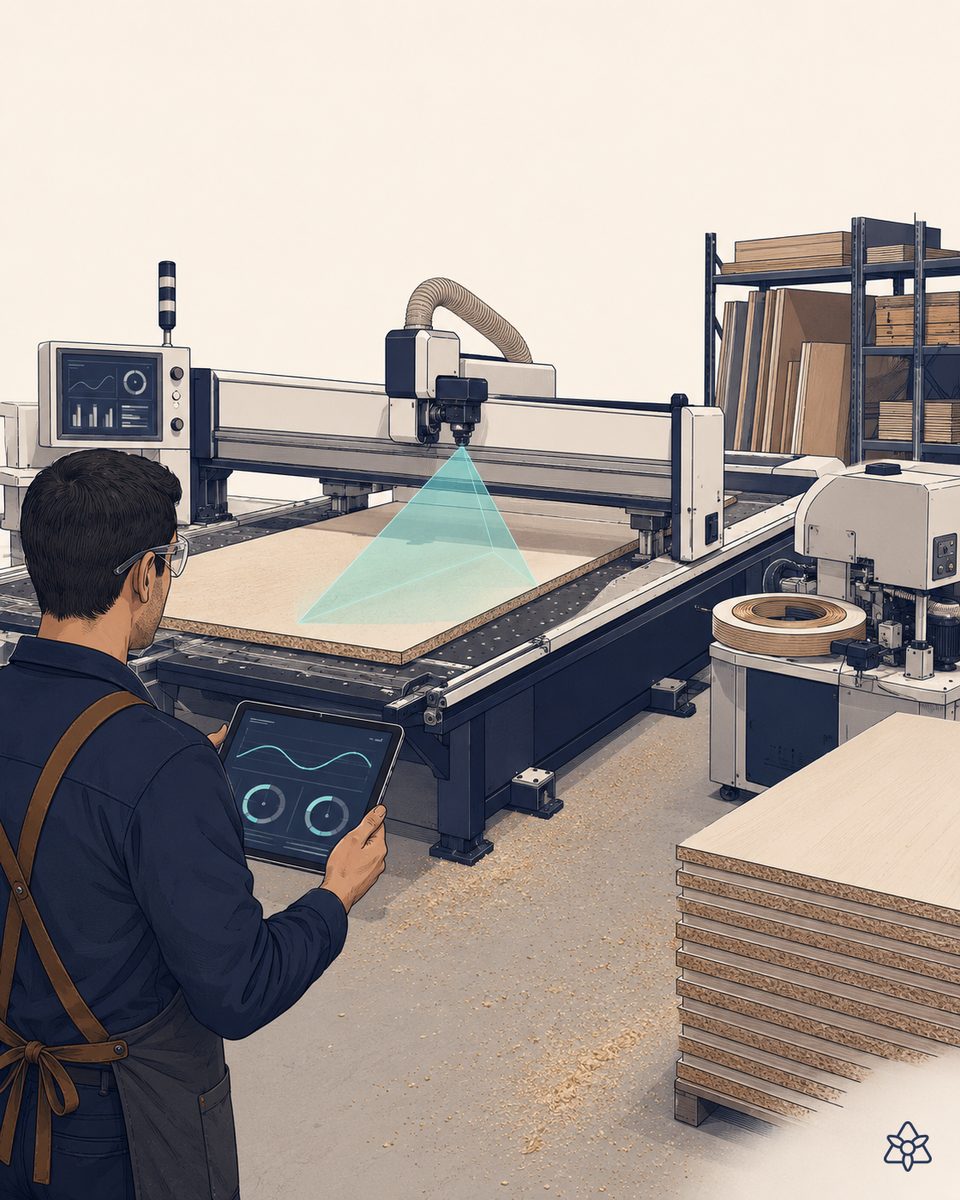
The biggest island in your plant lives in one person — and one day he walks out.
In a custom millwork factory, the most valuable knowledge does not live in the ERP, or in the MES, or in any manual. It lives in the master: in how he separates an oak board that “will split” from one that “will hold”, in how he recognizes that the varnish is “just right” by sheen and touch, in the millimeter adjustment he asks of the planer before every shift — the one that takes ten years of craft to learn to hear.
That is what the book calls the knowledge island: the biggest of all the data islands, the one that sits in no system, the one worth the most and the worst protected. And the math is merciless: the day the master retires, half the plant walks out with him. Apprentices learn in a fraction of the time, of course — but what they learn is not the same, and the error curve of the first years is a direct cost in scrap and rework.
The problem is not that the master doesn't want to teach: he teaches whoever is next to him. The problem is that knowledge only transfers when there is an apprentice standing beside him at the exact moment, and that no longer happens often enough. The result: when retirement arrives, what he had in his head disappears. The classic system (a notebook + oral transmission) worked when there were a hundred apprentices per master. Not anymore.
iLEAN Connect doesn't turn the master into a typist — it captures what he does naturally and turns it into the plant's heritage.
The problem is not a lack of technology for writing manuals: there have already been attempts to document the master's knowledge with forms, internal handbooks, formal videos — and almost all of them died because the master is not a technical writer, and forcing him to become one takes time away from his craft. iLEAN acts as the putty that fills the gap between what he does every day and a system the apprentice can inherit.
Connect captures the master through his natural channel: voice, photo, dictation. The agent normalizes and organizes. The apprentice asks and receives the answer with the authorship acknowledged. The person signs — never the other way around.
The iLEAN pieces applied to capturing the master carpenter's knowledge:
- iLEAN Connect — inward listening across the plant: each person carries a phone + earpiece, online, full duplex. The master dictates the criterion while he works (“I'm rejecting this board, look at the grain, it will split in the planer”), shows the board to the camera, sends a photo of a hand-drawn plan. Connect digitizes photo, voice and image, and everything becomes usable data with no forms. Two-way: the apprentice asks the assistant and receives the answer with the master's voice or text, under his name.
- iLEAN Agents — the brain. They normalize the captured content, organize it by process (lumber selection, machine adjustment, finishing criteria), cross-reference it with the specific part the master was handling, and build the criterion cards. When a new supplier or an unfamiliar tropical wood arrives, the agents bring the master's relevant criterion to the place where it is needed.
- Central — keeps the heritage. Criterion cards are versioned, signed by the master, accessible to the next generation. The knowledge island stops being an island: it is now a capability of the factory.
Oral transmission with an apprentice at hand vs. natural capture with iLEAN Connect
| Aspect | Classic oral transmission | With iLEAN Connect + Agents |
|---|---|---|
| Transmission trigger | An apprentice present at the exact moment | The master dictates whenever it strikes him — natural voice |
| Coverage | Only the criteria the apprentice happened to see | Everything the master decides to share |
| Medium | The apprentice's memory, a personal notebook | Audio + photo + versioned card, author's signature |
| Future access | If the apprentice is still at the plant — and remembers | Anyone asks and gets the answer |
| Retirement risk | Total loss of the island | Knowledge remains as a permanent capability |
| Effort for the master | Repeating the same thing many times | Say it once, it stays on record |
Impact estimate for your plant — to be validated with your numbers.
The block below is an estimate to be validated with the specific data of your factory. We put it forward so the committee has an order of magnitude; we refine it during the diagnostic.
- Custom millwork factory with one or two masters expected to retire in the next few years, a young team in training, no consolidated internal manual, critical knowledge about lumber selection, machine adjustment and finishing criteria.
- Connect pilot for knowledge capture (phone with earpiece + normalizing agent + apprentice access by voice). First value expected within a few weeks with the first criterion cards captured and consulted.
- Indicative payback between 4 and 9 months, depending on the volume of knowledge exposed to retirement and the error curve of new staff during the first year.
- Expected reduction of junior-staff errors in lumber selection or machine adjustment ≥ 30% in the first year. The hard lever is what the first big mistake would have cost in scrap, replacement and lead time.
And the production manager's reasonable doubt
“What if the AI rephrases what the master said and kills the nuance?” — hallucination is a problem of free generation, not of anchored tasks. In tasks where the AI merely transcribes voice, links it to the photo and organizes it by process (without rewriting the criterion), the best models brought error below 1.5% [1]. And even so, the card is always stored with the master's original voice and his name: the summary is navigation, not substitution. The person signs every captured card.
[1] OpenAI paper “Why Language Models Hallucinate”, 2025 — on the reliability of AI in anchored tasks.
What people ask about capturing the master carpenter's knowledge
What kind of master carpenter knowledge needs to be captured?
The master carpenter's tacit knowledge is not written in any manual: when an oak board is “good” by eye and by touch (grain, color, fiber direction), when the varnish “grabs” and when it doesn't, what adjustment the jointer plane needs judging by the sound of the motor, how the shop's winter humidity is compensated with an extra drying pass, which glue supplier causes trouble on tropical wood, how to spot a problem knot before it breaks the tool. These are criteria that live in the person's head and in his hands. The day he retires, they leave with him.
How does iLEAN Connect capture that knowledge without the master having to learn a system?
Through the channel he already uses — and above all, by voice. A phone with an earpiece, online, full duplex. The master tells the system “I'm rejecting this board, look at the grain, it will split in the planer” and shows the board to the camera; the system records audio + photo and it is stored as a captured criterion. A photo of a hand-drawn plan, a dictated tolerance, a comment at the end of the shift. Connect ingests it, normalizes it and the agents cross-reference it with the specific part — no forms, no new system to learn.
What is that knowledge good for once it is captured?
Captured knowledge becomes a permanent capability of the plant. The young hire who starts tomorrow can ask the assistant: “how do I tell a good board from a bad one for the planer?” and gets the answer with the master's criteria and the photo he left behind. The production manager can review the master's rejection pattern and cross-reference it with the supplier's batch to anticipate problems. The knowledge island — the most valuable of all and the worst protected — stays inside the system with its author acknowledged.
Is this about replacing the master? Like making a digital version of him?
No. iLEAN assists and simplifies — it does not replace. The master is still the master as long as he is at the plant — all the system does is turn his judgment into something the next generation can inherit, instead of losing it. And while he is there, the system takes the dumb work off his plate: filling in a report, writing an email, repeating the same thing three times to three apprentices. The judgment is still his; the paperwork stops being his.
How much does it cost and when does the first value show up?
An iLEAN Connect pilot for capturing the master's knowledge covers the operator's equipment (phone with earpiece or tablet), the multichannel capture flow (voice, photo, dictation), the agent that normalizes the content and the license. First value expected within a few weeks with the first criterion cards captured — of the kind “how I select an oak board for a cabinet front”. Indicative payback between 4 and 9 months, depending on the volume of knowledge exposed to retirement and the cost of each error the capture prevents. We send you the estimated ROI in 48h with your plant's data.
More cases in other sectors
- Your flat-pack kitchen is not judged in the factory — it is judged by the fitter in the customer's home.How iLEAN coordinates just-in-sequence assembly of flat-pack kitchen furniture with an agent that…
- The hinge cup works loose two months after installation — and nobody knows why.How iLEAN Brain infers the root cause of loose hinge cups in kitchen cabinets by cross-referencing board…
- Loose knots in solid pine: what breaks a bunk bed is not what you see on the inspection table.How iLEAN Vision detects loose knots and resin pockets in solid pine before cutting, preventing rejected…
- Melamine facing scrap reduction on chipboard — a defect found after the cut is a whole module in the bin.iLEAN Vision spots bubbles, lifted edges and press marks on the melamine facing line over chipboard. It…
- Your multi-opening board press has no API — and your ERP needs the data anyway.How iLEAN captures the analog panel of a multi-opening board press without replacing PLC or SCADA: a…
- Detecting delamination in OSB before the hot press — a badly formed mat is a pallet of scrap.iLEAN Vision detects delamination in OSB before the hot press and holds the stack to avoid structural…
Tell us your case and in 48h we'll send you the estimated ROI of this AI project for your millwork factory.
We work on your plant's real data, not ours. Diagnostic with no commitment.
Request estimated ROI in 48h See furniture and wood