Your multi-opening board press has no API — and your ERP needs the data anyway.
In almost every board plant (particleboard, MDF, plywood) the main press is the most expensive machine, the oldest one, and the one that talks worst to the rest of the system. iLEAN Connect captures the analog panel of the multi-opening press — cycle, pressure, temperature per opening — without replacing PLC or SCADA, and delivers the data to the ERP at second zero. The person signs — the press is never touched.
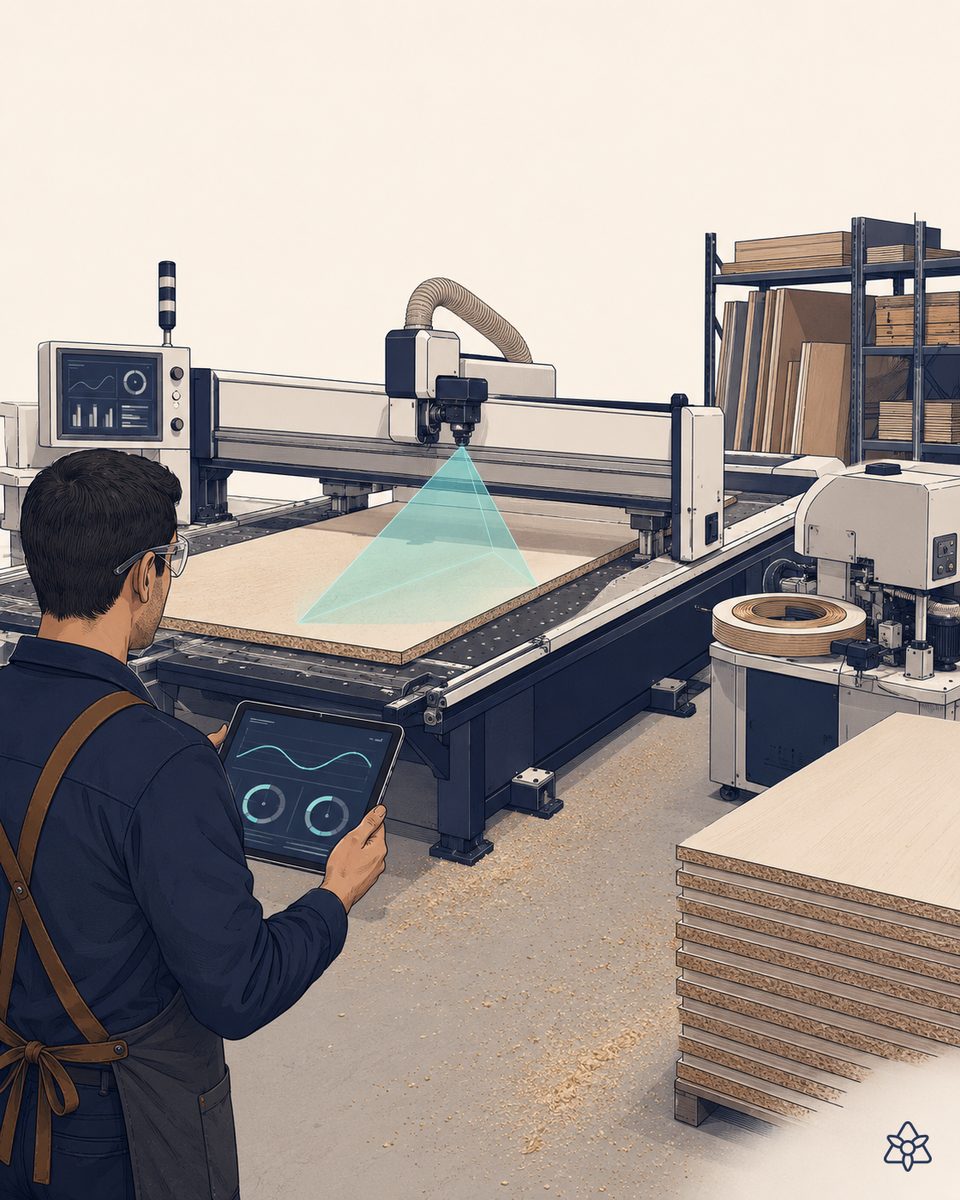
The press is the heart of the plant — and the darkest corner of your data.
The multi-opening press is the single largest investment in a board plant. It is also the machine that integrates worst: a PLC from decades ago, proprietary drivers, an analog panel with needle gauges or 7-segment displays, a local SCADA that barely pushes any data outside. When the ERP needs to know the real cycle per opening — for planning, for quality, for traceability — the answer is always the same:
- The operator writes it down on a sheet. If they forget, there is no data. If they write it down wrong, the data lies.
- A custom integration gets built with the press manufacturer. It takes months, serious money, and the maintenance manager does not want to sign off on the downtime.
- Everyone accepts that this machine is an island and keeps planning by feel. That is the "spreadsheet + experience + fingers crossed" model.
The result: the most expensive asset in the plant is the one that yields the least information. And the knowledge of how the press really behaves lives in the head of the press lead — the biggest island of them all, the one that is in no system, and the one that walks out the door the day that person retires.
iLEAN Connect reads the panel the way an operator would — and touches nothing.
The problem with an old press is not that the data does not exist: it is that the data is locked inside a machine that tells nobody about it. iLEAN acts as the putty that seals that crack: a camera facing the panel, a vision model that reads the displays opening by opening, and an agent that packages the data and delivers it to the ERP/MES as if the press had had an API all along.
Connect carries. The agents decide. The person signs. The press is never touched.
The iLEAN pieces applied to capturing the multi-opening press panel:
- Connect — capture calibrated to the real state of the machine. If the panel is analog (needles, 7-segment displays, indicator lamps), a fixed camera watches it and the model extracts the value every few seconds. If the press has a local computer, however old and isolated, Connect connects through whatever channel exists (serial port, legacy OPC, flat-file reader) and pulls the data. If it has a modern interface, direct integration. The customer does not have to change the machine.
- Edge — an on-site terminal, with no dependency on the network. The reader lives on an Edge terminal at the line, right by the press. If the plant loses WiFi, the terminal keeps reading and storing locally; when the network comes back, it syncs. What is critical cannot depend on connectivity.
- Agent — packages and delivers. It cross-references the panel reading with the production order in the ERP, tags the cycle to its batch and its opening, and pushes the data to ERP/MES/BI with the signed JSON of the middle ring. If it detects a deviation (cycle out of band, low pressure in one specific opening), it does not act alone: it alerts the press lead.
Operator writing it down vs. panel capture with iLEAN
| Aspect | Operator + sheet + spreadsheet | With iLEAN Connect + Edge + Agent |
|---|---|---|
| Data frequency | Once per shift, at best | Every few seconds, per opening |
| Changes to the PLC / SCADA | n/a | Zero — the panel is only read from outside |
| Downtime risk during integration | n/a | None — the press is never intervened |
| Cost of the integration | "Impossible" or six figures of custom work | Typical industrial Edge pilot |
| Time to first data point | Weeks, if the manufacturer is willing | A few weeks, without stopping the press |
| The press lead's knowledge | Lives in their head; leaves with them | Captured as a permanent capability |
Impact estimate for your plant — to be validated with your numbers.
The block below is an estimate to be validated with your plant's data. We put it forward so the committee has an order of magnitude; we refine it during the diagnostic.
- Board plant with one multi-opening press (10-16 openings), proprietary PLC, local SCADA, analog panel at the machine.
- Connect pilot on the main press: fixed camera facing the panel, Edge terminal at the line, integration with ERP/MES. First data expected within a few weeks.
- Indicative payback between 4 and 9 months, depending on how much press cycle time weighs in your cost per m³ of board today and how many "invisible" stoppages end up documented.
- Hard levers: scrap reduction from out-of-band cycles ≥ 30%, better downstream planning, the press lead's know-how captured as permanent data, an automatic dossier for the FSC/PEFC or CARB 2 auditor where it applies.
And the maintenance manager's reasonable doubt
"What if the AI invents a value that was never on the panel?" — hallucination is a problem of free generation, not of anchored tasks. Here the model does not offer opinions: it reads a display, turns it into a number, and the photo itself is stored as evidence. In anchored tasks, the best models brought error below 1.5% [1]. And even so, what is critical is never decided alone: a human validates the data before it affects planning or quality. The three safety rings exist precisely for this.
[1] OpenAI paper “Why Language Models Hallucinate”, 2025 — on the reliability of AI in anchored tasks.
What people ask about capturing a multi-opening press panel
Why not just integrate the multi-opening press through the PLC and be done with it?
Because the PLC is almost always twenty or thirty years old, with proprietary drivers, no living documentation, and sometimes running on Windows 2000 or an embedded OS with no network. Touching it to get data out takes months, serious money and a downtime risk the maintenance manager does not want to sign off. The good news is that it is no longer necessary: iLEAN Connect captures the data from the panel without touching the PLC, reading it the way an operator reads it — with a camera looking at the panel and OCR that extracts the values every few seconds. The PLC stays exactly where it was. The data reaches the ERP all the same.
How accurate is reading an analog panel by vision compared with a real integration?
Accurate enough for the data the plant is asking for: cycle, pressure per opening, platen temperature, alarms. Vision-based reading works because AI has driven down the cost of recontextualization: a vision model turns the image of the display into structured data, anchored to the photo itself (the source is never lost). In anchored tasks — reading a piece of data in one place and putting it in another — the best models brought error below 1.5% according to the OpenAI paper “Why Language Models Hallucinate” (2025). For a press process variable, that accuracy is operational.
How long before the press is actually sending data?
In practice, the first value shows up within a few weeks: mount the camera facing the panel, calibrate the reading zones per opening, connect the output to the ERP/MES. There is no need to stop the press to integrate anything. An iLEAN immersion usually lasts 3-5 days, and by the end the team already has a first agent reading the panel and a dashboard with the data per opening.
What if the camera fails or the plant loses its network?
The camera can fail and the press keeps working exactly as always, because iLEAN does not intervene in critical OT (it never writes to the PLC, it only reads the panel). If the plant loses its network, the Edge terminal hosting the reader keeps running on the power in the cabinet — it stores the data locally and uploads it when the network comes back. What is critical cannot depend on there being WiFi.
How does it fit with the legacy SCADA we already have?
It does not replace it — it sits on top. The SCADA remains the control system for the press; iLEAN acts as putty, filling the gap between the analog panel (which the SCADA never reached) and the ERP/MES (where the data is needed for planning, quality and traceability). The SCADA does not change, does not get upgraded, does not get touched; it simply stops being an island.
More cases in other sectors
- Loose knots in solid pine: what breaks a bunk bed is not what you see on the inspection table.How iLEAN Vision detects loose knots and resin pockets in solid pine before cutting, preventing rejected…
- Capturing the master carpenter's knowledge before retirement — the day he leaves, half the plant leaves with him.iLEAN Connect digitizes the master carpenter's knowledge before retirement: selection criteria,…
- Melamine facing scrap reduction on chipboard — a defect found after the cut is a whole module in the bin.iLEAN Vision spots bubbles, lifted edges and press marks on the melamine facing line over chipboard. It…
- Detecting delamination in OSB before the hot press — a badly formed mat is a pallet of scrap.iLEAN Vision detects delamination in OSB before the hot press and holds the stack to avoid structural…
- The PEFC audit is not won during the audit — it is won in the dossier for every batch.How iLEAN Writer assembles the PEFC dossier for the supply chain of veneered MDF interior doors with an…
- Flatness and thickness in phenolic plywood — an out-of-tolerance panel is a permanent imprint on an exposed concrete wall.iLEAN Vision validates the flatness and thickness of every phenolic plywood panel with 3D vision at end…
Tell us your case and in 48h we'll send you the estimated ROI of capturing your press panel.
We work on your plant's real data, not ours. Diagnostic with no commitment.
Request estimated ROI in 48h See furniture and wood