Melamine facing scrap reduction on chipboard — a defect found after the cut is a whole module in the bin.
On a melamine facing line over chipboard, an adhesion defect (bubbles, lifted edges, press marks, contamination) discovered after the cut-to-size operation turns the module into finished scrap. iLEAN Vision sees it at the press exit, before the cut, and holds the board for rework or for an alternative cutting order where the affected area falls in the offcut. The person signs.
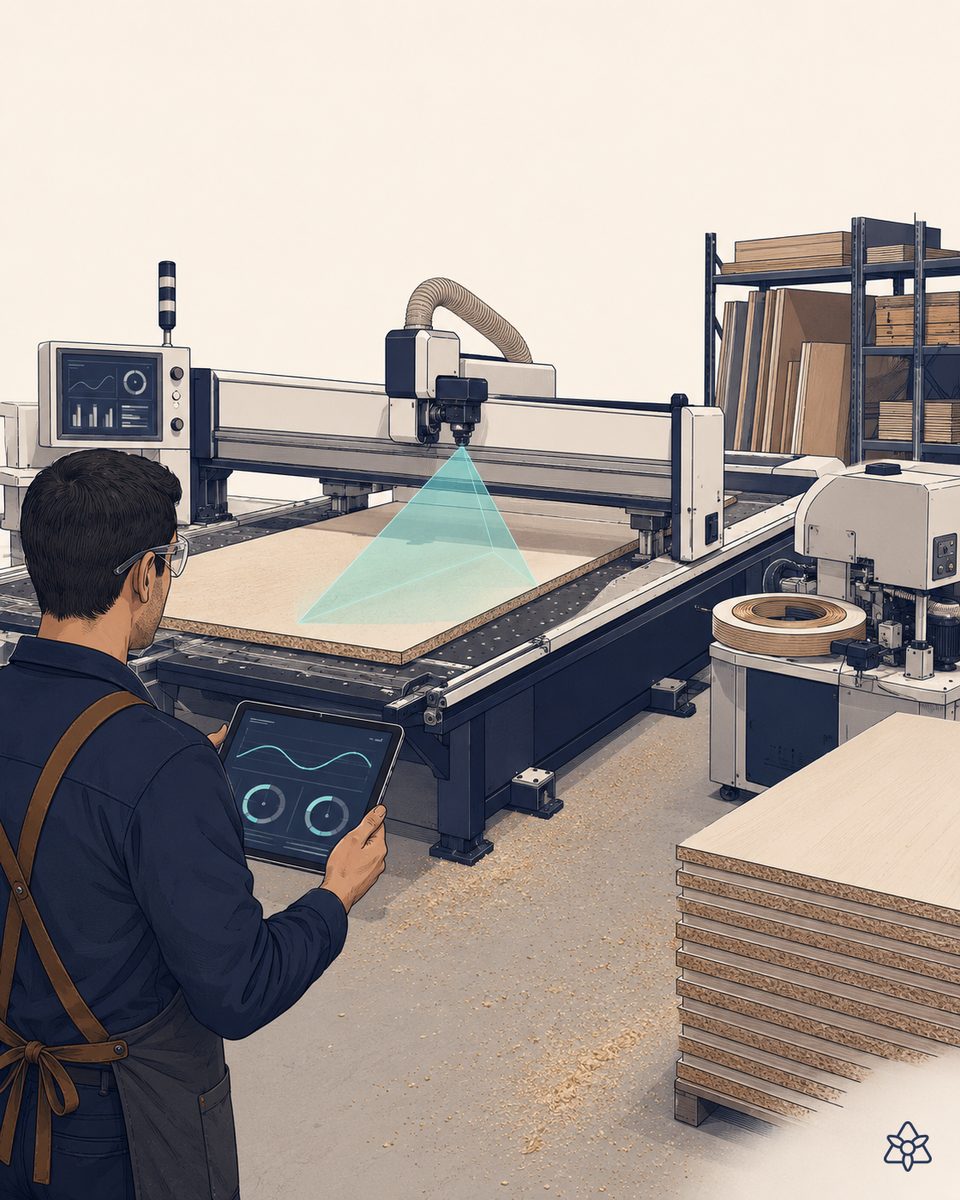
The bubble does not show up until the module is cut and packed.
On a melamine facing line over chipboard, the decorative paper goes into the hot press, bonds to the board through the pressure and temperature cycle, and comes out as a finished board. Most defects — a localized bubble, a lifted edge, a press mark left by a press platen, contamination under the paper — are small and local: they cover a few square centimeters on a 2.8 x 2.1 m board. And they are exactly what the human eye lets through in an inspection at the press exit.
The defects are not the problem. The problem is the moment they are discovered. At an office and flat-pack furniture manufacturer, the melamine board goes from the press to the cut-to-size saw, where it is broken down according to the module drawing (cabinet side panel, drawer bottom, shelf). If the defect falls inside one of the module's parts, that part is finished scrap: it is already cut to the millimeter, edge-banded, drilled and, in some cases, even packed and labeled. The compound cost:
- The whole board lost — if the cut has already run, the affected area drags down the entire yield of the breakdown.
- Added cost of the breakdown — saw, edge banding, drilling and packaging spent on material that is already scrap.
- Kit replacement on end-customer orders with tight lead times.
- Returns of the kits that get past final inspection and reach the user with the bubble in plain sight.
Classic inspection at the press exit (eye + raking light) works 99% of the time. The 1% is what carries the compound cost to the end of the line.
iLEAN Vision does not replace the quality manager — it puts their judgment on every board before the cut.
The problem is not a lack of judgment: your quality manager knows perfectly well which bubble will show on the finished module and which one will not. The problem is that one person cannot look at every board, face A and face B, under two different lights, at conveyor speed. iLEAN acts as the putty between that judgment and the reality of the line, without asking you to change the press or the saw.
Vision sees every board with your team's criteria. Connect reads the destination of the batch (visible module vs. drawer interior). The agent classifies, holds the critical ones and proposes rework or an alternative breakdown. The person signs — never the other way round.
The iLEAN pieces applied to melamine facing scrap reduction:
- iLEAN Vision (Edge) — a terminal with machine vision (CNN) and an industrial camera with combined lighting (raking light to capture the relief of a bubble or a press mark + bright field to capture contamination and paper misalignment). 100% inspection of face A and face B on the press exit conveyor. It works with no network: as long as the terminal has power, the actuator keeps diverting boards to rework.
- Connect — reads the destination of the batch in the MES or ERP (module visible to the end user vs. drawer interior, kitchen front vs. cabinet back) and applies the right acceptance threshold. It also captures what arrives from outside (a US retailer specification, a catalog requirement for an office kit) at second zero.
- Agent — cross-references the board image, the destination of the batch and the planned breakdown pattern. If the bubble falls on a critical module, it holds the board and proposes an alternative cutting order in which the affected area falls in the offcut. The shift lead validates the proposal and signs — the saw does not start on its own on a compromised board.
Eyeball inspection at the press exit vs. 100% inspection with iLEAN Vision
| Aspect | Manual inspection + the eye | With iLEAN Vision + Connect + agent |
|---|---|---|
| Inspection coverage | The operator's glance at conveyor speed | 100% of boards, face A and face B |
| Relief defects (bubble, press mark) | Only the large ones, general raking light | CNN over dedicated raking light |
| Flat defects (contamination, misalignment) | Hit and miss | CNN over bright-field lighting |
| Decision on a compromised board | Full scrap to the bin | Rework or alternative breakdown by destination |
| Operation with no network | n/a | Vision keeps classifying on panel power |
| Traceability per board | Batch level, no detail | Photo per board + classification + reason |
Impact estimate for your plant — to be validated with your numbers.
The block below is an estimate to be validated with the specific data of your plant. We put it forward so the committee has an order of magnitude; we refine it during the diagnostic.
- Office and flat-pack furniture manufacturer, one melamine facing line over chipboard, hot press followed by cut-to-size, monthly scrap documented with photos over recent years.
- Vision pilot at the press exit (camera with dedicated lighting + Edge terminal with CNN + diverter to rework + MES integration for the destination of the batch). First value expected within a few weeks with the first boards classified automatically.
- Indicative payback between 4 and 9 months, depending on volume, current facing scrap % and the average cost of the finished module in a kit.
- Expected reduction of facing-defect scrap ≥ 30% over the baseline. The hard lever is every finished module avoided + every alternative breakdown that saves the board.
And the quality manager's reasonable doubt
“What if the AI passes a board with a hidden bubble and the end customer sees it on their cabinet?” — hallucination is a problem of free generation, not of anchored tasks. In tasks where the AI merely compares an image against closed criteria learned from your quality team, the best models brought error below 1.5% [1]. And even so, what is critical is never decided alone: iLEAN holds the borderline cases and the person signs. The three safety rings exist precisely for this.
[1] OpenAI paper “Why Language Models Hallucinate”, 2025 — on the reliability of AI in anchored tasks.
What people ask about melamine facing scrap reduction
What typical defects does a melamine facing line over chipboard produce?
The typical defects in melamine facing over chipboard are: bubbles of air trapped between the decorative paper and the substrate, lifted edges caused by insufficient pressure or incomplete curing, press marks in areas where the press platen has an imperfection, contamination (dust, chips, glue residue) embedded under the paper, and paper misalignment relative to the board. Any of them goes unnoticed in a quick look, but once the board is cut into kits for office or kitchen furniture, the affected module becomes complete scrap.
Why detect the defect before the cut and not after?
Detecting the defect before the cut-to-size operation radically changes the economics of scrap. A full melamine board found to have a bubble in one localized area can go to rework or to an alternative cutting order where the affected area falls in the offcut and not in a module. Detected after the cut, every defective part is complete scrap of a finished module. The difference between the two scenarios is, directly, raw material yield percentage.
How does iLEAN Vision tell a real bubble from a color variation in the paper?
iLEAN Vision is an Edge terminal with machine vision (CNN) trained on real patterns from your line — the defects your quality manager already flags as critical are labeled as critical. An industrial camera with raking light to capture relief (bubbles, press marks) and bright-field lighting to capture color variations and contamination. The CNN tells a physical defect (a bubble) from the normal pattern of the decorative paper (grain, speckle). Where there is doubt, the person reviews — the system holds, it does not decide alone.
Does iLEAN Vision work without a network in the plant?
Yes. iLEAN Edge is designed so that the critical cycle does not depend on the internet or on the central SCADA. As long as the terminal has power, the CNN infers locally and the actuator diverts the board to rework or to class B. When the network comes back, it syncs the history against the central agent and per-pallet traceability is rebuilt. In a facing plant with a hot press running 24/7, a WiFi outage cannot stop the line — and with this architecture it does not.
How much does it cost and when do you see the first value?
The order of magnitude of a Vision pilot on a melamine facing line covers an industrial camera with dedicated lighting (raking + bright field), an Edge terminal with GPU, a diverter to rework, MES integration for per-board traceability, plus the license. First value expected within a few weeks, with the first run classified automatically. Indicative payback between 4 and 9 months depending on volume, historical frequency of facing-defect scrap and the cost of the finished module in a furniture kit. We send you the estimated ROI in 48h with your plant's data.
More cases in other sectors
- The hinge cup works loose two months after installation — and nobody knows why.How iLEAN Brain infers the root cause of loose hinge cups in kitchen cabinets by cross-referencing board…
- Loose knots in solid pine: what breaks a bunk bed is not what you see on the inspection table.How iLEAN Vision detects loose knots and resin pockets in solid pine before cutting, preventing rejected…
- Capturing the master carpenter's knowledge before retirement — the day he leaves, half the plant leaves with him.iLEAN Connect digitizes the master carpenter's knowledge before retirement: selection criteria,…
- Your multi-opening board press has no API — and your ERP needs the data anyway.How iLEAN captures the analog panel of a multi-opening board press without replacing PLC or SCADA: a…
- Detecting delamination in OSB before the hot press — a badly formed mat is a pallet of scrap.iLEAN Vision detects delamination in OSB before the hot press and holds the stack to avoid structural…
- The PEFC audit is not won during the audit — it is won in the dossier for every batch.How iLEAN Writer assembles the PEFC dossier for the supply chain of veneered MDF interior doors with an…
Tell us your case and in 48h we'll send you the estimated ROI of this AI project for your facing plant.
We work on your plant's real data, not ours. Diagnostic with no commitment.
Request estimated ROI in 48h See furniture & wood