DGA analysis of dielectric oil — a report that arrives late is a transformer that is already failing.
DGA is a good thermometer for a transformer — but it arrives as a quarterly report cut off from everything else. iLEAN Brain cross-references the gas analysis with the real load, the oil temperature and the machine's history, and proposes the intervention before an incipient failure turns into unplanned downtime. The person signs.
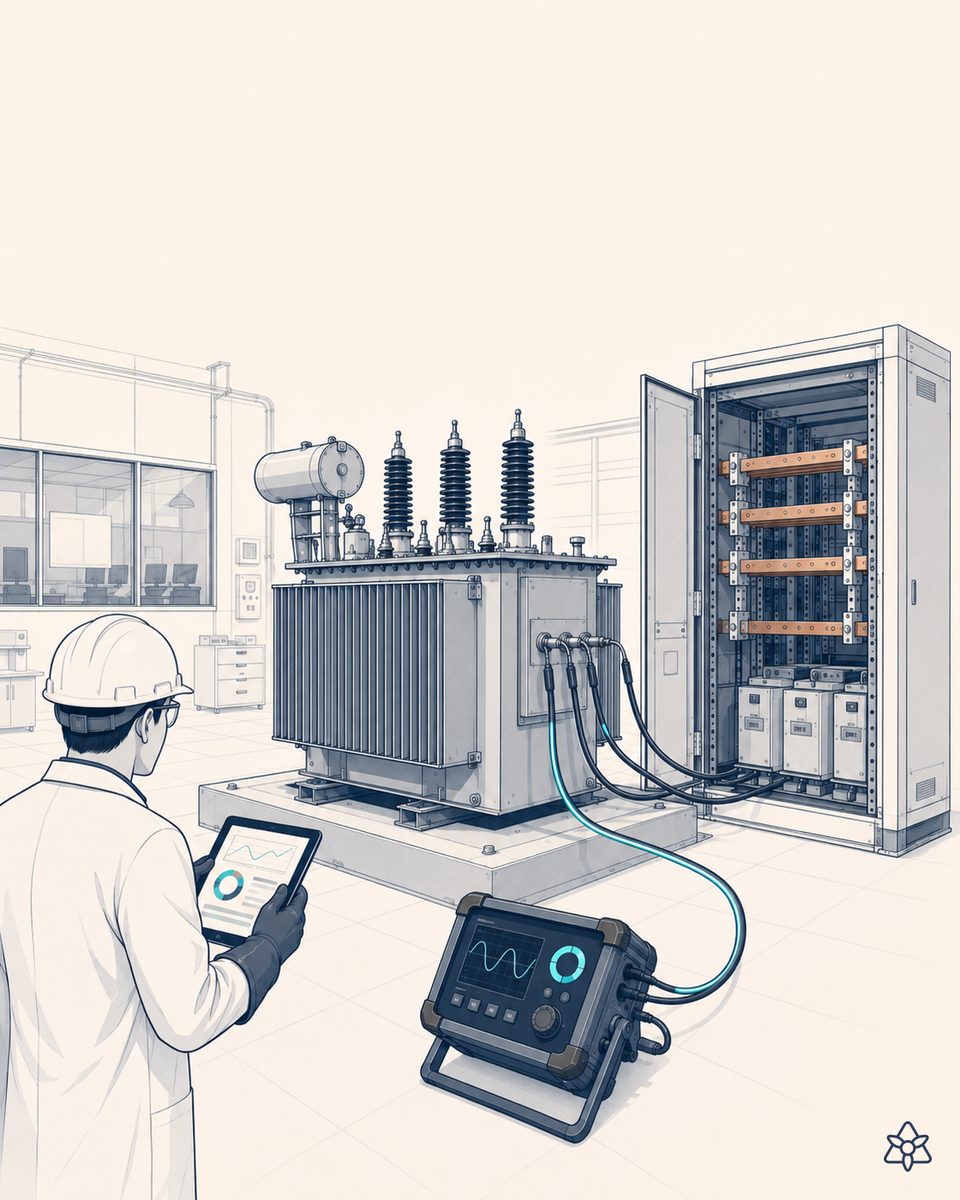
DGA is good; the routine it gets used in, not so much.
Dissolved gas analysis of dielectric oil is one of the most solid predictive techniques the transformer world has. The problem is not the technique — it is how the data enters the operation:
- It arrives as an isolated report. The external lab sends a PDF or a spreadsheet every three or six months. The technician reads it, files it, and if the ratios are within standard that is where it stays.
- It is not cross-referenced with the real load. The same acetylene level means very different things depending on whether the transformer has been running at 90% load through a heat wave or at 40% in winter. The load curve lives in the SCADA and almost never gets looked at next to the DGA.
- It is not cross-referenced with temperature. Oil and winding temperature are the other half of the story. If the fan or the oil pump is running at degraded efficiency, the failure is cooking — and the DGA, read on its own, will not tell you.
- The history gets lost. Each inspection lives in its own PDF; the pattern over time is there, but it has to be rebuilt by hand every time a suspicion comes up.
The maintenance engineer is not short of judgment — they are short of time to do the cross-referencing by hand every time. And that is why an incipient failure, which was sending signals weeks earlier, arrives as a surprise on the day of the unplanned outage.
iLEAN Brain does not replace the engineer — it does the cross-referencing they never have time for.
The DGA lives on an island. The load lives on another one (SCADA). The temperature lives on a third (transformer sensors, sometimes only on a local panel). The history lives in a folder full of PDFs. iLEAN acts as the putty that fills the cracks between those systems and puts the finished cross-reference on the manager's desk.
Brain cross-references DGA with load, temperature and history. When it sees a pattern consistent with incipient failure, it proposes the intervention. The person signs — closing a breaker is never decided alone.
The iLEAN pieces applied to transformer DGA analysis:
- Brain (Agents on Central) — the multi-agent brain that cross-references the DGA with the load curve, the temperatures and the history. It applies the Rogers, Duval and IEEE C57.104 ratio methods, but puts them in the context of what has actually been happening to the machine. When it sees a clear pattern, it opens the intervention proposal.
- Connect — captures the data wherever it lives: the external lab's PDF, the maintenance manager's spreadsheet, a clean SCADA integration or the photo of the analog panel the operator takes on their round. And it also captures what arrives from outside (a heads-up from the lab, a manufacturer alert about a series with a known defect) at second zero.
- Three safety rings — the SCADA's OT network stays isolated. Brain works in ring 3 with the raw data, proposes, and the decision to intervene enters ring 1 signed by the person. AI applied to hacking is real; OT isolation is not paranoia, it is survival.
DGA read on its own vs. DGA cross-referenced with iLEAN Brain
| Aspect | Current routine | With iLEAN Brain |
|---|---|---|
| Useful frequency of the DGA | Quarterly or half-yearly, filed after review | Cross-referenced with load and temperature from the day of the sample |
| Context of the report | Rogers/Duval ratios only | Ratios + load curve + temperature + history |
| Detecting incipient failure | On the day of the unplanned outage | Weeks earlier, with time to schedule the intervention |
| Rebuilding the history | A folder of PDFs, by hand | Trend already plotted, machine by machine |
| Heterogeneous fleet (SCADA + analog) | Each one on its own | Connect reads from whatever source exists, throwing nothing out |
| File for audit / insurer | By hand, weeks | Per-transformer dossier, automatic |
Impact estimate for your plant — to be validated with your numbers.
The block below is an estimate to be validated with the specific data of your fleet. We put it forward so the committee has an order of magnitude; we refine it during the diagnostic.
- Industrial plant or grid operator with several power transformers, periodic external DGA, its own SCADA for load and temperature, and a couple of serious documented incidents in recent years.
- Brain pilot on the critical fleet (3-5 transformers), integrating the lab PDFs with the SCADA readings. First value expected within a few weeks: the cross-referencing done over the existing history surfaces trends that were in the data but that nobody had seen side by side.
- Indicative payback between 4 and 9 months, depending on the documented frequency of incidents and the average cost of unplanned downtime per transformer.
- The hard lever is a single unplanned outage avoided: lost output, emergency repair, temporary replacement, downstream damage. One episode pays for the pilot with room to spare.
- Expected reduction in unplanned outages caused by transformer failure of ≥ 30% against the baseline — conservative, and dependent on the condition of the fleet.
And the maintenance manager's reasonable doubt
“What if the AI invents a trend that isn't there?” — hallucination is a problem of free generation, not of anchored tasks. When the AI merely reads one piece of data and cross-references it with another (DGA against load curve, temperature, history), the best models brought error below 1.5% [1]. And even so, Brain proposes — it does not open the breaker. The person validates and signs. The three rings exist precisely for this.
[1] OpenAI paper “Why Language Models Hallucinate”, 2025 — on the reliability of AI in anchored tasks.
What people ask about DGA analysis with AI
What is DGA analysis and what is it for in a transformer?
DGA (Dissolved Gas Analysis) measures the gases dissolved in the transformer's dielectric oil — hydrogen, methane, ethylene, acetylene, carbon monoxide and carbon dioxide. Each combination points to a different failure mechanism: electric arcing, partial discharge, overheating of the copper, degradation of the paper. It is one of the best thermometers there is for the internal condition of a transformer. The classic problem is not the technique, it is that the report arrives every three or six months, cut off from the real load and from the oil temperature — so the technician reads it and files it away.
How does iLEAN anticipate incipient failure by cross-referencing DGA, load and temperature?
iLEAN Brain (the Agents running on Central) picks up the DGA from every sample, cross-references it with the transformer's load curve (from the SCADA or from the clamp meter you already have), the oil and winding temperatures, and the machine's history. It applies the Rogers, Duval and IEEE C57.104 ratio methods, but it also sees the trend and the context: a low acetylene level creeping upward on a heavily loaded machine during a hot month is not the same as on a machine running at 40% in winter. When a pattern consistent with incipient failure appears, it opens the intervention proposal and passes it to the maintenance manager. The person signs.
Does iLEAN replace the engineer who interprets the DGA?
No. Interpreting a DGA is a matter of judgment — and judgment stays with the person. What iLEAN removes is the dumb work: digitizing the lab report, cross-referencing it with the load over the last quarter, pulling up the transformer's drying-oven curve, remembering what happened at the previous inspection. The engineer opens their screen and the cross-referencing is already done, with a reasoned hypothesis attached. They decide, with more context and in less time.
What if the plant has old transformers with no IoT sensors?
That is the most common case — a fleet of transformers several decades old, mixing brands and firmware. iLEAN Connect acts as putty: it reads the data wherever it lives, from a clean SCADA integration to a photo of the analog panel that the operator takes on the inspection round. The DGA report can come in as a spreadsheet, a PDF or an email from the external lab — Connect digitizes it and drops it into the base that Brain works from. It does not force you to replace transformers or to throw out the old SCADA.
What order of magnitude of savings comes from anticipating a transformer failure?
The hard lever is not the oil or the inspection — it is unplanned downtime. A power transformer that drops out of service through sudden failure in an industrial plant or at a critical grid node can cost five to seven figures once you add lost output, emergency repair, temporary replacement and, in serious cases, damage to downstream equipment. Anticipating the intervention lets you schedule it in a maintenance window, with parts and labor ready. We ask for your fleet's data and send you the estimated ROI in 48h — with your numbers, not ours.
More cases in other sectors
- NH fuse breaking capacity test — reading the oscillogram by eye means expensive scrap and an expensive technician.iLEAN Edge captures the oscillogram of the NH fuse breaking capacity test and validates it automatically…
- Busbar torque control in power switchboards — every tightening tied to its switchboard, no paper.How iLEAN Edge traces every busbar tightening in a power switchboard: torque, angle and operator, tied…
- Stationary battery capacity testing — only the veteran spots the marginal cell.Edge AI in the formation room: iLEAN monitors stationary battery formation cycles and capacity tests in…
- The UPS VRLA battery — the annual test says OK and the bad block is still there, waiting for the real outage.iLEAN Brain cross-references impedance, ohms and temperature of every VRLA block in the data center UPS…
- VFD traceability — without serial number and firmware tied to the order, a claim is argued in the dark.iLEAN Tracer reads the serial number and firmware of a VFD drive by OCR at end of line and ties them to…
- Void detection in XLPE insulation with AI — a dielectric failure is not a warning, it is a breakdown.How iLEAN Vision detects voids and bubbles in XLPE insulation as it leaves the extruder, before curing,…
Tell us your case and in 48h we'll send you the estimated ROI of this AI project for your transformer fleet.
We work on the real data from your plant, not ours. Diagnostic with no commitment.
Request estimated ROI in 48h See electrical equipment