Busbar torque control in power switchboards — every tightening tied to its switchboard, no paper.
The tightening torque on a power switchboard busbar is the difference between a joint that holds for decades and a hot spot that shows up on thermography in the first week of service. Today it is controlled with a torque wrench and a paper checklist — and when there is an incident, proving after the fact that the initial tightening was correct is nearly impossible. iLEAN Edge captures torque, angle and operator for every tightening, ties them to the switchboard number, and leaves the dossier ready to hand over. The person signs — the switchboard never ships on its own.
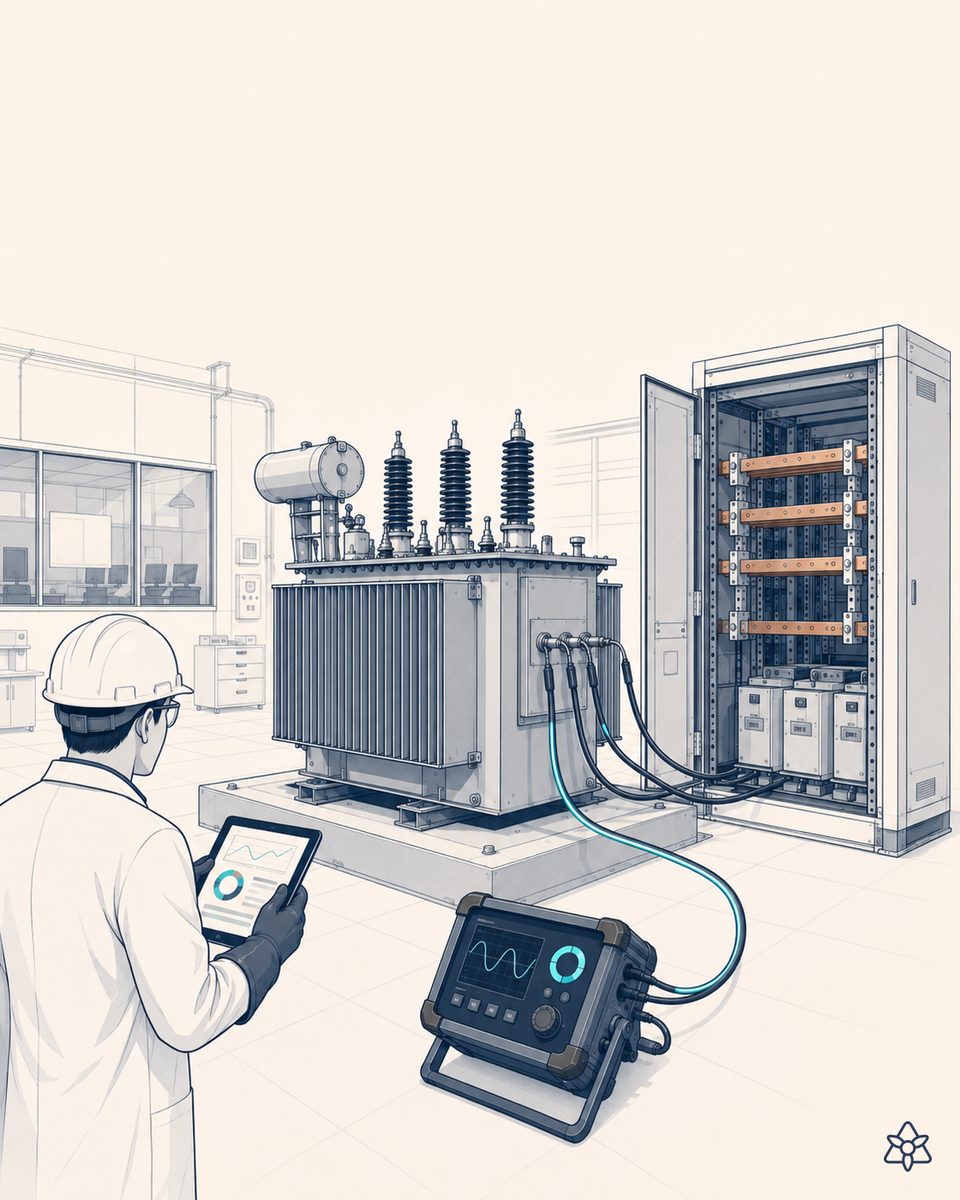
Dozens of tightenings per switchboard, one global sign-off, zero traceability per joint.
A loose joint on a busbar carrying hundreds or thousands of amps heats up through contact resistance, and hot means hot spot, oxidation, coating degradation and, in the worst case, an arc. Too much torque and the material cracks. That is why the manufacturer specifies torque and angle per joint type. In service, that data should be auditable tightening by tightening; on the shop floor:
- Dozens or hundreds of tightenings per switchboard — main bars, taps, vertical and horizontal busbar runs, connections to breakers and to the outgoing cables.
- Calibrated torque wrench + paper checklist — the operator does it right, but the data stays on a sheet signed at the end of the board. If it gets lost, it does not exist.
- Global supervisor sign-off, not per tightening — when one fails on thermography, there is no way to know which one it was or who did it.
- Retightening at maintenance — the end customer's manual says “retighten after one year”, but with no initial torque recorded per joint, what do you compare against?
The quality manager knows it; the shop lead knows it. The classic system works 99% of the time. That 1% is the switchboard that shows up with a hot spot on thermography at commissioning — and then you have to open it, retighten, rewrite, and sometimes replace the damaged bar.
iLEAN does not add a new wrench — it captures the one you already have, tightening by tightening.
Torque control does not fail for lack of tooling; it fails because the data of each tightening is not tied to the switchboard. iLEAN acts as the putty that fills the gap between the torque wrench, the paper checklist and the manufacturing ERP, without forcing you to change anything.
Edge identifies the switchboard and the joint. Connect captures torque and angle from the wrench. The agent closes the dossier and warns of any out-of-range tightening. The person signs — never the other way round.
The iLEAN pieces applied to busbar torque control:
- Edge — a terminal at the assembly bench. It reads the switchboard label (QR/DataMatrix) and, via camera or voice, identifies the joint being tightened. If the operator wears an earpiece, saying “tightening 17 done” is enough and the system ties it in. It works without a network. If the plant loses its connection, it keeps capturing.
- Connect — pairs with the digital torque wrench (Atlas Copco, Bosch, Stahlwille, Saltus, Norbar) over Bluetooth/USB and captures torque and angle in real time. If the wrench is analog, the operator photographs the reading and Connect reads it.
- Tightening agent — cross-references torque + angle + joint + operator + switchboard number. If something falls out of range, it warns the operator through the earpiece or on the panel. If the switchboard is handed over with tightenings pending, it holds the release until the quality manager validates. The person signs — the switchboard never ships on its own.
Wrench + paper checklist vs. tightening traced with iLEAN Edge
| Aspect | Torque wrench + checklist | With iLEAN Edge + Connect (tightening by tightening) |
|---|---|---|
| Torque record per tightening | Manual note or no record | Digital capture from the wrench in real time |
| Joint identification | Implicit in the checklist order | Explicit via switchboard QR + voice/camera |
| Out-of-range tightening | If the operator spots it, he fixes it; if not, it slips through | Operator warned at second zero |
| Forgotten tightening | Surfaces at final inspection or at commissioning | Switchboard release held until completed |
| Dossier per switchboard | Globally signed sheet, no detail | Torque/angle/operator for every tightening, automatic |
| Reference for retightening at maintenance | “The value in the manual” | The real as-delivered value, per joint |
Impact estimate for your plant — to be validated with your numbers.
The block below is an estimate to be validated with the specific data of your plant. We put it forward so the committee has an order of magnitude; we refine it during the diagnostic.
- LV/MV power switchboard shop (main LV switchboards, substation switchgear, switchboards for data centers or hospital electrical boards), with digital torque wrenches already in use.
- Edge pilot on one assembly bench (terminal + Bluetooth integration with the wrench + switchboard identification). First value expected within a few weeks.
- Indicative payback between 4 and 9 months, depending on switchboards/month volume and the average cost of a hot-spot incident at commissioning (opening, retightening, delivery delay, brand damage with the EPC integrator).
- Hard levers: ≥ 30% reduction in incidents from out-of-range tightening; a manufacturing dossier per switchboard ready to hand over; better positioning in tenders where tightening traceability is a requirement.
And the quality manager's reasonable doubt
“What if the system misreads a torque value?” — false positives exist, and that is why the system never decides alone. Hallucination is a problem of free generation, not of anchored tasks. In tasks where the AI merely receives a digital value from the wrench and compares it against a specified range, the best models brought error below 1.5% [1]. And even so, what is critical is never decided alone: iLEAN warns and the operator or the quality manager sign. The three safety rings exist precisely for this.
[1] OpenAI paper “Why Language Models Hallucinate”, 2025 — on the reliability of AI in anchored tasks.
What people ask about busbar torque control in power switchboards
Why is busbar tightening torque critical in a power switchboard?
Because a loose joint on a busbar carrying hundreds or thousands of amps heats up through contact resistance, and hot means hot spot, oxidation, coating degradation and, in the worst case, an arc. An over-tightened joint cracks the material or deforms the connector. Manufacturers specify a torque and an angle per joint type (copper/copper, copper/aluminum, recommended tightening torque). In service, that torque should be auditable tightening by tightening; in practice, almost nobody has that traceability.
Why does classic tightening control with a torque wrench and a paper checklist fail?
For three typical reasons: (1) the operator uses a calibrated torque wrench, but the record stays on the switchboard's paper checklist — if the sheet gets lost, the data does not exist; (2) a complex switchboard has many tightenings (dozens or hundreds per board) and the supervisor's sign-off is global, not per tightening; (3) when a joint fails in service, there is no way to prove after the fact whether the initial tightening was correct. The problem is not the person; it is that the information is not captured tied to the switchboard.
How does iLEAN Edge capture the torque of every tightening without changing the torque wrench?
iLEAN Connect pairs with the digital torque wrench you already have (Atlas Copco, Bosch, Stahlwille, Saltus, Norbar, whatever it is) over Bluetooth, USB or whichever channel it offers. It captures torque and angle for every tightening in real time. iLEAN Edge identifies the switchboard by its QR/label and, via camera or voice earpiece, the operator says “tightening 17 done” — the system ties it in without him having to write anything. If the wrench is analog, the operator photographs the reading and Connect reads it.
What happens if a tightening is out of range or never completed?
The agent detects it at second zero. If the torque is below the range specified for that specific joint, the system warns the operator through the earpiece or on the panel: “tightening 17, torque 38 Nm below the 42 Nm minimum — retighten”. If a tightening is still pending when the switchboard is closed, it holds the handover to final inspection until it is completed or the quality manager validates the exception. The person signs — the switchboard never ships on its own.
What do you gain in a power switchboard manufacturing plant?
Three concrete levers: (1) a manufacturing dossier per switchboard with torque and angle for every tightening, operator and date — deliverable directly to the end customer or the EPC integrator, with nothing to reconstruct; (2) fewer warranty returns for hot spots detected by thermography at commissioning; (3) capture of the veteran's judgment — the fine adjustment a fitter with 20 years' experience makes without thinking is kept as a pattern. Tightening traceability is increasingly demanded in switchboards for data centers, hospitals with critical UPS and substations.
More cases in other sectors
- Inter-turn short in a motor — once it goes into the impregnation oven, it is scrap.iLEAN Vision plus an AI-assisted surge test detects inter-turn shorts in motor windings before…
- MV switchgear heat rise test — the hot spot sits between two thermocouples.AI thermography on the heat rise test of metal-enclosed MV switchgear: iLEAN Edge spots hot spots in…
- NH fuse breaking capacity test — reading the oscillogram by eye means expensive scrap and an expensive technician.iLEAN Edge captures the oscillogram of the NH fuse breaking capacity test and validates it automatically…
- Stationary battery capacity testing — only the veteran spots the marginal cell.Edge AI in the formation room: iLEAN monitors stationary battery formation cycles and capacity tests in…
- DGA analysis of dielectric oil — a report that arrives late is a transformer that is already failing.iLEAN Brain cross-references DGA, load and temperature of the transformer to anticipate incipient…
- The UPS VRLA battery — the annual test says OK and the bad block is still there, waiting for the real outage.iLEAN Brain cross-references impedance, ohms and temperature of every VRLA block in the data center UPS…
Tell us your case and in 48h we'll send you the estimated ROI for your power switchboard shop.
We work on your plant's real data, not ours. Diagnostic with no commitment.
Request estimated ROI in 48h See industrial electrical equipment