MV switchgear heat rise test — the hot spot sits between two thermocouples.
The IEC 62271 heat rise test measures with thermocouples placed as the standard prescribes, but the hot spot can be two centimeters further along. iLEAN Edge runs AI thermography across the entire surface of the metal-enclosed cubicle and flags anomalies in real time, without losing a single point. The test dossier builds itself. The person signs.
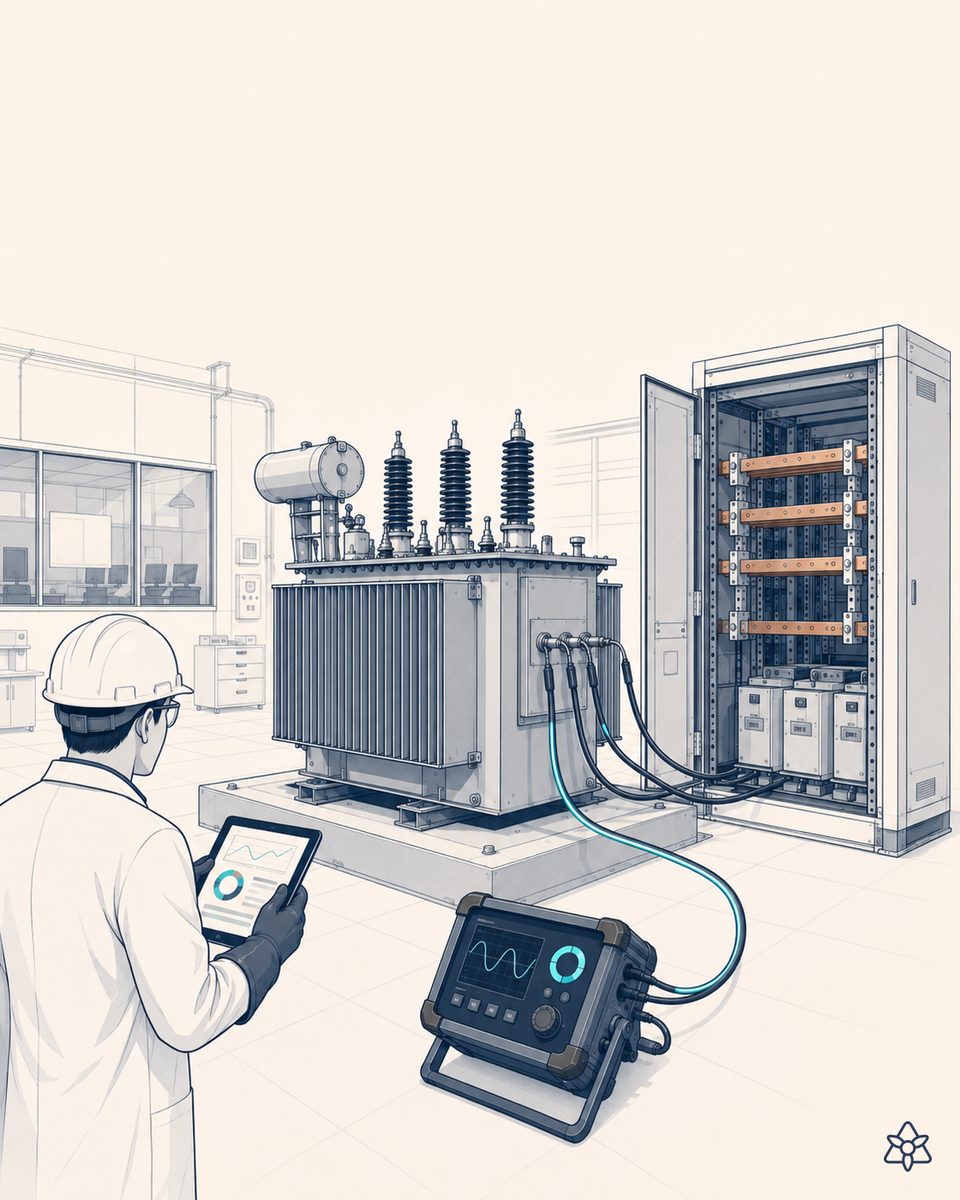
Thermocouples see where they sit — heat gives no warning before it shows up.
The IEC 62271 heat rise test on metal-enclosed MV switchgear is designed with thermocouples placed by the standard on the critical connections. But the thermal reality of a loaded cubicle is the sum of hundreds of surfaces, bolted contacts and insulation zones. The classic setup leaks in three places:
- The thermocouple measures where it sits — if the real hot spot is a few centimeters further along (a bolt torqued wrong, a badly tightened busbar), the thermocouple never sees it.
- The IR photo arrives at the end — the engineer shoots a thermographic image when the test closes, hours after the fact, with no way to correlate it to a specific event.
- The dossier is rebuilt afterwards — curves, IR photo, construction drawing and standard are stitched together by hand for the final report.
When a test comes back non-conforming close to the limit, you have to reassemble the cubicle, re-instrument it and energize again — days lost. The classic setup works 99% of the time. That 1% is a reopened test, and for the end customer waiting on the switchgear it is a delay that is hard to explain.
iLEAN does not add a fourth system — it seals the cracks between the thermocouples and the construction drawing.
The problem is not a lack of data: thermography has been around for decades. The problem is that nobody can watch an IR map for six hours of testing. iLEAN acts as the putty that fills the gap between what the laboratory can instrument and what the engineer can sustain.
The IR camera sees the whole cubicle. iLEAN Edge analyzes the stream in real time against the type test pattern. The agent cross-references the construction drawing and flags the suspect connection. The person signs — never the other way round.
The iLEAN pieces applied to the MV switchgear heat rise test:
- iLEAN Edge — a terminal with a CNN trained to identify thermally anomalous zones in the IR camera stream. It compares against the learned pattern from the cubicle's type test and flags events in real time. It works with no network: it records and flags locally, then syncs later. What is critical does not depend on WiFi.
- Connect — captures the standard thermocouples (whether modern acquisition or legacy equipment), the cubicle's construction drawing from PLM/CAD, and the manufacturing batch of the busbars and connectors. The graduated capture covers all three cases you find in a laboratory.
- iLEAN Writer — generates the test dossier with curves, the evolving thermographic map, flagged events and the correlation with the construction drawing. The responsible engineer signs with their digital signature and the evidence stays linked to the cubicle's serial number. If a notified body asks for the file, it comes out in one click.
Thermography at the end vs. real-time AI thermography with iLEAN
| Aspect | Classic heat rise test | With iLEAN Edge + Writer |
|---|---|---|
| Coverage of the cubicle | Thermocouples where the standard says | The whole surface, by continuous thermographic stream |
| Hot spot detection | IR photo at the end of the test | Real-time thermal map, event flagged at the moment |
| Correlation with construction drawing | Manual, after the test | Automatic, while the test runs |
| IEC 62271 dossier | Rebuilt by hand for the report | Generated at second zero, human signature |
| Non-conforming test close to the limit | Reopen, re-instrument, repeat — days | Anomaly caught live, informed decision |
| Traceability of the connection | A note from the lab technician | Time stamp per event, linked to the serial number |
Impact estimate for your plant — to be validated with your numbers.
The block below is an estimate to be validated with the specific data of your laboratory. We put it forward so the committee has an order of magnitude; we refine it during the diagnostic.
- Mid-sized manufacturer of metal-enclosed MV switchgear (IEC 62271-200), with its own laboratory running the rated-current heat rise test, instrumented with standard thermocouples and a final IR photo.
- Edge pilot with a fixed thermal camera over the cubicle + integration with the thermocouple acquisition system + construction drawing from PLM. First value expected within a few weeks: the first thermal anomaly flagged with a time stamp and correlated to a specific connection.
- Indicative payback between 4 and 9 months, depending on how often non-conforming tests get reopened and on the cost of each re-instrumentation.
- Expected reduction in reopened tests ≥ 30%, a defensible floor. The hard lever is one test not reopened: days recovered + delivery date to the end customer met.
And the lab engineer's reasonable doubt
“What if the AI flags something as a hot spot when it isn't?” — hallucination is a problem of free generation, not of anchored tasks. In tasks where the AI compares a real thermal map against a learned pattern from the type test, the best models brought error below 1.5% [1]. And even so, what is critical is never decided alone: iLEAN flags the event and the engineer decides. The three safety rings exist precisely for this.
[1] OpenAI paper “Why Language Models Hallucinate”, 2025 — on the reliability of AI in anchored tasks.
What people ask about the MV switchgear heat rise test with AI
What does IEC 62271 require for the heat rise test on MV switchgear?
IEC 62271-1 (common definitions) and IEC 62271-200 (metal-enclosed MV switchgear) require you to verify that the assembly, energized at rated current, does not exceed the temperature rise limits (Δθ) over ambient temperature — typically 65 K on bolted connections, 105 K on insulation. The test is run with heating loops and point thermocouples. The classic problem: thermocouples only see where they sit — the hot spot can be 2 cm away.
Why does thermography change the heat rise test?
An IR camera sees the whole surface at once. It catches the hot spot the thermocouple missed by a couple of centimeters: a bolted connection torqued wrong, a badly tightened busbar contact, a poor contact area between busbar and cubicle. iLEAN Edge runs a CNN on the thermographic stream in real time, identifies anomalous zones against the learned pattern of the type test, and time-stamps the event. What used to be one photo at the end of the test is now continuous coverage of the entire cubicle — without losing a single point.
Does the AI replace the laboratory engineer?
No, it takes the dumb work off their hands. The lab engineer still designs the test, wires the standard thermocouples and signs the report. What iLEAN Edge does is see what a human eye cannot sustain for six hours: an evolving thermal map of the whole cubicle. When a hot spot appears, the agent cross-references it with the construction drawing (which connection sits in that area, what torque it should have) and prepares the decision for the engineer. The person signs — the AI does not decide the test.
How is the IEC 62271 test signed with traceable evidence?
iLEAN Writer generates the test dossier: the curve for every thermocouple, the evolving thermographic map, time-stamped flagged events, the correlated construction drawing, and the maximum Δθ recorded against the standard's limit. The responsible engineer signs with their digital signature and the record shows who, when and on what evidence. If the end customer or the notified body asks for the file, it comes out in one click — it is not rebuilt a week later from a lost IR photo.
How much does an AI thermography pilot cost in an MV switchgear laboratory?
The order of magnitude of an Edge pilot with an IR camera in a heat rise test laboratory is close to that of any Edge pilot on the shop floor: an initial investment covering terminals + thermal camera + integration with your thermocouple acquisition system, plus an annual license. A reasonable payback is several months — the hard lever is one failed test reopened, which today means reassembling and re-energizing the cubicle all over again. We ask for your laboratory's data and send you the estimated ROI in 48h.
More cases in other sectors
- AI control of the VPI cycle on an HV motor stator — four parameters, a single screen.How iLEAN Edge controls the HV motor stator VPI cycle (vacuum + pressure): vacuum level, resin…
- Cell-by-cell traceability in LiFePO4 battery racks — the field dossier is not built by hand.How iLEAN Tracer ties batch, OCV, IR and destination module to every LiFePO4 cell in BESS and UPS…
- Inter-turn short in a motor — once it goes into the impregnation oven, it is scrap.iLEAN Vision plus an AI-assisted surge test detects inter-turn shorts in motor windings before…
- NH fuse breaking capacity test — reading the oscillogram by eye means expensive scrap and an expensive technician.iLEAN Edge captures the oscillogram of the NH fuse breaking capacity test and validates it automatically…
- Busbar torque control in power switchboards — every tightening tied to its switchboard, no paper.How iLEAN Edge traces every busbar tightening in a power switchboard: torque, angle and operator, tied…
- Stationary battery capacity testing — only the veteran spots the marginal cell.Edge AI in the formation room: iLEAN monitors stationary battery formation cycles and capacity tests in…
Tell us your case and in 48h we'll send you the estimated ROI of this AI project for your switchgear laboratory.
We work on your laboratory's real data, not ours. Diagnostic with no commitment.
Request estimated ROI in 48h See industrial electrical equipment