NH fuse breaking capacity test — reading the oscillogram by eye means expensive scrap and an expensive technician.
Every shot in a breaking capacity test on an industrial NH fuse burns a sample and ties up a qualified technician. iLEAN Edge captures the complete oscillogram, validates it automatically against IEC 60269 (prospective current, I²t, arcing time), holds the doubtful samples and frees the technician for the ones that genuinely need judgment. The report is always signed by a human.
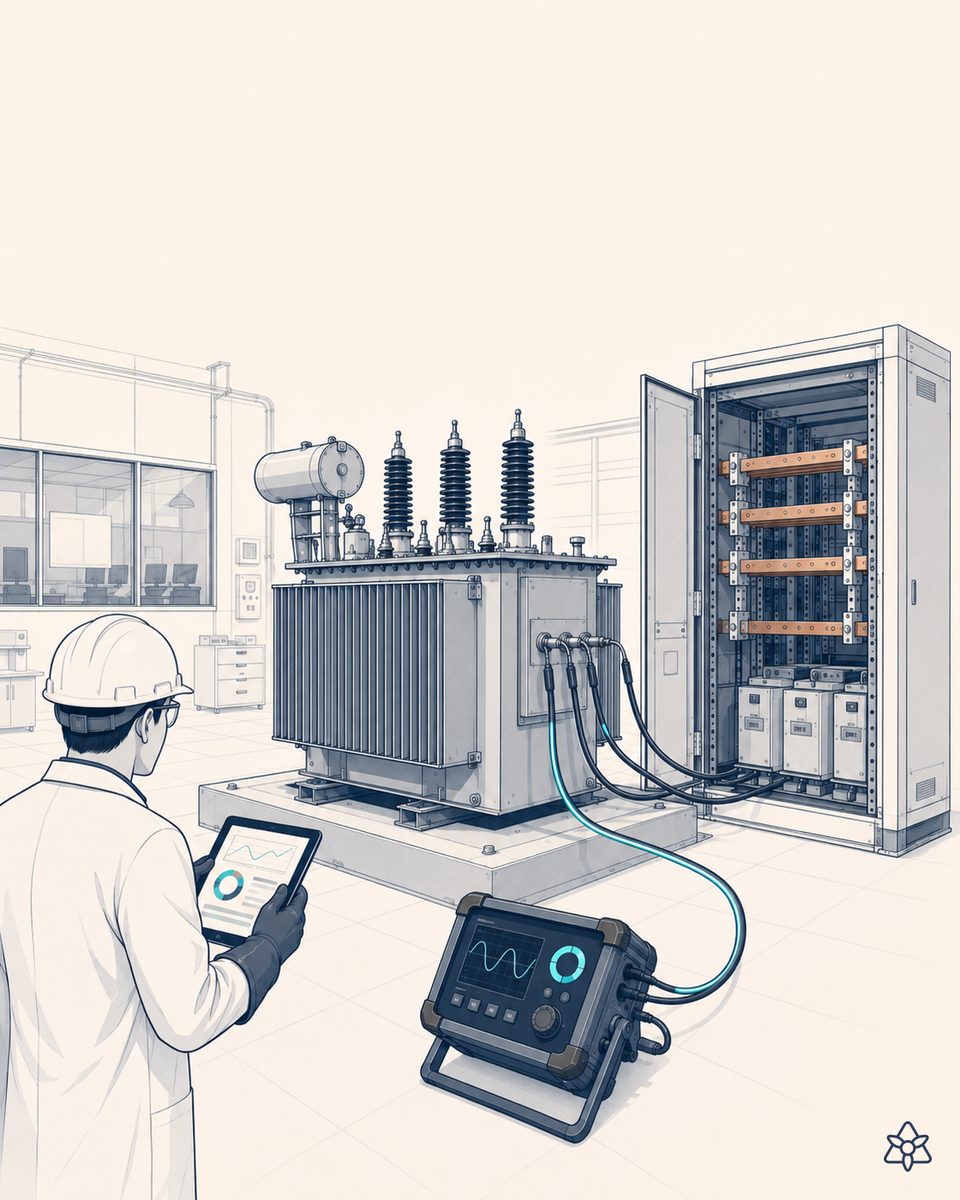
The test is sound; validating by eye breaks down at high volume.
The breaking capacity test on an industrial NH fuse admits no middle ground: the cartridge has to interrupt a real prospective current, without the arc escaping the enclosure, within the declared I²t and time. The standard — IEC 60269 — is clear. The laboratory knows how to run it. Where the chain breaks is in how each oscillogram is handled:
- Every shot costs a sample. The NH fuse under test is destroyed. If the trace is doubtful and gets discarded to be safe, a sample is lost; if a doubtful trace is accepted under time pressure, the risk goes out into the field.
- The qualified technician is spent on dumb work. Looking at 200 clean traces to find 5 doubtful ones is not what they were hired for. That is screening work, not judgment.
- The oscillogram is stored in fragments. The bench oscilloscope, the results spreadsheet, the manager's report in Word. Rebuilding a batch dossier for an audit is a week in the archive.
- The bench conditions never get tied together. Recovery voltage, frequency, room temperature, time of the shot: it all exists, but in separate files, and the cross-referencing is done by hand.
The laboratory has the technique and the people. What it lacks is the putty that binds the oscillogram to the standard, the conditions and the history — at second zero, not at month end.
Edge on the bench, IEC 60269 in the agent, judgment in the person.
The breaking capacity test lives between three islands: the oscilloscope, the bench conditions sheet and the standard. iLEAN acts as the putty that seals the cracks between those three, without asking you to change the oscilloscope or rewrite the procedures.
Edge digitizes the oscillogram. The agent validates it against IEC 60269. The person signs — the batch report does not go out without a human seal.
The iLEAN pieces applied to NH fuse testing:
- Edge — a terminal next to the short-circuit bench. It reads the oscilloscope channels on every shot and digitizes the complete oscillogram. It applies a first screening (prospective current reached, arcing time inside the window, no visible re-ignition) in milliseconds. If the trace is clean, it seals it; if it is doubtful, it holds the sample and passes it to the technician. It works with no network.
- Connect — captures the room conditions (recovery voltage, frequency, ambient temperature) from the bench SCADA or the local panel, and cross-references them with the oscillogram. The bench configuration sheet — today a spreadsheet — becomes data bound to the shot.
- Agent — on top of what has been digitized, it validates the IEC 60269 criteria: total I²t, no re-ignition, let-through energy, arc waveform. It builds the batch dossier automatically, ready for an audit or for the customer running the approval.
Validating by eye vs. validating with iLEAN Edge
| Aspect | Laboratory today | With iLEAN Edge + Agent |
|---|---|---|
| Oscillogram capture | Oscilloscope + manual saving | Edge digitizes the complete oscillogram on every shot |
| Screening of clean traces | Technician looks at all 200 | Agent filters; technician only looks at the doubtful ones |
| Validation against IEC 60269 | By eye, against a mental checklist | Agent applies quantitative criteria |
| Bench conditions | Spreadsheet separate from the oscillogram | Cross-referenced with every shot, at second zero |
| Audit dossier | Rebuilt by hand, weeks | Per batch, automatic, with every trace |
| Operation with no network | n/a | Edge keeps capturing as long as the panel has power |
Impact estimate for your plant — to be validated with your numbers.
The block below is an estimate to be validated with the specific data of your laboratory. We put it forward so the committee has an order of magnitude; we refine it during the diagnostic.
- In-house laboratory of an NH fuse manufacturer or of an electrical testing operator, with its own short-circuit bench, several hundred shots a month and one qualified person mainly dedicated to validating traces.
- Edge pilot on one bench (terminal + integration with the oscilloscope + IEC 60269 adapter). First value expected within a few weeks: automatic screening of 80-90% of the clean traces frees technician hours from day one.
- Indicative payback between 4 and 9 months, depending on shot volume and on the cost of discarded samples.
- Expected reduction in samples discarded out of doubt ≥ 30% and reduction in technician time spent screening ≥ 30% — conservative.
- Extra levers (not counted in the floor): automatic audit dossier and complete batch traceability with no manual rebuilding.
And the quality manager's reasonable doubt
“What if the agent accepts a doubtful trace the technician would have held?” — hallucination is a problem of free generation, not of anchored tasks. Applying quantitative IEC 60269 criteria to a digitized trace is exactly an anchored task: the best models brought error below 1.5% [1]. And, once again, Edge does not sign — it proposes and holds. The seal on the report always belongs to the person.
[1] OpenAI paper “Why Language Models Hallucinate”, 2025 — on the reliability of AI in anchored tasks.
What people ask about NH fuse testing with AI
What is the breaking capacity test on an NH fuse and what does IEC 60269 require?
The breaking capacity test subjects the NH fuse to the prospective short-circuit current to verify that the cartridge interrupts it without the arc escaping the enclosure, without loss of insulation and within the declared I²t (Joule integral) limits. IEC 60269 (part 1 + part 2 for industrial low voltage) defines the prospective current values, the recovery voltage, the test bench conditions and the acceptance criteria: arc waveform, extinction time, let-through energy. A fuse outside those limits is not just a bad product — it is an electrical safety failure.
How does iLEAN Edge capture the oscillogram of the shot and validate it against the standard?
iLEAN Edge is a terminal with a CNN installed in the test laboratory, right next to the short-circuit bench. It reads the oscilloscope channels (current, voltage, derivative) on every shot and digitizes the complete oscillogram — not just the final result. On that trace, an agent verifies the IEC 60269 criteria: prospective current reached within tolerance, arcing time, total I²t, no re-ignition. If the test is valid, it triggers the automatic seal; if there is doubt, it holds the sample and alerts the lab technician. The report is always signed by a human.
What happens today when the oscillogram is read by eye?
The most expensive part of a short-circuit test is not the bench — it is the fuse burned on every shot and the hour of a qualified technician. If the technician has to look at each trace one by one and decide whether the interruption complies, two things happen: valid samples discarded out of doubt (waste of samples and of laboratory hours), and doubtful samples accepted on a busy day (risk out in the field). Edge does not take judgment away from the technician — it takes away the eyeballing of every single trace. The technician looks at the doubtful ones, not at the 200 clean ones of the day.
Does Edge work if the laboratory has no stable network?
Yes. Edge is designed as a self-contained box: as long as it has power, its capture, validation and sealing cycle keeps running even if the plant loses WiFi. The oscillogram is stored locally and syncs with Central when the network comes back. In a test room where the shots generate electrical noise and the network drops now and then, this is not a detail — it is the difference between having traceability and not having it.
How much does it cost to automate the breaking capacity test in an in-house laboratory?
The order of magnitude of an Edge pilot in an electrical test laboratory is close to that of any Edge on an industrial shop floor: terminal + integration with the oscilloscope + IEC 60269 adapter + annual license. The hard lever is twofold: valid samples not discarded (every NH fuse tested carries a manufacturing cost and a bench-hour cost) and qualified technician time freed up for the genuinely complex shots. We ask for your laboratory's data and send you the estimated ROI in 48h.
More cases in other sectors
- Cell-by-cell traceability in LiFePO4 battery racks — the field dossier is not built by hand.How iLEAN Tracer ties batch, OCV, IR and destination module to every LiFePO4 cell in BESS and UPS…
- Inter-turn short in a motor — once it goes into the impregnation oven, it is scrap.iLEAN Vision plus an AI-assisted surge test detects inter-turn shorts in motor windings before…
- MV switchgear heat rise test — the hot spot sits between two thermocouples.AI thermography on the heat rise test of metal-enclosed MV switchgear: iLEAN Edge spots hot spots in…
- Busbar torque control in power switchboards — every tightening tied to its switchboard, no paper.How iLEAN Edge traces every busbar tightening in a power switchboard: torque, angle and operator, tied…
- Stationary battery capacity testing — only the veteran spots the marginal cell.Edge AI in the formation room: iLEAN monitors stationary battery formation cycles and capacity tests in…
- DGA analysis of dielectric oil — a report that arrives late is a transformer that is already failing.iLEAN Brain cross-references DGA, load and temperature of the transformer to anticipate incipient…
Tell us your case and in 48h we'll send you the estimated ROI of this AI project for your test laboratory.
We work on your bench's real data, not ours. Diagnostic with no commitment.
Request estimated ROI in 48h See electrical equipment