On one-off work, the setup is the process
Most machine time goes into preparing, not cutting. And it is where the expensive mistakes concentrate: the wrong workholding, a part zero picked up badly, a tool left over from the previous job, material that looks right but is a different alloy, a program from the old revision. Edge cameras compare the table with the reference state and will not release the cycle until everything matches and the supervisor signs.
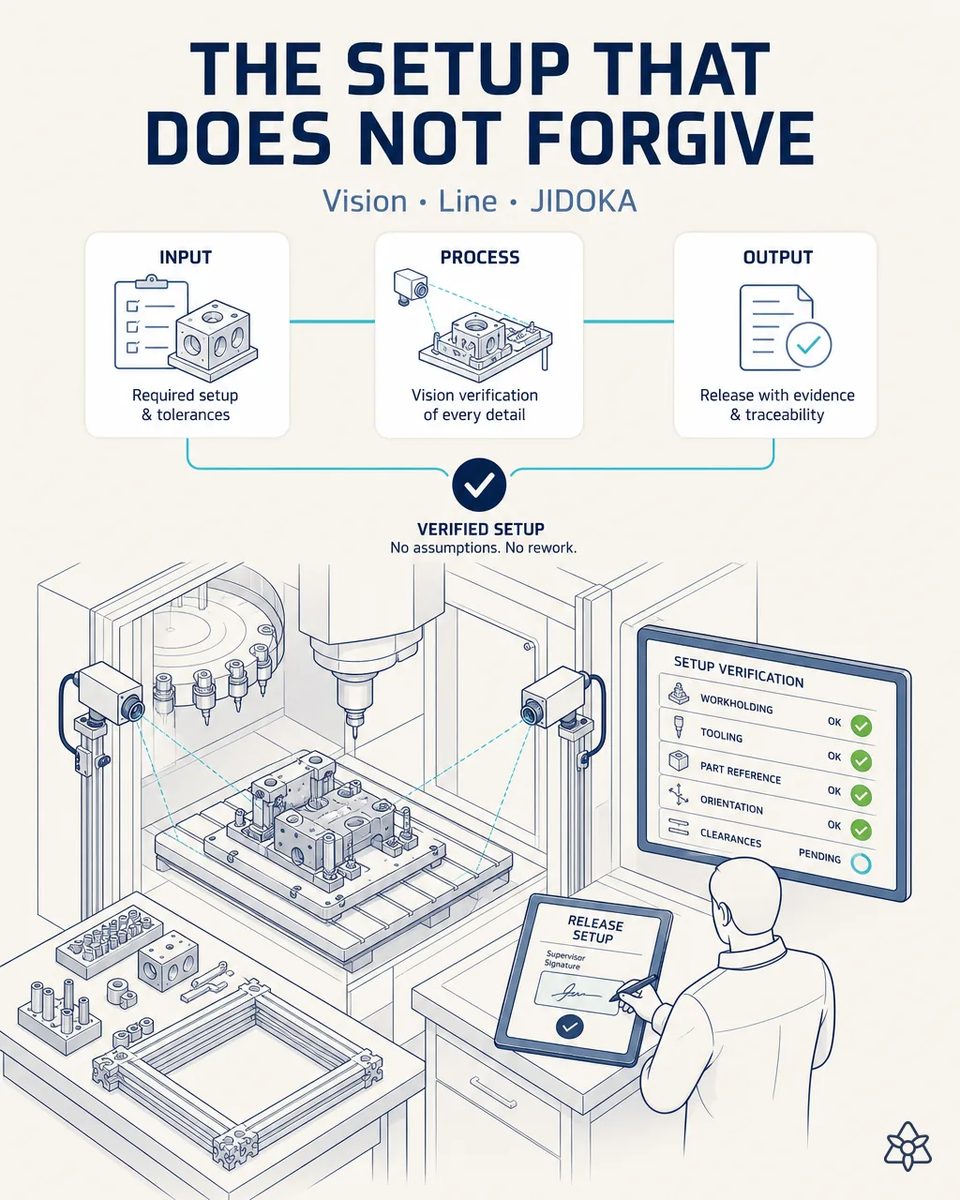
Every job brings a different setup, so there is no muscle memory to protect you.
Every job brings a different setup, so there is no muscle memory to protect you. Verification depends on the machinist mentally checking five things at once in a hurry, and on the shop lead walking past in time. When it fails, it does not fail cheap: you lose the plate, the machine hours already invested and your slot in the schedule. And because setup dominates total time, every minute added "for safety" is paid straight out of capacity. It is where the most is won and the most is lost.
- The wrong workholding, a mis-set part zero, a tool left over from the previous job, material that looks the same but is a different alloy, the old revision's program.
- Verification depends on the operator mentally checking five things at once in a rush, and on the shop lead walking past in time.
- When it fails, it does not fail cheap: the plate, the machine hours already invested and the slot in the schedule are all lost.
- And because setup dominates total time, any minute added “for safety” is paid straight out of capacity.
Edge cameras on the critical points, plus JIDOKA AI and SMED AI.
Edge cameras at the critical points of the table and the carousel, plus JIDOKA AI and SMED AI.
SMED AI supplies the other half: the check stops being a manual walk-around and becomes instantaneous, so the setup gets shorter rather than longer. It is the only way a control gets accepted where time is capacity.
- iLEAN compares the current state with the reference state tied to the job: correct material in shape, dimension and marking; workholding and stops in place; tooling consistent with the program; program revision matching the current drawing revision.
- If anything is off, JIDOKA AI does not release the start and shows what failed.
- When everything is conforming, the supervisor signs and the cycle runs.
- SMED AI brings the other side: verification stops being a manual walk-round and becomes instantaneous, so setup gets shorter rather than longer.
Mental verification vs. objective verification
| Aspect | Today | With Edge and JIDOKA AI |
|---|---|---|
| Material | Looks right, assumed right | Form, size and marking verified |
| Workholding and stops | Checked mentally | Compared with the reference |
| Tooling | Whatever was left | Consistent with the program |
| Program revision | Assumed current | Checked against the drawing |
| Startup | When the operator decides | Enabled when everything matches |
| Setup time | The manual walk-around | Instant check |
mental setup verification driven by time pressure → objective, signed verification in seconds. One-off part lost to a badly prepared start → risk bounded before the first cut.
Impact estimate — to validate against your numbers.
The block below is an estimate to be validated against your plant's actual data. We put it forward so the committee has an order of magnitude; we refine it during the assessment.
- One-off shops where preparation takes most of the machine time.
- Indicative reduction of ≥30% in setup time and a significant drop in scrap from startup errors.
- Indicative payback between 5 and 11 months.
- Measure your real setup time per machine first: without that baseline there is no way to defend the return.
estimated ≥30% reduction in setup time and a significant drop in one-off scrap from start-up errors. Estimated payback 5-11 months. *Estimate to be validated* by first measuring real setup time per machine.
And the fair question from the production manager
“Won't blocking startup cost me capacity?” — it is the fair objection, and it is why this case travels with SMED AI: the goal is a startup that is faster and verified. The check replaces a manual walk-around that already happens today — when there is time — and what it removes is the lost plate, which is machine hours plus the slot in the schedule.
[1] OpenAI paper "Why Language Models Hallucinate", 2025 — on the reliability of AI in anchored tasks.
What people ask about verifying the setup
What if a camera fails?
The rule is defined before deployment. The usual setup is that a failure raises an alert and allows a supervisor override with a record, rather than leaving the machine down. What is not allowed is an override with no trace: if somebody starts without a green light, that is exactly the fact worth having recorded.
How does it know the reference state if every job is different?
The reference state belongs to the order, not to the machine: which material, which workholding, which tooling and which revision correspond to that job. That information already exists in the preparation; what changes is that it is now checked against what is actually on the table.
How many points need covering?
The critical ones on that machine: the table with the workholding and stops, the tool carousel and the presented material. They are defined at the start with the shop lead, because they are the same five checked mentally today.
Doesn't it add minutes to the startup?
It replaces minutes, it does not add them. The check already exists when there is time, and when there is not it gets skipped — which is when the expensive error happens. Making it instant stops verification competing with capacity.
Can we start with one machine?
That is the recommended way, and it should be the one running the most expensive one-off work. You validate there, measure the effect on real setup time and replicate. The mounting is the same for machines of similar configuration.
More cases from this series
- The delivery file stops being assembled by hand on the last dayDrawing, heat, dimensions, images and signatures organised by each customer's standard while the job…
- A tooling shop's core pain is not cost, it is the dateFour coordinated rings from material receiving to the shipping dock: intake, start, execution and…
- You already own the good pieces — they just needed stitchingThe measurement report and the machining program tie themselves to the job and its revision. Without…
- A late drawing revision is the most expensive mistake in the shopThe revision lands by email or WhatsApp and the plate is already on the machine. iLEAN catches it the…
- Your most veteran machining centre can finally talkAn external camera reads the proprietary control of your veteran machining centre: spindle hours,…
- The heat number stops getting lost between the dock and the filing cabinetPhotograph the packing slip and the mill certificate: supplier, alloy and heat number enter the ERP with…
Start with the machine where a lost plate costs you the most days.
We work on your plant's real data, not ours. Assessment with no commitment.
Request estimated ROI within 48h ‹ See all cases of precision fixtures and frames See metal fabrication