Here the defect is not paid for in the part, it is paid for in the cycle
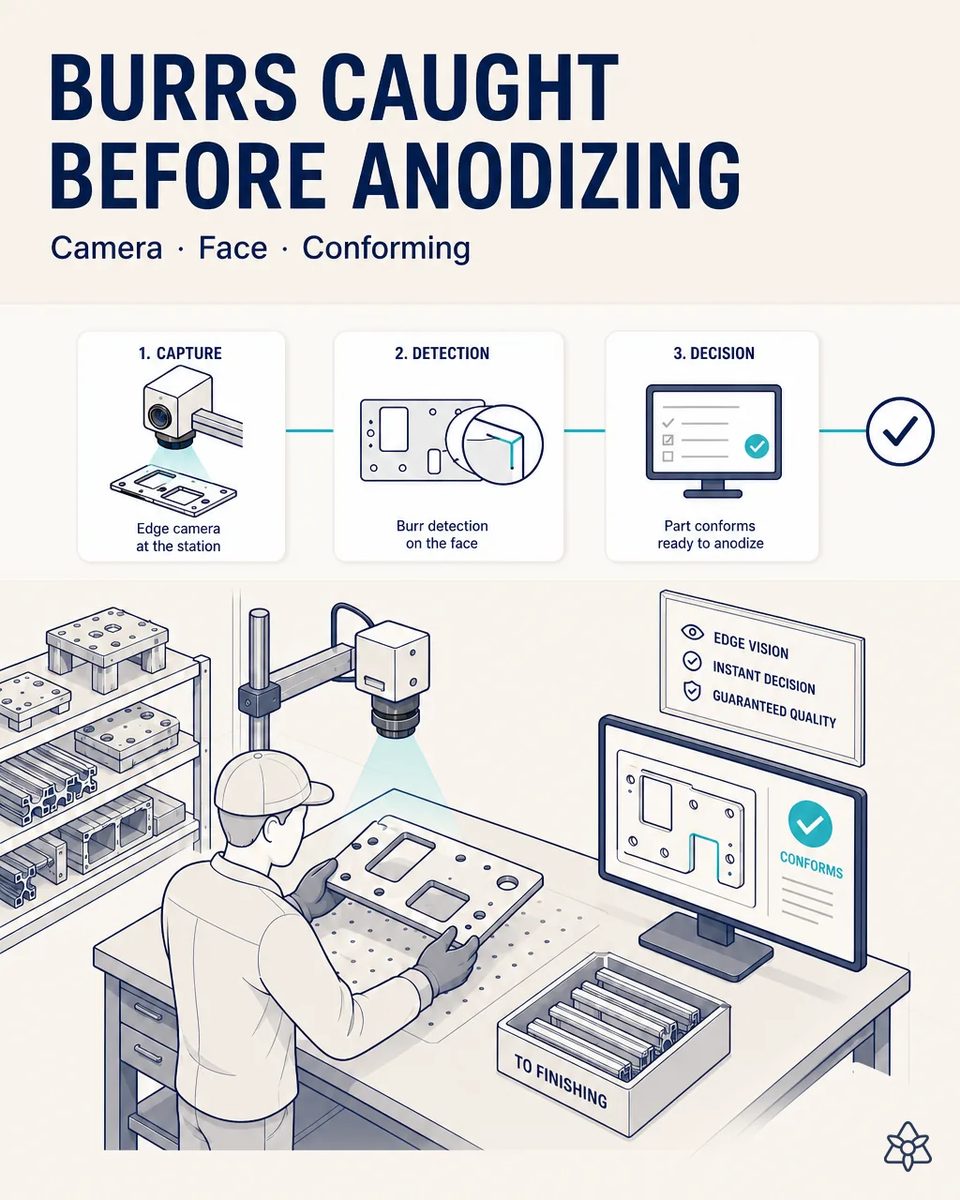
A burr that gets through, a clamping mark on a visible face or a scratch on a plate headed for anodizing are not caught at the bench: they are caught when the part comes back from finishing, days later, with the defect already sealed under the coating. An Edge camera over the bench checks every face before the part leaves the shop.
The cost is not the part: it is that treatment is external and has its own lead time.
Inspection is visual and human, at the end of the day, part in hand, in a hurry to close the shipment to finishing. Eyes tire, and a fine burr on an internal edge or a light scratch on a visible face are exactly the defects a human lets through. The cost is not the part: surface finishing is an outside service with its own lead time, so every repeat adds whole days to the job. You re-machine, re-finish and re-ship. And on a one-off part there is no spare.
- Control is visual and human, at the end of the day, with the part in hand and a rush to close the shipment.
- The eye tires, and a fine burr on an internal edge or a light scratch on a visible face are exactly the defects a human lets through.
- Every repeat adds whole days to the project: re-machine, re-treat and re-ship.
- And on one-off work there is no spare: the defect comes back from treatment already sealed under the coating.
An Edge camera over the deburring bench — the AI flags, the person resolves.
Edge camera over the deburring and finishing bench.
It blocks nothing on its own: it holds the part and points at the specific area. The decision to rework or pass belongs to the operator, who has the part in hand.
- A vision model trained on good and bad examples of the shop's real parts: plates, brackets, blocks, cut profiles.
- Inference in milliseconds on each face presented.
- It marks the part conforming or holds it before packing, pointing at the specific area.
- The operator decides: the AI flags, the person resolves. It blocks nothing on its own.
End-of-day control vs. control at the bench
| Aspect | Today | With iLEAN Edge |
|---|---|---|
| When it is detected | On return from treatment | Minutes before packing |
| Cost of the defect | Whole days of cycle | Rework while fresh |
| Fine burr on an internal edge | Let through | Flagged by area |
| Coverage | Whatever the eye holds | Every face presented |
| Shipping to treatment | Repeated | Once |
| Decision | The operator's | The operator's |
defect found when the part returns from finishing (days lost, cycle repeated) → caught at the bench, minutes before packing. Rework after anodizing → rework avoided or done in the raw.
Impact estimate — to validate against your numbers.
The block below is an estimate to be validated against your plant's actual data. We put it forward so the committee has an order of magnitude; we refine it during the assessment.
- Shops sending plates, brackets, blocks and profiles out to anodizing or surface treatment.
- Indicative reduction of ≥30% in treatment repeats caused by finish defects.
- Indicative payback between 6 and 12 months, depending on the volume going out to treatment.
- The saving that does not show on the spreadsheet: the calendar days each avoided repeat gives back.
estimated ≥30% reduction in surface finishing re-runs caused by finish defects. Estimated payback 6-12 months depending on how many parts go out for finishing. *Estimate to be validated.*
And the fair question from the production manager
“What if it holds good parts?” — the threshold is tuned during the training weeks with real parts from the shop, and the starting point is conservative: better a few doubtful ones sent back to the bench than one that comes back sealed from anodizing. Everything it flags is kept with its image, so the criterion gets reviewed instead of argued.
[1] OpenAI paper "Why Language Models Hallucinate", 2025 — on the reliability of AI in anchored tasks.
What people ask about vision on finishing
Is it trained on catalog parts or on mine?
On yours, good and defective. What counts as an acceptable burr on a clamping bracket is not what counts on a base plate with a visible face, and a generic model does not tell those apart. That is why training uses real parts from the shop.
How long does training take?
Weeks, not months, and the practical constraint is accumulating defect examples: if one appears once a month, it takes time. For the frequent ones — burrs, clamp marks, scratches — there is usually enough material within a few weeks of production.
Does it work on one-off parts, if every job is different?
That is the right question. The model does not learn “this part”, it learns the defect: burr, mark, scratch on a machined surface. That is why it generalizes to geometries it has not seen, as long as the material and finish resemble those in training.
Does it slow the finishing bench?
No: inference happens in milliseconds on each face presented to the camera. The gesture it adds is showing it the part, which the operator already does when inspecting it.
Where should we start?
With the family of parts that comes back from treatment most. That is where the case pays for itself first and where the examples needed to train the rest accumulate soonest.
More cases from this series
- The delivery file stops being assembled by hand on the last dayDrawing, heat, dimensions, images and signatures organised by each customer's standard while the job…
- A tooling shop's core pain is not cost, it is the dateFour coordinated rings from material receiving to the shipping dock: intake, start, execution and…
- You already own the good pieces — they just needed stitchingThe measurement report and the machining program tie themselves to the job and its revision. Without…
- A late drawing revision is the most expensive mistake in the shopThe revision lands by email or WhatsApp and the plate is already on the machine. iLEAN catches it the…
- Your most veteran machining centre can finally talkAn external camera reads the proprietary control of your veteran machining centre: spindle hours,…
- The heat number stops getting lost between the dock and the filing cabinetPhotograph the packing slip and the mill certificate: supplier, alloy and heat number enter the ERP with…
Tell us how many parts came back wrong from treatment last year.
We work on your plant's real data, not ours. Assessment with no commitment.
Request estimated ROI within 48h ‹ See all cases of precision fixtures and frames See metal fabrication