What the AI captures does not enter until a human has seen it
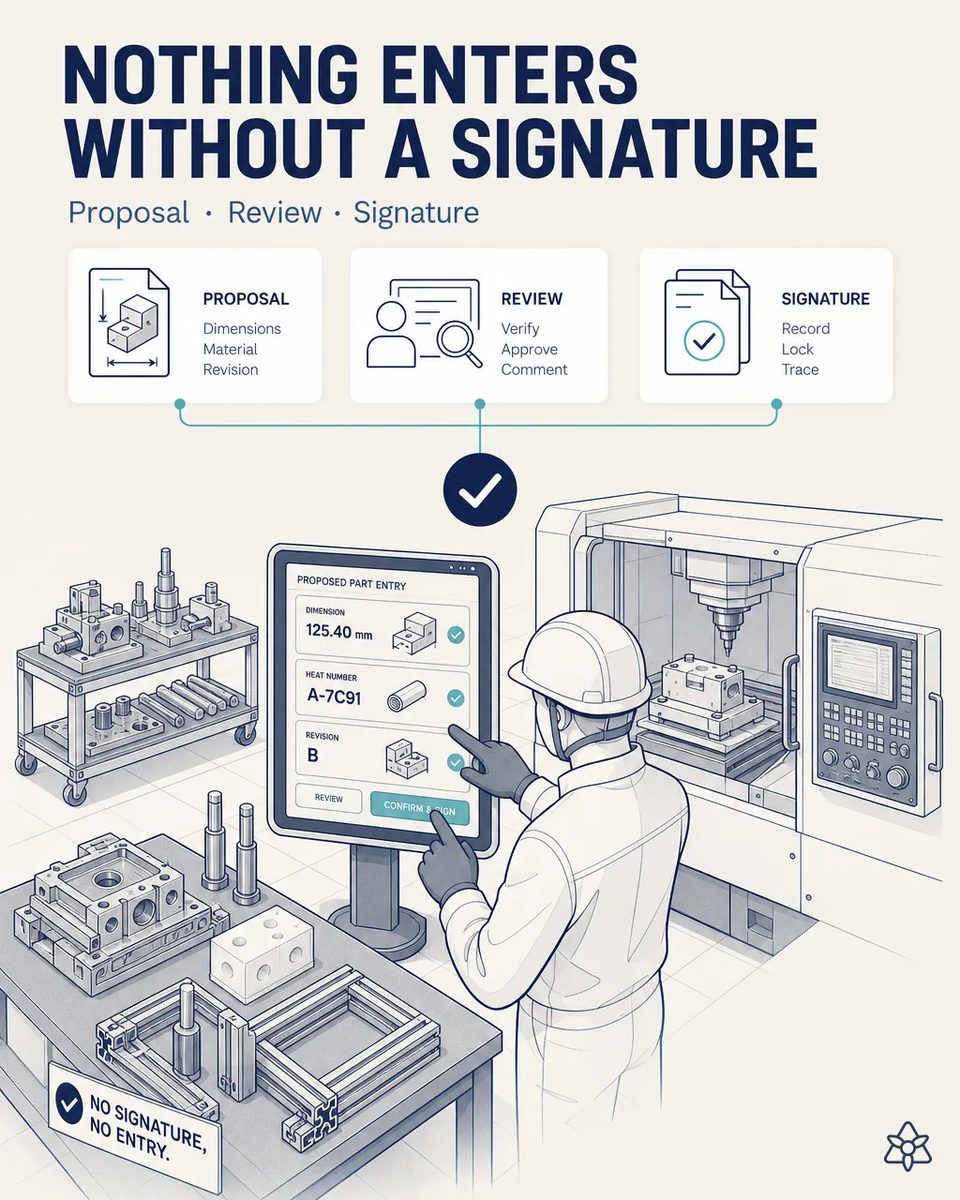
This is what separates iLEAN from an "autonomous" AI that writes data without a signature and ends up contaminating the master. In a shop where one mis-recorded dimension becomes a rejected fixture, the tablet at the machine shows a summary of what was captured and the machinist confirms with two taps. Only then does the data cross.
The data that weighs most is the data that forgives a transcription error least.
The data that carries the most weight is exactly the data that forgives a transcription error least: the drawing revision the part was cut to, the heat number of the material and the critical dimension measured. An extra zero on a dimension or a misattributed heat is not caught on the floor: it is caught in the customer's audit or in the complaint, weeks later, when there is no way to reconstruct what happened. At the same time the machinist cannot afford a long form: if the human gate costs him time, he routes around it. That is where most of these projects fail.
- The drawing revision the part was machined to, the material heat number and the measured critical dimension.
- An extra zero on a dimension or a mis-attributed heat are not caught in the shop: they are caught in the customer's audit or in the claim, weeks later.
- And by then there is no way to reconstruct what happened.
- At the same time the operator cannot afford a long form: if the human gate costs them time, they route around it. That is where most of these projects fail.
Connect in early-human-verification mode — the AI proposes, the person signs.
Connect in early human verification mode.
The tablet shows large cards with the field, the read value and the confidence level. It is built for validating, not for entering data, and that distinction decides adoption.
- The tablet shows large cards with what iLEAN proposes: field, read value and confidence level.
- The machinist validates with 2 taps or corrects the field directly.
- What he corrects feeds back into the system.
- Only after the signature does the data cross into central memory and the ERP, with authorship and timestamp recorded. The AI proposes, the person signs.
Data with no gate vs. signed data
| Aspect | Without the human gate | With early verification |
|---|---|---|
| Entry into the ERP | Direct, or never out of fear | Only after the signature |
| Transcription error | Found in an audit | Found at the machine |
| Operator's work | A form they route around | Two taps |
| Authorship and time | Not recorded | Recorded |
| Corrections | Lost | Fed back to the system |
| History for quoting | Unreliable | Signed |
AI-captured data entering unchecked (risk of contaminating the master) or not captured at all out of caution → data captured and signed in seconds, with authorship and time. Transcription error found in the audit → found at the machine.
Impact estimate — to validate against your numbers.
The block below is an estimate to be validated against your plant's actual data. We put it forward so the committee has an order of magnitude; we refine it during the assessment.
- Applies to every capture in the matrix: traveler, machine panel, revision, voice, metrology and receiving.
- Indicative payback between 4 and 9 months, dominated by avoiding rejections on documentation.
- Plus the reliability of the history that feeds future quotes, which on one-off work is where margin is decided.
- Without this piece, the rest gets neither signed off in committee nor accepted in the shop.
estimated payback 4-9 months, driven by avoided documentation rejections and by the reliability of the history that feeds future quoting. *Estimate to be validated.*
And the fair question from the production manager
“Isn't this putting somebody back to entering data?” — it is the opposite, and the difference is what is being asked. A form makes you produce information from scratch; here there is a summary already composed and the task is to say whether it is right. In most cases the gesture is to confirm; what is preserved is the judgment of the person at the machine.
[1] OpenAI paper "Why Language Models Hallucinate", 2025 — on the reliability of AI in anchored tasks.
What people ask about early human verification
Why not let the data through on its own?
Because the cost of a bad record is not proportional to the error. A mis-recorded dimension or a mis-attributed heat contaminates the delivery dossier and shows up in the customer's audit, when nothing can be reconstructed. The gate costs seconds and removes that whole category of problem.
What is the confidence level it shows?
How sure the reading of that specific field is. It directs attention: low-confidence fields get looked at, the rest get confirmed at a glance. That is what makes validating cost two taps instead of a full review.
Who validates what?
Whoever has the judgment to catch the error, not whoever has the title. Machine data is validated by the operator, because they can see that a dimension does not add up; metrology or receiving data, by the relevant lead.
What if nobody validates?
It stays pending and visible, and does not enter. Captures piling up is itself an indicator that the capture is badly fitted into that role's flow and needs revisiting. That beats letting them in and having the problem surface three months later.
Does it count as evidence for the customer?
Yes, and it is a side effect that tends to surprise. Who validated what and when is recorded, and that feeds the delivery dossier with no extra work. Part of what gets assembled by hand on the last day comes from here.
More cases from this series
- The delivery file stops being assembled by hand on the last dayDrawing, heat, dimensions, images and signatures organised by each customer's standard while the job…
- A tooling shop's core pain is not cost, it is the dateFour coordinated rings from material receiving to the shipping dock: intake, start, execution and…
- You already own the good pieces — they just needed stitchingThe measurement report and the machining program tie themselves to the job and its revision. Without…
- A late drawing revision is the most expensive mistake in the shopThe revision lands by email or WhatsApp and the plate is already on the machine. iLEAN catches it the…
- Your most veteran machining centre can finally talkAn external camera reads the proprietary control of your veteran machining centre: spindle hours,…
- The heat number stops getting lost between the dock and the filing cabinetPhotograph the packing slip and the mill certificate: supplier, alloy and heat number enter the ERP with…
Tell us which transcription error showed up in your last audit.
We work on your plant's real data, not ours. Assessment with no commitment.
Request estimated ROI within 48h ‹ See all cases of precision fixtures and frames See metal fabrication