The traveler is still paper, but it no longer gets lost
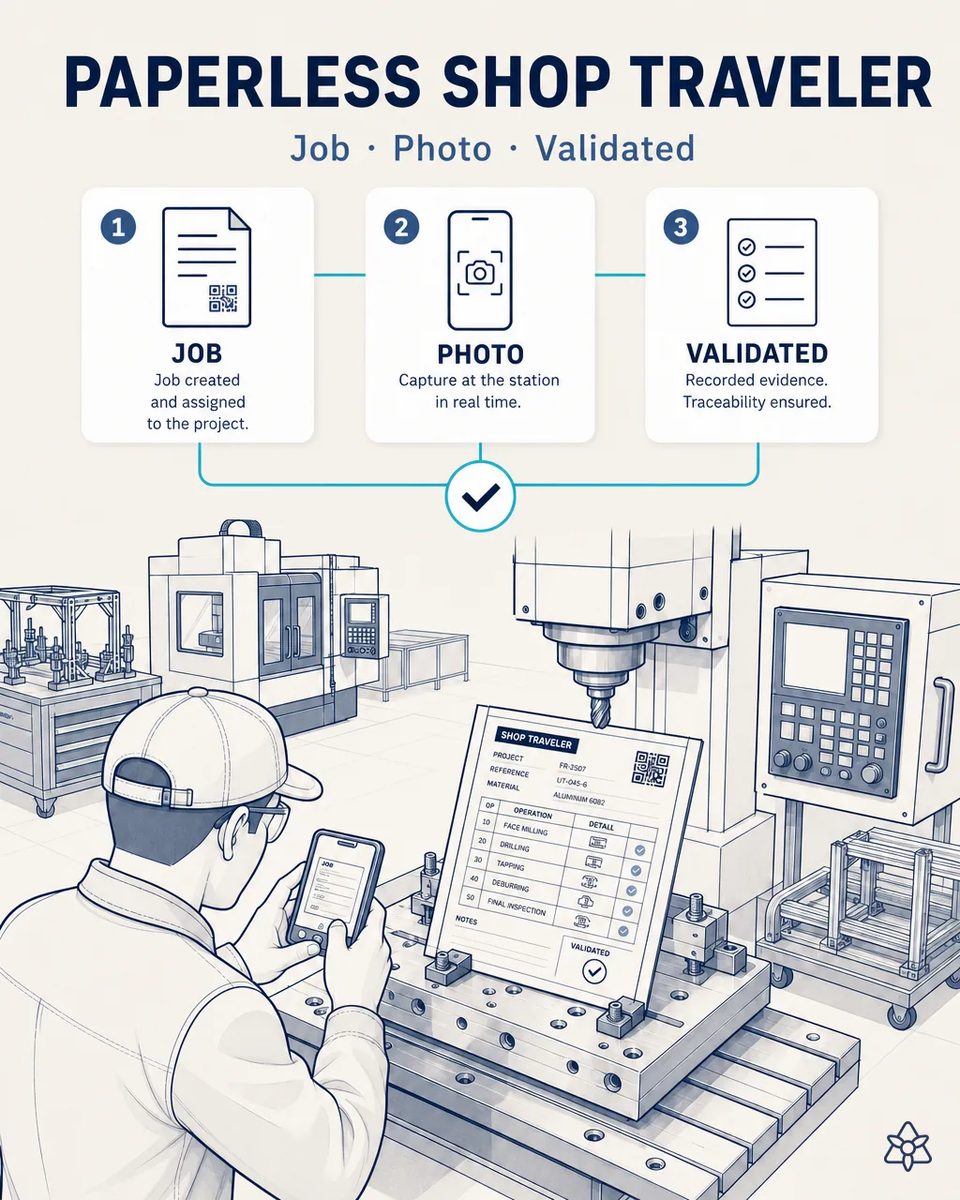
In a tooling shop every job rides with its printed router, and that sheet is the only place the truth lives: which operation ran, on which machine, how many hours it took and what was reworked. It travels with the part for days and ends up in a tray until somebody captures it at job close. With Connect the machinist photographs it when clocking each operation and the job exists in the central system from second zero, with no change to his routine.
On one-off work, knowing late is the same as not knowing.
The sheet is printed when the job is released and from then on accumulates handwritten notes: actual hours, tool changes, "waiting on material", "repeated because of a burr", the operator's signature. Because it is paper, nobody knows the real status of a job without physically finding it at the machine. And the comparison that really matters — quoted hours against actual hours — can only be made at the end, when nothing can be corrected. On one-off work that lag is the difference between a job with margin and a job that ate its margin without anyone noticing.
- The traveler accumulates handwritten notes: real hours, tool change, “waiting on material”, “repeated for burr”, the operator's signature.
- Because it is paper, nobody knows the real state of a project without physically walking to the machine to find it.
- The comparison that matters — quoted hours against real hours — can only be made at the end, when nothing can be corrected.
- And that is the difference between a job with margin and one that ate the margin without anybody noticing.
Connect in photo mode — the paper keeps traveling with the part.
Connect in photo mode.
Zero habit change. It is the condition for the solution to still be alive in month three, which is where the ones that make the operator clock in on a screen die.
- The machinist photographs the sheet when starting and closing each operation.
- A grounded model extracts structured fields: job number, operation, machine, operator, hours and any noted issue.
- It is stored in central memory tied to the job and its revision.
- Tablet validation confirms before anything crosses to the ERP. Zero habit change: the paper sheet still exists and still rides with the part.
A traveler in a tray vs. a captured traveler
| Aspect | Today | With iLEAN Connect |
|---|---|---|
| Real state of the project | 1-3 days of latency, or only at close | Second zero |
| Checking it | Walk down to the machine | From anywhere |
| Quoted vs. real hours | Known when it ends | While the job is alive |
| Noted incidents | Stay on the paper | Tied to the project |
| Revision worked to | Has to be inferred | On record |
| Operator's routine | — | The same |
real job status with 1-3 days of latency (or only at close) → status at second zero, visible without walking the floor. Quoted vs. actual hours known at the end → known while the job is still alive.
Impact estimate — to validate against your numbers.
The block below is an estimate to be validated against your plant's actual data. We put it forward so the committee has an order of magnitude; we refine it during the assessment.
- Shops with several dozen jobs open in parallel and a paper traveler per project.
- Indicative payback between 4 and 9 months, depending on the number of simultaneous jobs.
- Through recovered administrative capture time and visibility of hour deviations in time to react.
- On one-off work that reaction is the entire margin: there are no follow-on units to make it back.
estimated payback 4-9 months depending on how many jobs run in parallel. Recovery of administrative capture time and visibility of hour overruns in time to react. *Estimate to be validated.*
And the fair question from the production manager
“What if the operator skips the photo?” — that is the real risk of any capture, and it is why the gesture is a photo and not a screen clock-in: it takes two seconds with the phone already in their pocket. Operations with no photo show up as gaps in the project, so the omission is visible the same day instead of at close.
[1] OpenAI paper "Why Language Models Hallucinate", 2025 — on the reliability of AI in anchored tasks.
What people ask about digitizing the shop traveler
Does the paper have to go?
No, and that is the point. The traveler still prints when the job is released and still travels with the part, which is how the shop knows how to work. Removing the paper in one go is what makes these projects get abandoned: you replace the medium that works with a screen that gets in the way.
Does it read handwriting?
It reads the structured fields reliably and free notes as associated text. If a note is unreadable it gets flagged in the validation rather than invented. The photo is kept, so the original source is always there to check.
What about subcontracted operations?
They are recorded the same way, with a photo of the traveler on dispatch and on return. In this sub-sector surface treatment is usually external and it is where most days disappear unnoticed, so having the dispatch and the return time-stamped changes the conversation about why a project is late.
Does it help compare quoted with real hours?
That is the main reason to do it. Today that comparison arrives at close, when the job has already eaten the margin. With capture per operation the deviation shows while the project is still on the table and something can still be decided.
Does the shop need network coverage?
Not continuously. If the machine area has poor coverage, the photo queues and uploads when there is signal. That is one reason to do it by photo rather than with a connected app.
More cases from this series
- The delivery file stops being assembled by hand on the last dayDrawing, heat, dimensions, images and signatures organised by each customer's standard while the job…
- A tooling shop's core pain is not cost, it is the dateFour coordinated rings from material receiving to the shipping dock: intake, start, execution and…
- You already own the good pieces — they just needed stitchingThe measurement report and the machining program tie themselves to the job and its revision. Without…
- A late drawing revision is the most expensive mistake in the shopThe revision lands by email or WhatsApp and the plate is already on the machine. iLEAN catches it the…
- Your most veteran machining centre can finally talkAn external camera reads the proprietary control of your veteran machining centre: spindle hours,…
- The heat number stops getting lost between the dock and the filing cabinetPhotograph the packing slip and the mill certificate: supplier, alloy and heat number enter the ERP with…
Tell us how many jobs you have open at once and how you know their state today.
We work on your plant's real data, not ours. Assessment with no commitment.
Request estimated ROI within 48h ‹ See all cases of precision fixtures and frames See metal fabrication