In a tooling shop, the shop lead is the system
He knows which job is tight on schedule, which machine is leaving finish problems, which customer will accept a day of slack and which machinist is right for a delicate setup. And he never types, because his hands are never free. All that knowledge evaporates at the end of the shift. With the earpiece he talks to the AI without stopping.
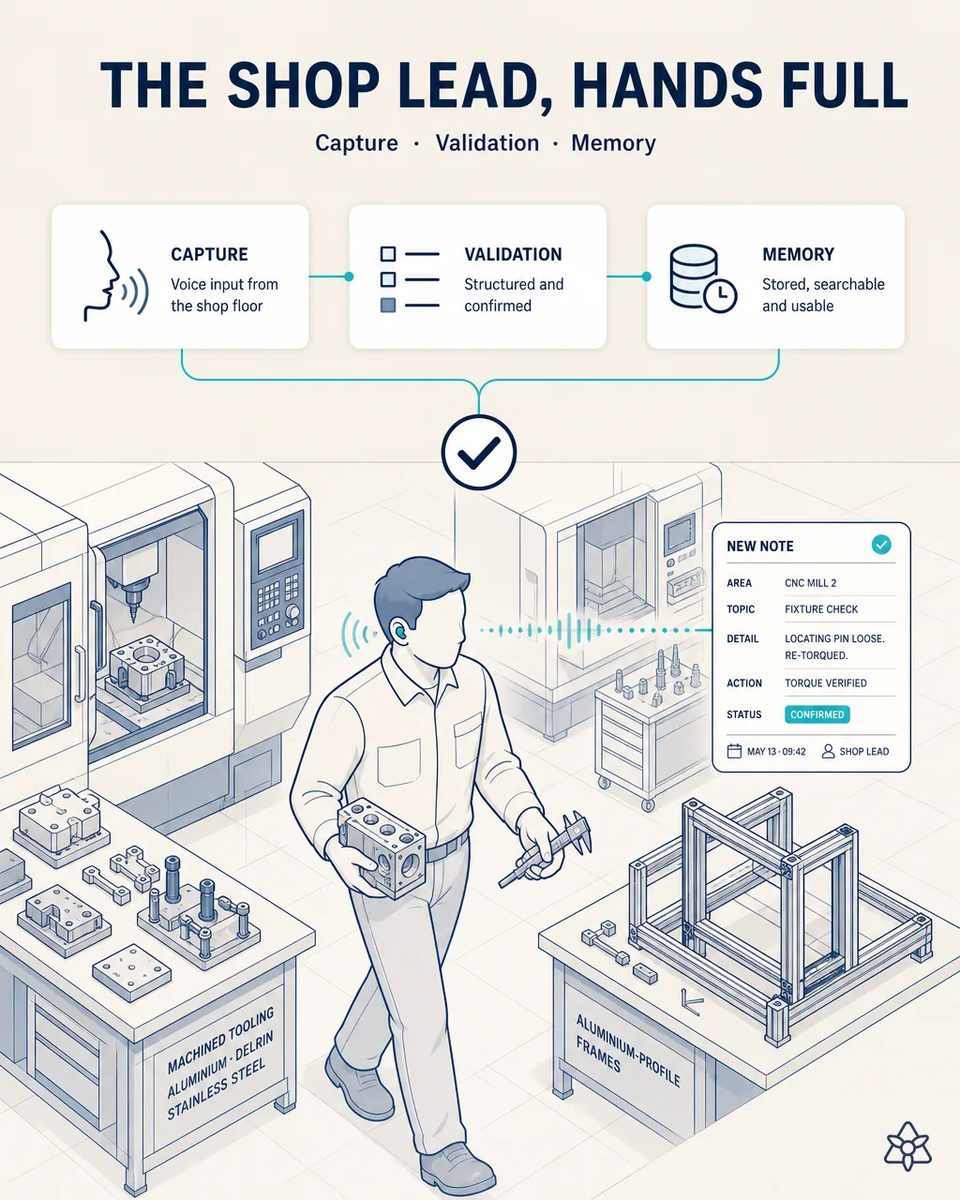
When that person is off, the operation degrades overnight.
The most valuable operational knowledge in the business is tacit and lives in no system. When that person takes leave, falls ill or retires, the operation degrades overnight — a concrete exposure in a trade where experience is counted in decades. On top of that, everything he spots while walking ("this machine has been leaving a clamping mark since the vise change") never reaches whoever could fix it at the root. It is not a willingness problem: recording costs time, and he has none.
- They know which project is tight on date, which machine is giving finish problems, which customer will take a day of slack and which operator is the right one for a delicate setup.
- They never type, because their hands are never free.
- What they notice while walking — “this machine has been leaving a clamp mark since the vise change” — never reaches whoever could fix it at the root.
- It is not a willingness problem: recording costs time and they do not have it. In a sub-sector where experience is counted in decades, that dependency is a concrete risk.
Connect in voice mode — and the conversation runs both ways.
Connect in voice mode over an industrial Bluetooth earpiece.
They do not just dictate: they ask. Which operation a project is on, whether there is equivalent stock, who has already been notified. The answer comes back through the same earpiece.
- He dictates in plain language while walking.
- iLEAN listens, structures (job, downtime cause, machine, symptom) and stores it in central memory.
- It answers through the same earpiece with useful support: which job is affected, whether equivalent stock is on the shelf, who it has already notified.
- It also answers his questions: which operation a given job is on. The conversation runs both ways.
Tacit knowledge vs. central memory
| Aspect | Today | With iLEAN Connect voice |
|---|---|---|
| Recording what they see | Stop and type: does not happen | Dictate it while walking |
| What they know | Leaves with them | Cumulative team memory |
| Checking a project's state | Ask them | Ask the system |
| When they are off or retire | The operation degrades | The knowledge stays |
| Symptom spotted at a machine | Never reaches maintenance | Routed on its own |
| Friction cost | The reason it does not happen | None |
tacit knowledge dying at shift end → cumulative central memory the whole team can query. Issues spotted while walking and never recorded → recorded with no friction cost.
Impact estimate — to validate against your numbers.
The block below is an estimate to be validated against your plant's actual data. We put it forward so the committee has an order of magnitude; we refine it during the assessment.
- Shops where one person holds the schedule, the assignment and the quality criterion.
- Indicative payback between 4 and 10 months.
- The big value is not the time saved, it is reducing the dependency on one person.
- It is the case that fits a savings spreadsheet worst and the one most missed the day that person is not there.
estimated payback 4-10 months. The big value is not the time saved but the reduced dependence on a single person. *Estimate to be validated.*
And the fair question from the production manager
“Is this monitoring the shop lead?” — the architecture prevents it before the promise does: the system listens after a wake word they say themselves, there is no open microphone, and what gets recorded are process incidents tied to a project and a machine. There are no indicators about people and no record of conversations.
[1] OpenAI paper "Why Language Models Hallucinate", 2025 — on the reliability of AI in anchored tasks.
What people ask about dictating in the shop
Does it work with machine shop noise?
That is the first test to run, and it depends on the earpiece more than the model. With a contact earpiece and active cancellation, background noise is handled well; next to a rougher at full tilt, less so. It gets tested in the actual shop before anything is committed.
What does it gain over noting it on a phone?
That you do not have to take your hands off or stop. Noting it on a phone is already possible today and does not happen, and not for lack of discipline: it interrupts what they are doing. Voice removes exactly that friction, which is why the record does not exist.
Does it answer questions too?
Yes, and that is half the value. They can ask which operation a project is on, or whether there is equivalent material in stock, without walking back to the office. That turns the earpiece into something that saves them trips rather than something that asks them for work — which is why it gets adopted.
Where does what they dictate go?
To central memory, structured by project, machine, cause and symptom, and routed to the relevant role. It passes through the tablet validation before becoming a firm record, like every other capture in this matrix.
How long before it shows?
The record, from the first shift. The real value appears once a few weeks have accumulated and the recurring symptom reads as a pattern — “this machine has been leaving a mark for a month since the vise change” is a sentence nobody can say with data today.
More cases from this series
- The delivery file stops being assembled by hand on the last dayDrawing, heat, dimensions, images and signatures organised by each customer's standard while the job…
- A tooling shop's core pain is not cost, it is the dateFour coordinated rings from material receiving to the shipping dock: intake, start, execution and…
- You already own the good pieces — they just needed stitchingThe measurement report and the machining program tie themselves to the job and its revision. Without…
- A late drawing revision is the most expensive mistake in the shopThe revision lands by email or WhatsApp and the plate is already on the machine. iLEAN catches it the…
- Your most veteran machining centre can finally talkAn external camera reads the proprietary control of your veteran machining centre: spindle hours,…
- The heat number stops getting lost between the dock and the filing cabinetPhotograph the packing slip and the mill certificate: supplier, alloy and heat number enter the ERP with…
Tell us what happens in your shop the day the shop lead is not in.
We work on your plant's real data, not ours. Assessment with no commitment.
Request estimated ROI within 48h ‹ See all cases of precision fixtures and frames See metal fabrication