Setup verified by vision before start
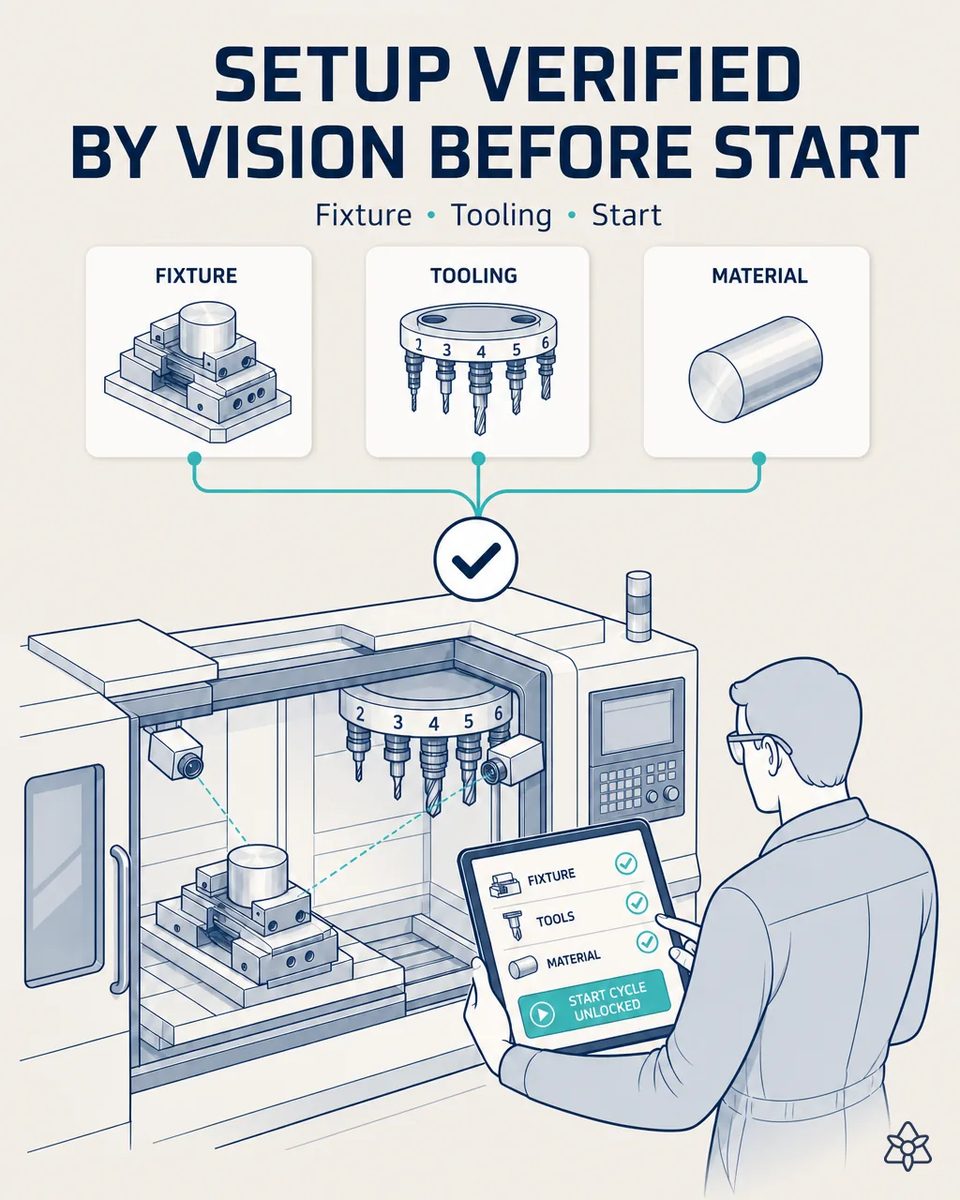
A high-mix shop runs several part-number changes per shift. Each setup means mounting the right fixture, loading the right tools in the carousel and the raw stock of the right material. iLEAN Edge uses cameras to compare the machine state with that job's reference: fixture, visible tools and material.
In a high-mix shop, one wrong tool pocket can cost days of spindle time.
A high-mix shop runs several part-number changes per shift. Each setup means mounting the right fixture, loading the right tools in the carousel and the raw stock of the right material. A tool in the wrong pocket or a fixture from another part number means, at best, a bad first part; at worst, a spindle crash with days of downtime and an expensive repair. Today it all depends on the setup technician checking by eye.
- A high-mix job shop runs several part-number changes per shift, each one with a fixture to mount, tools to load in the carousel and raw stock to fit.
- A tool in the wrong pocket or a fixture from another part number means, at best, a bad first part and a setup to redo. In a shop where lots are small, one bad first part can be a meaningful share of the batch.
- At worst it means a spindle crash: days of downtime, an expensive repair and every job queued behind that machine late.
- Today it all depends on the setup technician checking by eye, often under pressure because the machine is waiting and the planner is asking.
Edge plus JIDOKA AI — cycle start waits for the cameras and the technician.
iLEAN Edge uses cameras to compare the machine state with that job's reference: fixture, visible tools and material. JIDOKA AI: cycle start is not enabled until the cameras give OK and the technician signs off. SMED AI also records every setup to shorten the next one. The setup technician still releases the machine, but now signs off with visual evidence on the tablet. The AI verifies, the person decides.
The technician still releases the machine, but now signs on visual evidence instead of on memory. And because SMED AI records every setup, the next changeover of the same part number starts from the best one so far instead of from scratch. The knowledge of your best setup technician stops living only in their hands.
A setup checked by eye versus a setup verified by camera
| Aspect | Today | With iLEAN Edge |
|---|---|---|
| Fixture for the part number | Checked by eye | Compared with the job reference |
| Tools in the carousel | Pocket list on paper | Visible tools verified by pocket |
| Raw stock material and size | Assumed from the traveler | Checked against the job |
| Cycle start | Whenever the technician presses it | Enabled only after OK plus sign-off |
| Setup duration | Not measured | Recorded and shortened with SMED AI |
| Proof of how the machine was set up | A signature | Images stored with the job |
Setup checked by eye → verified by cameras against the job reference. Crashes and bad first parts from setup errors → start blocked until OK + sign-off. Setup time unmeasured → measured and reduced with SMED AI.
Impact estimate — to be validated against your part mix and crash history.
The block below is an estimate to be validated against your plant's actual data. We put it forward so the committee has an order of magnitude; we refine it during the assessment.
- Estimated payback 4-10 months, depending on part mix and changeovers per shift.
- Zero crashes or bad first parts from setup errors as the target, with start blocked until OK and sign-off. One avoided crash usually pays a large part of the case.
- Shorter setups, measured one by one, because SMED AI keeps the best changeover of each part number as the reference to beat.
- And setup evidence ready for a PPAP or FAI package without anyone photographing it by hand, stored with the job and the technician's signature.
Payback 4-10 months · zero crashes or bad first parts from setup errors (estimate to be validated) Fewer crashes, fewer bad first parts and shorter setups measured one by one. We estimate a 4 to 10 month payback depending on part mix; estimate to be validated.
And the fair question from the production manager
“What if the camera blocks a correct setup and the machine sits idle?” — comparing a fixture, visible tools and stock against a stored reference image is an anchored task, where the best models drop below 1.5% error [1]. When the system is unsure it does not block silently: it shows the technician what differs, and the technician decides and signs, with the exception recorded. Over time the exceptions show which references need updating and which setups really were wrong.
[1] OpenAI paper "Why Language Models Hallucinate", 2025 — on the reliability of AI in anchored tasks.
What people ask about verifying a CNC setup by camera
What exactly do the cameras check before cycle start?
The fixture against the part number's reference, the visible tools in their carousel pockets, and the raw stock's material and size. The checkpoints are defined with your setup team, starting with the ones behind your last crashes or bad first parts.
How is the reference for a part number created?
From the first approved setup of that part number. The technician confirms it once and it becomes the reference for every later changeover, updated when the job changes revision. The setup technician can replace the reference whenever the fixture is modified.
Can it see tools hidden inside a closed magazine?
Only the visible ones. For the rest it reads the tool table on the control screen and compares it with the tool list of the job, so a hidden tool in the wrong pocket is still caught. Tool length offsets that look wrong for the job are highlighted the same way.
Does camera verification slow down the changeover?
The check takes seconds. What lengthens setups today is the double-checking out of fear of a crash, and that is exactly what it replaces. Most technicians end up faster, not slower, because they stop rechecking pockets by hand.
How does SMED AI shorten the next setup of the same part?
It records each setup step by step and its duration, so the next changeover of the same part number has a measured best time and sequence to beat. Over months that turns setup reduction from a workshop exercise into a daily habit.
More cases from this series
- Lights-out night shift without surprisesConnect, Edge, JIDOKA AI and Agents working together to run CNC cells unattended at night: more spindle…
- PPAP and FAI evidence pack, always readyEvery setup, first article and validated measurement generates evidence; Agents builds the PPAP or FAI…
- Two-tap human validation at the cellWhat iLEAN captures appears on the cell tablet; the operator validates it with two taps before it…
- Modern CNC and robot cell wired to the ERPiLEAN reads what the machine publishes via MTConnect or OPC UA and mirrors it in the ERP; the ERP…
- Drawing revision change caught instantlyiLEAN reads the customer email, spots the new drawing revision and matches it to the job on the machine…
- The shift supervisor, hands-freeThe supervisor dictates issues while walking the floor; iLEAN structures them by machine, job and shift…
Tell us what your last spindle crash cost in repair and lost hours.
We work on your plant's real data, not ours. Assessment with no commitment.
Request estimated ROI within 48h ‹ See all cases of CNC machining See metal fabrication and capital equipment