Lights-out night shift without surprises
In CNC machining the expensive asset is the machine and what you sell is spindle hours. Many shops use their machines less than half of the available time: stops with no recorded cause, long setups, and night shifts nobody dares to run without an operator. iLEAN coordinates everything we have seen.
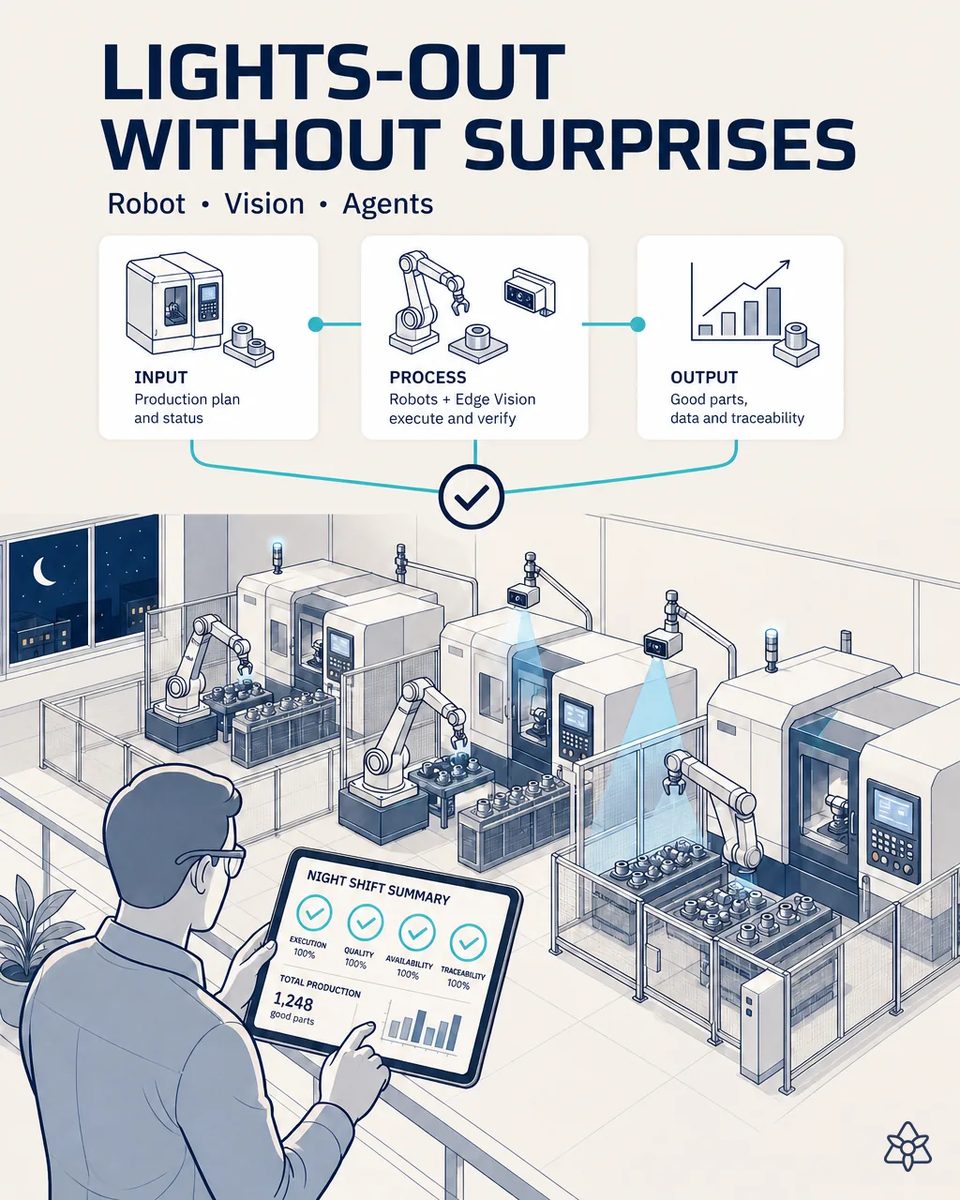
The robot makes the night shift possible; trust is what is missing.
In CNC machining the expensive asset is the machine and what you sell is spindle hours. Many shops use their machines less than half of the available time: stops with no recorded cause, long setups, and night shifts nobody dares to run without an operator. A loading robot makes night production possible, but nobody trusts it: a broken tool, a bad part repeated four hundred times, an alarm that leaves the cell idle from two in the morning. In the morning, a surprise.
- In CNC machining the expensive asset is the machine and what you sell is spindle hours, yet many shops use their machines less than half of the available time.
- The hours go to stops with no recorded cause, long setups and night shifts nobody dares to run without an operator.
- A loading robot makes the night possible, but nobody trusts it: a broken tool, a bad part repeated four hundred times, an alarm that leaves the cell idle from two in the morning.
- So the robot cell runs one shift, and the morning starts with a surprise more often than with finished parts.
Connect, Edge, JIDOKA AI and Agents together — everything above, orchestrated for the night.
iLEAN coordinates everything we have seen. Connect wires modern and legacy machines to the ERP and knows which job runs on which revision. Edge verifies the setup before the cell is left alone and sees every part at the exit. JIDOKA AI stops the cell on an anomaly instead of making scrap. And Agents reads tool wear and spindle load signals, anticipates failures and organizes the evidence. If something needs a decision, Agents alerts the on-call technician with the cause and the suggested action; the technician decides. In the morning, the production manager finds a shift summary, not a surprise.
No single piece makes a lights-out shift safe; each one already exists in some shops and the night still goes wrong. What changes is that the setup is verified before the cell is left alone, every part is seen, an anomaly stops the cell instead of feeding scrap, and a person is called only when a decision is needed. That is what turns an idle night into spindle hours you can sell.
The layers of a lights-out shift, and what each one covers
| Layer | Which cases it draws on | What it covers at night |
|---|---|---|
| 1 · Job and revision | Revision change (3) + MTConnect (8) + legacy panel (2) | Which job runs on which revision, on every machine |
| 2 · Before leaving the cell | Setup verification (10) + cell tablet (5) | Fixture, tools and stock signed off before lights go out |
| 3 · During the night | Burrs and features (9) + JIDOKA AI | Every part seen; the cell stops on an anomaly |
| 4 · Signals and wear | Agents on tool wear and spindle load | Failures anticipated, on-call technician alerted with cause |
| 5 · Next morning | Evidence pack (11) + supervisor voice log (4) | A shift summary and evidence filed by part number |
| Human in command | On-call technician and production manager | Every decision that is not routine |
Spindle utilization below 50% and unattended night shifts avoided → lights-out shift with verified setup, 100% inspection and automatic stop on anomaly. Morning surprises → shift summary and actionable alerts to the on-call technician.
Impact estimate — to be validated with your machine utilization data.
The block below is an estimate to be validated against your plant's actual data. We put it forward so the committee has an order of magnitude; we refine it during the assessment.
- Estimated payback 6-12 months, counted on spindle hours that today simply do not exist at night.
- +20 to +40% productive spindle hours from the same machines, by opening the night to cells that today stand still.
- The path is measure, decouple the operator from the machine, consolidate and predict — each step paying on its own.
- And mornings that start with a shift summary and actionable alerts instead of a cell in alarm since two o'clock.
Payback 6-12 months · +20 to +40% productive spindle hours (estimate to be validated) The path is measure, decouple the operator from the machine, consolidate and predict. We estimate 20 to 40% more productive spindle hours from the same machines and a 6 to 12 month payback; estimate to be validated with your utilization data.
And the fair question from the production manager
“Do we need all twelve cases before running a single night unattended?” — no, and framing it that way would be the surest way never to start. The layers are built in order and each pays on its own. And the night decisions that matter are anchored tasks — reading a counter, matching a setup to its reference, classifying a known defect — where the best models drop below 1.5% error [1]; anything else wakes the on-call technician, who decides. The cell never guesses its way through a situation it has not seen.
[1] OpenAI paper "Why Language Models Hallucinate", 2025 — on the reliability of AI in anchored tasks.
What people ask about running CNC cells lights-out with iLEAN
Which case should a job shop start with on the way to lights-out?
Usually with measuring: reading the machines, modern and legacy, so you know your real spindle utilization before deciding which cell goes unattended first. The best candidate is usually a robot cell with long cycles and a stable part number.
Does the cell restart by itself after JIDOKA AI stops it?
No. A stop on an anomaly waits for a person. Agents tells the on-call technician the cause and the suggested action, and the technician decides whether to restart, change a tool or leave it for the morning. Every stop and its decision are logged for the morning summary.
How does it anticipate a broken tool during the night?
Agents follows tool wear and spindle load signals per tool and part number, and warns when the trend points to a failure before the tool life runs out. A sister tool can then be called, or the cell stopped cleanly, instead of crashing into the next part.
What does the production manager see in the morning?
A shift summary: good parts per job, stops and their causes, parts diverted by Edge and any alert sent to the on-call technician with its outcome. The morning meeting starts from facts, not from what the first operator found.
Can the return of an unattended shift be sized before committing?
Yes. With your utilization data, setups per shift and the cost of an idle night, we estimate the return of each layer before choosing the order. Nothing has to be committed for all twelve cases at once.
More cases from this series
- PPAP and FAI evidence pack, always readyEvery setup, first article and validated measurement generates evidence; Agents builds the PPAP or FAI…
- Two-tap human validation at the cellWhat iLEAN captures appears on the cell tablet; the operator validates it with two taps before it…
- Modern CNC and robot cell wired to the ERPiLEAN reads what the machine publishes via MTConnect or OPC UA and mirrors it in the ERP; the ERP…
- Drawing revision change caught instantlyiLEAN reads the customer email, spots the new drawing revision and matches it to the job on the machine…
- The shift supervisor, hands-freeThe supervisor dictates issues while walking the floor; iLEAN structures them by machine, job and shift…
- The legacy CNC lathe that now talksAn external camera reads the old CNC control screen: part counter, spindle load and alarms, without…
Book a utilization assessment of your CNC machines.
We work on your plant's real data, not ours. Assessment with no commitment.
Request estimated ROI within 48h ‹ See all cases of CNC machining See metal fabrication and capital equipment