The legacy CNC lathe that now talks
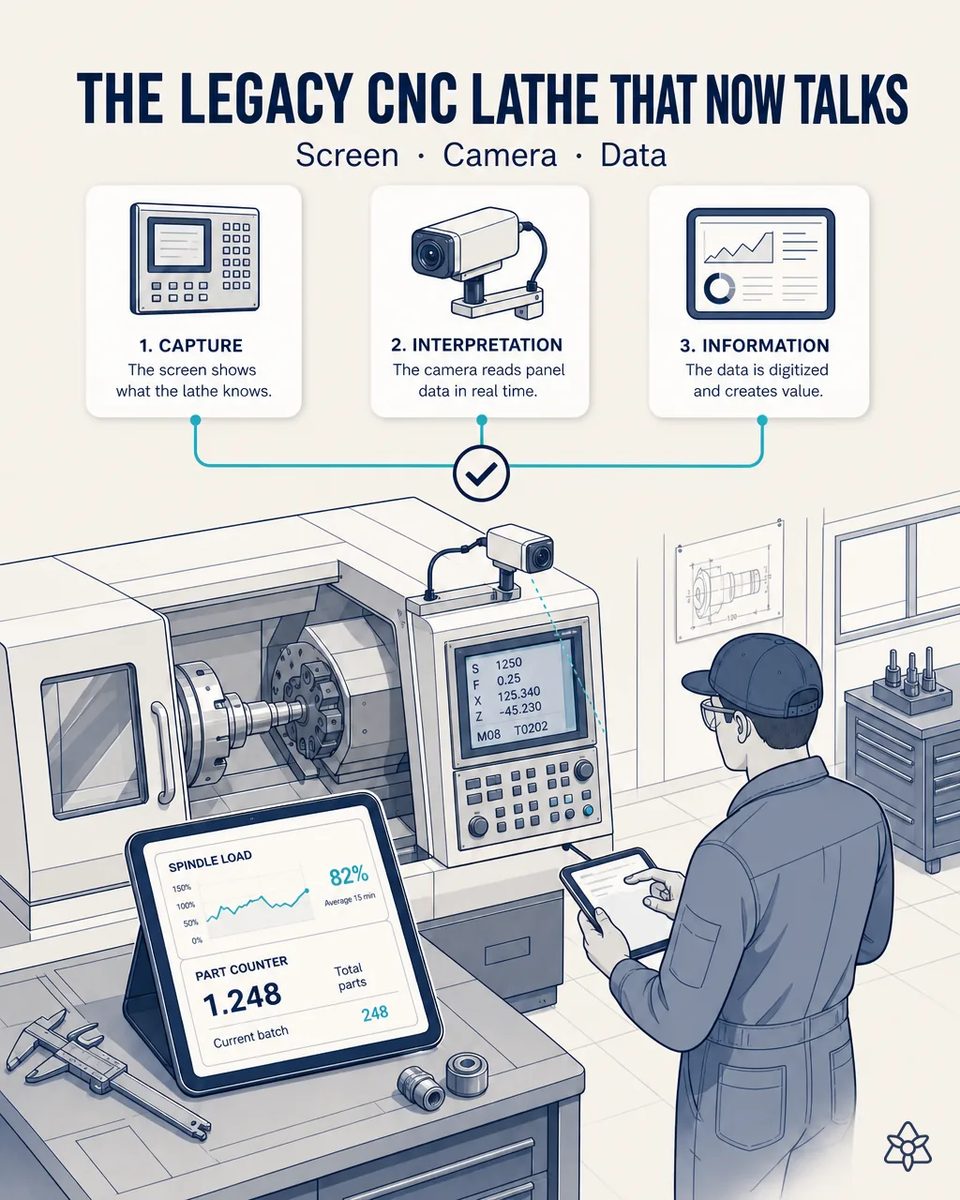
Almost every shop has one or more lathes or machining centers that are fifteen to twenty-five years old, with controls that have no Ethernet and no open protocol. They are paid off, reliable and critical for capacity. Replacing them costs hundreds of thousands and weeks of ramp-up. iLEAN Connect places an external camera aimed at the panel.
The machine that pays the bills is the one that tells you nothing.
Almost every shop has one or more lathes or machining centers that are fifteen to twenty-five years old, with controls that have no Ethernet and no open protocol. They are paid off, reliable and critical for capacity. Replacing them costs hundreds of thousands and weeks of ramp-up. The control screen shows exactly what you need: part counter, spindle load, active alarm, running program. But that data dies on the screen. Nobody knows how many real spindle hours that machine delivered yesterday, or why it stopped at three in the morning.
- Most job shops run lathes and machining centers that are fifteen to twenty-five years old: paid off, accurate enough and critical for capacity, but with a control that has no network port and no open protocol. Retrofitting a data interface onto one of them is often quoted at more than the machine is worth on paper.
- Replacing one costs hundreds of thousands and weeks of ramp-up, so the replacement keeps getting postponed, or approved, on gut feeling rather than on hours delivered.
- The control screen already shows everything that matters — part counter, spindle load, active alarm, running program — but that data dies on the screen the moment the next cycle starts.
- Nobody can say how many real spindle hours that machine delivered yesterday, or why it sat in alarm from three in the morning until the first shift arrived.
Connect in photo mode on the control screen — the cabinet stays closed.
iLEAN Connect places an external camera aimed at the panel. The system reads the screen every few seconds, interprets figures and alarms with OCR and an anchored model, and links them to the active job. The machine stays as it is, cabinet closed and control untouched, but now it talks. The maintenance lead reviews the detected events and decides which alarms open a work order. The AI never touches or stops the machine: it informs, and the person is in command.
Nothing is installed on the control, no wire goes into the cabinet and no retrofit kit is needed. On a machine whose original builder may not even support it anymore, that is the difference between a pilot you can start this month and a project nobody dares to sign, and it puts the oldest machines in the same utilization report as the newest.
The silent old control versus the control being read
| Aspect | Today | With iLEAN Connect |
|---|---|---|
| Spindle hours on the old fleet | Unknown | Logged per job and shift |
| Part counter on an old control | Seen only by whoever walks past | Recorded every few seconds |
| Alarm at three in the morning | Discovered at shift start | Timestamped with its code |
| Changes to the control or wiring | — | None: camera outside the cabinet |
| Replace-or-keep decision on an old lathe | Gut feeling | Real utilization data |
| Which alarms open a maintenance order | Whoever remembers | Decided by the maintenance lead |
Stops and output of the legacy fleet invisible → spindle hours, counter and alarms logged per job. Replacement decisions by gut feeling → decisions backed by real utilization data.
Impact estimate — to be validated against your oldest machine's real hours.
The block below is an estimate to be validated against your plant's actual data. We put it forward so the committee has an order of magnitude; we refine it during the assessment.
- Estimated payback 5-10 months, counted on the spindle hours recovered once stops have a recorded cause.
- The real OEE of your oldest machines and the cause of every stop, instead of nothing at all, measured on the same basis as the newer machines so the comparison is fair.
- The option to defer a machine replacement because the data shows the old one still delivers the hours you need — or, just as useful, the evidence that it really is time to replace it.
- And maintenance stops finding out about night alarms from the morning operator, hours after the cell went quiet.
Payback 5-10 months · spindle hours visible without replacing the machine (estimate to be validated) You go from knowing nothing to having the real OEE of your oldest machines and the cause of every stop. We estimate a 5 to 10 month payback and the option to defer machine replacements; estimate to be validated.
And the fair question from the production manager
“Can a camera reading a worn, glare-prone screen really be trusted?” — the task is anchored: the same screen, fields in fixed positions and physically possible ranges for spindle load and counter, where the best models drop below 1.5% error [1]. Any reading outside the possible range is discarded instead of stored, and the maintenance lead reviews the detected events before any of them opens a work order. If a reading is ambiguous, the frame is kept so a person can look at exactly what the camera saw.
[1] OpenAI paper "Why Language Models Hallucinate", 2025 — on the reliability of AI in anchored tasks.
What people ask about reading an old CNC control screen
Does mounting the camera void the machine builder's support?
No. Nothing is connected to the control, its wiring or its parameters. The camera sits outside the machine on its own bracket and power supply, and can be removed in minutes. The machine keeps running exactly as it did before the camera arrived.
What if the screen is an old monochrome CRT or a small LCD?
Both work. The model is trained on your specific screen, with its font, colors and glare, during commissioning, and keeps working when the operator switches between pages. Lighting around the panel is adjusted at installation so glare from shop lights does not hide digits.
Can it tell which job the spindle hours belong to?
Yes, by reading the program number on screen and linking it to the active job. That is what turns raw hours into hours per part number, which is what quoting needs. Over a few weeks it also shows which part numbers that machine handles worst.
Does it stop the machine if it sees an alarm?
Never. It informs. Stopping, resetting or calling maintenance stays with a person, and the maintenance lead decides which alarm codes deserve a work order.
Is it worth it for just one or two old machines?
Usually yes, because those are often the bottleneck machines. The pilot starts on the oldest one and the pattern is then copied to the rest of the legacy fleet. Each additional machine reuses what was learned on the first, so it goes faster.
More cases from this series
- Lights-out night shift without surprisesConnect, Edge, JIDOKA AI and Agents working together to run CNC cells unattended at night: more spindle…
- PPAP and FAI evidence pack, always readyEvery setup, first article and validated measurement generates evidence; Agents builds the PPAP or FAI…
- Two-tap human validation at the cellWhat iLEAN captures appears on the cell tablet; the operator validates it with two taps before it…
- Modern CNC and robot cell wired to the ERPiLEAN reads what the machine publishes via MTConnect or OPC UA and mirrors it in the ERP; the ERP…
- Drawing revision change caught instantlyiLEAN reads the customer email, spots the new drawing revision and matches it to the job on the machine…
- The shift supervisor, hands-freeThe supervisor dictates issues while walking the floor; iLEAN structures them by machine, job and shift…
Tell us which of your machines is the oldest one still running every shift.
We work on your plant's real data, not ours. Assessment with no commitment.
Request estimated ROI within 48h ‹ See all cases of CNC machining See metal fabrication and capital equipment