Two-tap human validation at the cell
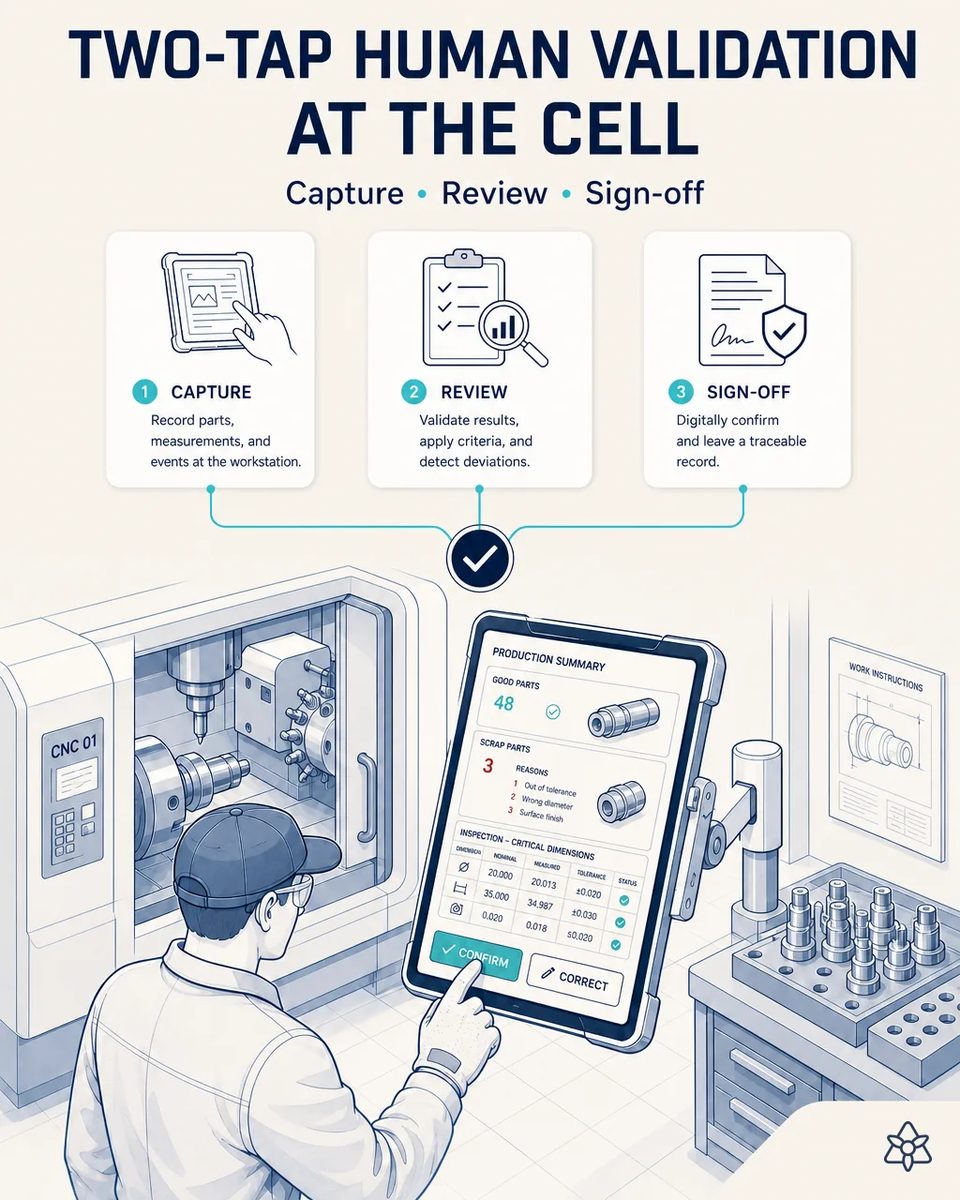
The biggest blocker to digitizing a shop is not technology, it is the fear that an AI will push data on its own and someone will have to clean the ERP master afterwards. At the same time, the operator does not want to type. Each cell has an industrial tablet showing a visual summary of what iLEAN has just captured: good parts, scrap and its reason, first-article dimensions.
Shops fear AI writing to the ERP more than they fear paper.
The biggest blocker to digitizing a shop is not technology, it is the fear that an AI will push data on its own and someone will have to clean the ERP master afterwards. At the same time, the operator does not want to type. iLEAN solves both with one rule: nothing it captures enters the central system unless a human has seen it first. Whether it is a photo of the traveler, a dictated issue or a customer email.
- The biggest blocker to digitizing a job shop is not technology: it is the fear that an AI will push data on its own and someone will spend weeks cleaning the ERP master afterwards.
- At the same time the machinist does not want to type, and a terminal at the far end of the aisle means data entered late, entered by someone else, or not entered at all.
- The result is either unvalidated data polluting routings and part counts, or data never captured because nobody trusts the source.
- Neither works when a customer asks who released a batch and on what measurements, and the honest answer is a shrug. An AS9100 or IATF auditor will ask exactly that question.
Connect with early human verification — a visual summary and two taps at the cell.
Each cell has an industrial tablet showing a visual summary of what iLEAN has just captured: good parts, scrap and its reason, first-article dimensions. The operator confirms with two taps, or corrects before it goes in. Latency: seconds, no training needed. This is what sets an IRIS system apart from an autonomous agent: the person is in command and signs off every piece of data that reaches the ERP.
This is what separates an IRIS system from an autonomous agent: every number that reaches the ERP has a person who looked at it. Without that rule, none of the other eleven cases would get signed off by quality, and with it, the shop can digitize without anyone fearing the master data. It is the first thing we install and the last thing anyone would remove.
Data typed later versus data confirmed at the cell
| Aspect | Today | With iLEAN Connect |
|---|---|---|
| Good parts and scrap by reason | Written on paper, typed at shift end | Shown on the tablet, confirmed in seconds |
| First-article dimensions at the cell | Typed by someone who never held the part | Confirmed by the machinist who measured it |
| State of the ERP master | Fixed after the fact | Clean from the start |
| Training the operator needs | ERP screens and codes | None: confirm or correct |
| Who answers for a value in the ERP | Unclear | A name, a time and what they saw |
| Can the AI write by itself | — | No, by architecture |
Unvalidated data polluting the ERP, or data never captured out of distrust → data captured, reviewed and signed in seconds. ERP master fixed after the fact → clean master.
No standalone payback — the piece every other case rests on.
The block below is an estimate to be validated against your plant's actual data. We put it forward so the committee has an order of magnitude; we refine it during the assessment.
- No standalone payback · enabling piece. Without early human verification nothing else in this matrix gets signed, so its value is counted in the other cases.
- Direct savings depend on how much data is keyed in by hand today; we prefer not to fix a figure until we have seen your shift paperwork and your ERP screens.
- Data captured, reviewed and signed in seconds at the machine instead of hours later at a terminal, by the person who actually held the part and the gauge.
- And a clean ERP master: corrections happen before the data goes in, not weeks afterwards in a cleanup project.
Enabling piece · data validated in seconds and a clean ERP (estimate to be validated) It is the enabling piece of the whole matrix: without early human verification, nothing else gets signed. Its value is strategic; direct savings depend on how much data is keyed in by hand today, estimate to be validated.
And the fair question from the production manager
“If a person confirms everything anyway, what is the AI saving?” — the work is not in deciding, it is in assembling. Reading a traveler, a counter or a dictated issue into the right fields is an anchored task, where the best models drop below 1.5% error [1], and it arrives ready to confirm. The machinist only checks and taps; every correction is stored, so the system learns where it fails. Over time the corrections concentrate on fewer fields, and the confirmation becomes faster still.
[1] OpenAI paper "Why Language Models Hallucinate", 2025 — on the reliability of AI in anchored tasks.
What people ask about confirming data on the cell tablet
How long does confirming take for the machinist?
A few seconds per summary. Good parts, scrap reasons and dimensions arrive already filled in, and the operator taps confirm or corrects a single field. There are no ERP codes to remember and no screens to navigate.
Can iLEAN post data to the ERP if nobody confirms?
No. It is not a setting that can be switched off: unconfirmed data stays in iLEAN's memory and never reaches the ERP, however long it waits. If nobody confirms by shift end, the supervisor sees the pending items instead of the ERP receiving them silently.
Where does the tablet go on a cell with coolant mist and chips?
On an articulated arm outside the guarding, in an industrial enclosure rated for the shop. It can be operated with gloves and wiped down like any other control. One tablet can serve two neighboring machines when the layout allows it.
What is logged when someone confirms or corrects?
The summary shown, who confirmed it, when, and the original and corrected value. That trail is what you show a customer or an auditor who asks who released a batch.
Is the tablet only for first-article data?
No. Traveler photos, dictated issues, customer emails and machine counters all pass through the same confirmation before reaching the ERP. One rule for every source is what makes the whole system auditable.
More cases from this series
- Lights-out night shift without surprisesConnect, Edge, JIDOKA AI and Agents working together to run CNC cells unattended at night: more spindle…
- PPAP and FAI evidence pack, always readyEvery setup, first article and validated measurement generates evidence; Agents builds the PPAP or FAI…
- Modern CNC and robot cell wired to the ERPiLEAN reads what the machine publishes via MTConnect or OPC UA and mirrors it in the ERP; the ERP…
- Drawing revision change caught instantlyiLEAN reads the customer email, spots the new drawing revision and matches it to the job on the machine…
- The shift supervisor, hands-freeThe supervisor dictates issues while walking the floor; iLEAN structures them by machine, job and shift…
- The legacy CNC lathe that now talksAn external camera reads the old CNC control screen: part counter, spindle load and alarms, without…
Watch a first-article value validated in two seconds at a real cell.
We work on your plant's real data, not ours. Assessment with no commitment.
Request estimated ROI within 48h ‹ See all cases of CNC machining See metal fabrication and capital equipment