Drawing revision change caught instantly
In make-to-order machining, the OEM customer emails a new drawing revision, a quantity change or a pulled-in date. It lands with one person, often the account manager or the planner, among a hundred other emails. iLEAN Connect sits silently in copy on the orders mailbox.
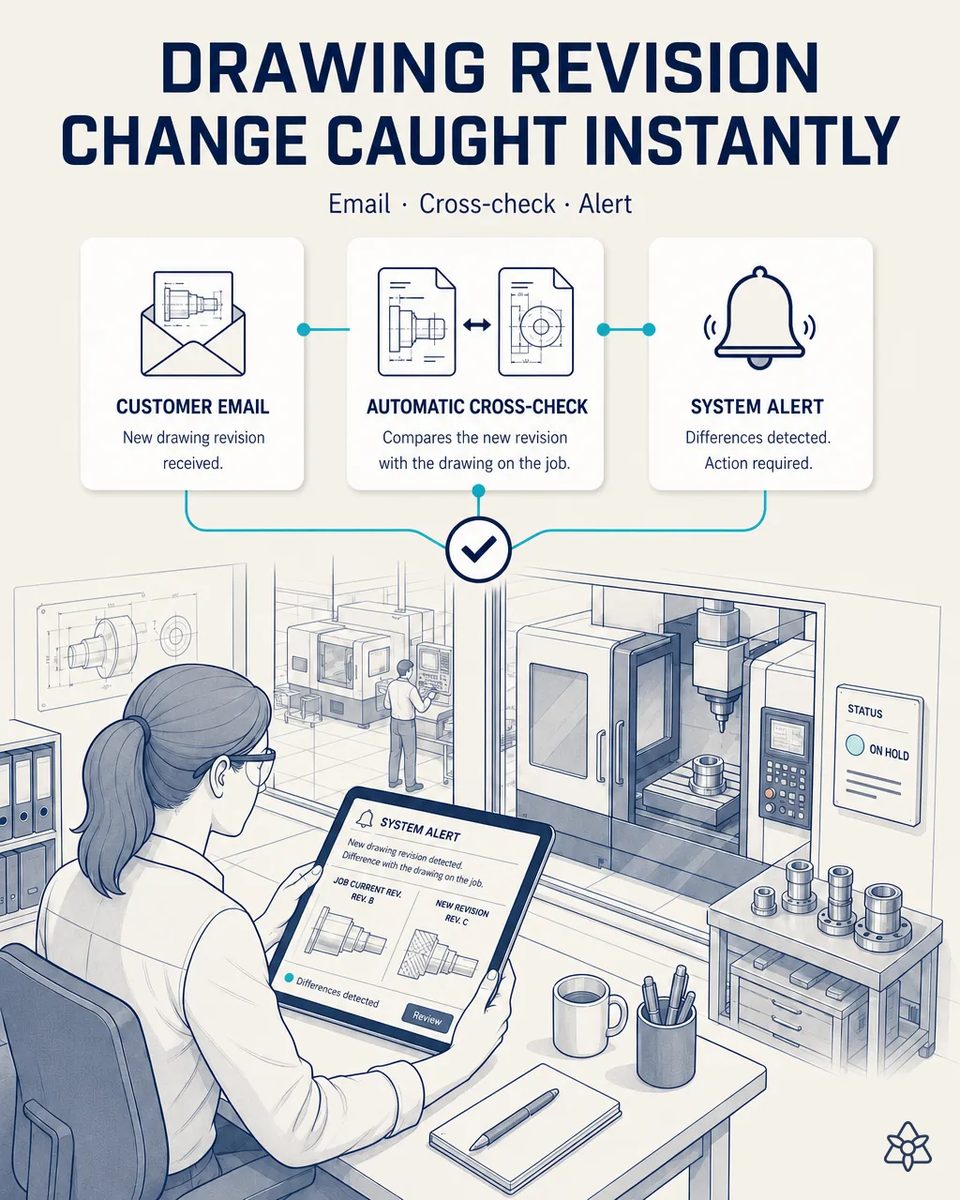
The revision that matters arrives in an inbox, not on the machine.
In make-to-order machining, the OEM customer emails a new drawing revision, a quantity change or a pulled-in date. It lands with one person, often the account manager or the planner, among a hundred other emails. If that email is read three hours late, the cell has already produced hundreds of parts on the previous revision. That is scrap, lost spindle hours, material to reorder and a late delivery.
- In make-to-order machining the OEM sends a new drawing revision, a quantity change or a pulled-in date by plain email, often with a PDF attached and one short line of text.
- It lands with one person — the account manager or the planner — among a hundred other messages, and nothing links it to the job that is running on the floor right now. If that person is on vacation or in a meeting, the email simply waits.
- If that email is read three hours late, the cell has already produced hundreds of parts on the previous revision, all of them in tolerance to a drawing that no longer applies.
- That is scrap, spindle hours lost, bar stock to reorder, a late delivery and an uncomfortable call with the customer's buyer, who will remember it at the next quarterly review.
Connect in silent copy on the orders mailbox — it reads, matches and proposes.
iLEAN Connect sits silently in copy on the orders mailbox. As soon as the email arrives, it extracts part number, revision, quantities and dates, matches them against the active jobs in the ERP and alerts the right role with a concrete action: this job is running revision C, the customer now requires D, review before the next cycle. The AI never stops the machine on its own: it proposes. The engineer or production manager decides with one tap whether to pause, adjust the program or continue. Humans in command.
The value is not in reading the email faster; it is in knowing, within seconds, that this email affects that machine. A person still decides whether to pause, edit the program or keep running, but now they decide before the next cycle instead of at final inspection, when the batch is already in the box. For a shop running forty active part numbers, that difference shows up every month.
A revision buried in an inbox versus a revision matched to the job
| Aspect | Today | With iLEAN Connect |
|---|---|---|
| Time until someone reads the change | 2-4 h, sometimes the next day | Seconds |
| Link between email and running job | In someone's memory | Matched by part number and revision |
| Batch machined to the old revision | Found at final inspection | Stopped before the next cycle |
| Who gets the revision alert | Whoever was in copy | The role that has to act |
| Decision to pause or continue | Made late, under pressure | One tap by the engineer |
| Quantity or date changes from the OEM | Retyped into the ERP by hand | Extracted and proposed |
Change email read 2-4 h later → alert matched to the active job in seconds. Batch machined to an obsolete revision → stopped before the next cycle.
Impact estimate — to be validated against how often your revisions change.
The block below is an estimate to be validated against your plant's actual data. We put it forward so the committee has an order of magnitude; we refine it during the assessment.
- Estimated payback 3-7 months, depending on how often your customers change revisions and how many active part numbers you carry.
- From hours of human latency to seconds between the email and the alert matched to the active job.
- Zero batches machined to an obsolete revision, which is where much of the avoidable scrap of a make-to-order shop sits.
- And fewer late deliveries caused by reordering material and re-running a job that was already finished once.
Payback 3-7 months · zero batches machined to an obsolete revision (estimate to be validated) You go from hours of human latency to seconds, and from finding the error at final inspection to avoiding it before the next cycle. We estimate a 3 to 7 month payback depending on how often revisions change; estimate to be validated.
And the fair question from the production manager
“What if it matches the email to the wrong job?” — pulling part number, revision, quantity and date out of a customer message and matching them against open jobs is an anchored task, where the best models drop below 1.5% error [1]. And it never acts alone: the alert shows the original email next to the job, and the engineer or production manager decides with one tap. If the match is uncertain, the alert says so instead of pretending, and lists the candidate jobs for a person to choose.
[1] OpenAI paper "Why Language Models Hallucinate", 2025 — on the reliability of AI in anchored tasks.
What people ask about catching drawing revision changes
Which inbox does iLEAN read for drawing revisions?
A dedicated orders mailbox, or the shared one your customers already write to, placed in silent copy. It does not read personal inboxes or anything outside that address.
Can it tell a real revision change from a routine order confirmation?
Yes. It classifies each message by intent and only raises an alert when a part number with an open job changes revision, quantity or date. Routine confirmations are filed without noise, so the alerts that do arrive are the ones worth reading.
What if the customer only attaches a PDF drawing with no text?
It reads the title block of the attached drawing to get part number and revision, and compares them with the job in the ERP. If the title block is unreadable, it asks a person rather than guessing a revision letter.
Can iLEAN pause the machine on its own?
No. It proposes the action to the right role. Pausing, editing the program or continuing is always a human decision, recorded with who took it. The machine stays exactly where the operator left it until someone with authority answers.
Does it also handle pulled-in dates and quantity changes?
Yes, they are extracted the same way and proposed to the planner, who confirms before anything changes in the ERP or on the schedule. A pulled-in date can then be checked against machine load before anyone promises it to the customer.
More cases from this series
- Lights-out night shift without surprisesConnect, Edge, JIDOKA AI and Agents working together to run CNC cells unattended at night: more spindle…
- PPAP and FAI evidence pack, always readyEvery setup, first article and validated measurement generates evidence; Agents builds the PPAP or FAI…
- Two-tap human validation at the cellWhat iLEAN captures appears on the cell tablet; the operator validates it with two taps before it…
- Modern CNC and robot cell wired to the ERPiLEAN reads what the machine publishes via MTConnect or OPC UA and mirrors it in the ERP; the ERP…
- The shift supervisor, hands-freeThe supervisor dictates issues while walking the floor; iLEAN structures them by machine, job and shift…
- The legacy CNC lathe that now talksAn external camera reads the old CNC control screen: part counter, spindle load and alarms, without…
Tell us which critical customer emails slipped through last month.
We work on your plant's real data, not ours. Assessment with no commitment.
Request estimated ROI within 48h ‹ See all cases of CNC machining See metal fabrication and capital equipment