The shift supervisor, hands-free
The shift supervisor in a CNC shop spends the day walking between lathes, machining centers and the inspection bench. Both hands are busy: a part, a caliper, a wrench. With iLEAN Connect in voice mode, the supervisor talks through an earpiece without stopping: note that lathe four has chatter since the insert change, I want maintenance to check it.
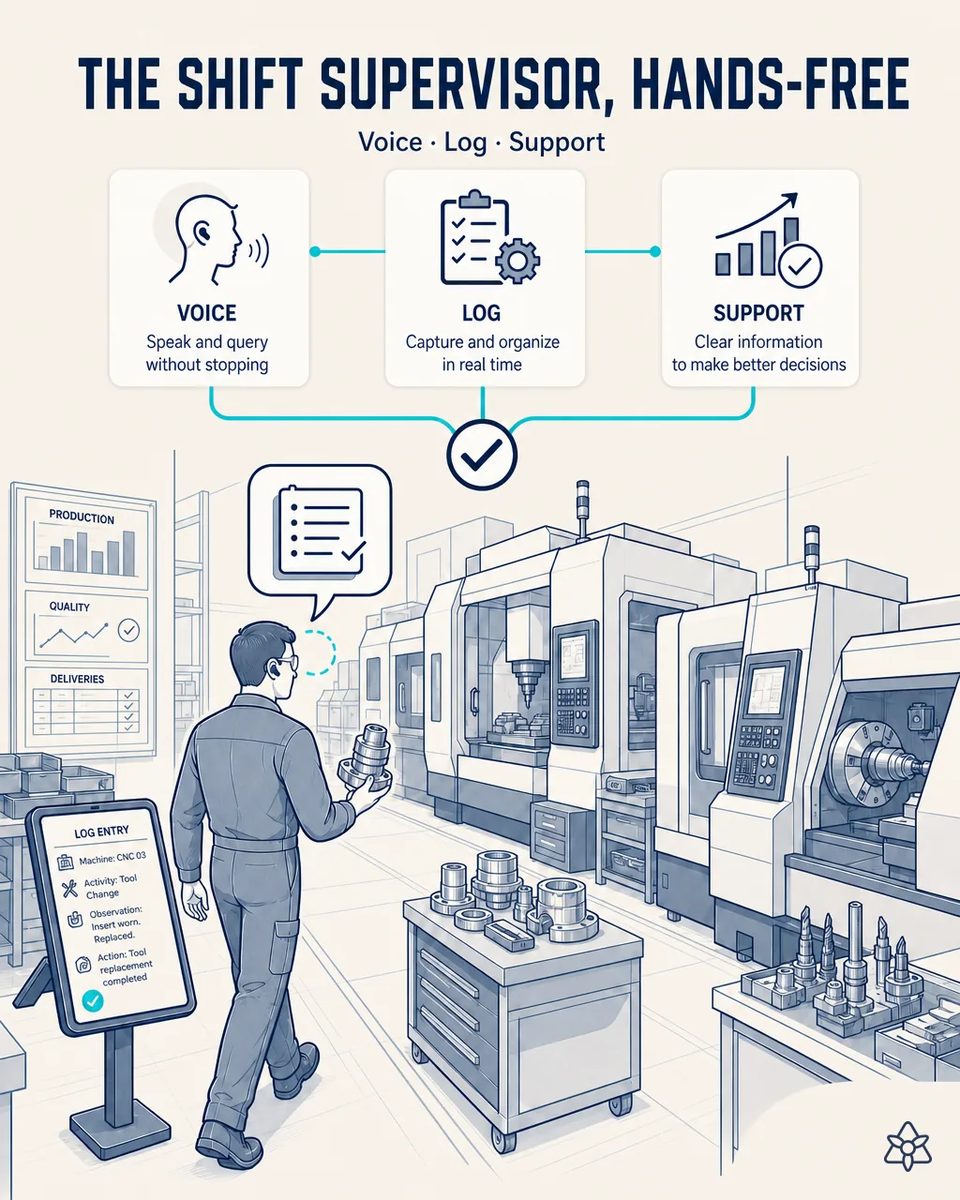
What the supervisor knows about each machine leaves with them at shift end.
The shift supervisor in a CNC shop spends the day walking between lathes, machining centers and the inspection bench. Both hands are busy: a part, a caliper, a wrench. The supervisor knows lathe four has chatter since the insert change, that the bar stock from the last lot is harder, that the new operator needs help with the setup. All of that lives in one head and is lost at shift change, because there is no time to stop and type.
- The supervisor spends the shift walking between lathes, machining centers and the inspection bench, with a part, a caliper or a wrench in hand.
- They know that lathe four has had chatter since the insert change, that the last lot of bar stock is harder, and that the new operator is stuck on a setup.
- None of it gets written down, because writing means walking to a terminal and typing, and there is no time for that in the middle of a shift with three machines waiting. At best it ends up on a sticky note on the control.
- So it lives in one head and is lost at shift change, and the night shift fights the same chatter from scratch, often with a different insert grade.
Connect in voice mode — the supervisor speaks, iLEAN files it against the machine.
With iLEAN Connect in voice mode, the supervisor talks through an earpiece without stopping: note that lathe four has chatter since the insert change, I want maintenance to check it. iLEAN listens, structures it as an issue linked to machine, job and shift, and replies within seconds: maintenance can come at eleven, shall I confirm? The supervisor confirms or corrects what was logged and decides who it is escalated to. The AI assists; it does not replace human judgment.
It only records what the supervisor chooses to say, when they choose to say it. That is why it is accepted on the floor: it is a tool for the person walking the shop, not a microphone on the operators, and it answers back with what the supervisor needs to keep moving. The supervisor gains a memory; the operators lose nothing.
The shift in one head versus the shift on record
| Aspect | Today | With iLEAN Connect |
|---|---|---|
| Chatter after an insert change | Mentioned at the time clock, maybe | Logged against lathe and job |
| Harder bar stock from a lot | Known by the person who noticed | Linked to the heat and the machine |
| Asking maintenance to come | Walk to find them | Dictated, with a time proposed back |
| Passing the shift to the night crew | Five minutes of talk | A searchable summary by machine |
| What machinists say to each other | — | Never recorded |
| Data for continuous improvement | Anecdotes | Issues by machine, cause and shift |
Shift issues in the supervisor's head → logged and linked to machine and job in real time. Verbal shift handover → handover with a searchable history.
Strategic value — no standalone payback, and we explain why.
The block below is an estimate to be validated against your plant's actual data. We put it forward so the committee has an order of magnitude; we refine it during the assessment.
- No standalone payback · enabling piece. We do not put a number on it because its value shows up in other cases — downtime, scrap, setups — not in this one, and a forced figure would not survive your review.
- Shift handover stops depending on one person's memory and becomes a history you can search by machine and job, ready before the next supervisor walks in.
- Continuous improvement finally gets shop-floor data: which machines repeat chatter, which bar stock lots cause trouble, which setups need help.
- The right person to size it is your continuous improvement lead, and we do it with them on your own downtime and scrap history.
Strategic value · shift knowledge is no longer lost (estimate to be validated) Shift handover no longer depends on one person's memory, and continuous improvement finally has shop-floor data. It is a strategic piece, hard to monetize upfront; estimate to be validated with your continuous improvement lead.
And the fair question from the production manager
“Is this a way to keep tabs on my machinists?” — no: iLEAN listens to the supervisor, not to the operators, and only to what they dictate. Turning a spoken sentence into machine, job, symptom and request is an anchored task, where the best models drop below 1.5% error [1], and the supervisor confirms or corrects every entry and decides who it is escalated to. There is no continuous listening and no tracking of where anyone walks during the shift.
[1] OpenAI paper "Why Language Models Hallucinate", 2025 — on the reliability of AI in anchored tasks.
What people ask about dictating issues on the CNC floor
Does it understand speech over coolant pumps and chip conveyors?
That is the design condition. The earpiece works with hearing protection and recognition is tuned for shop noise and machining vocabulary such as insert, offset, chatter or fixture. It also learns your own machine names, so lathe four is lathe four.
Does the supervisor have to name the machine every time?
Only the first time in a conversation. After that iLEAN keeps the context until the supervisor moves on to another machine or names a different job.
Can the supervisor ask iLEAN questions back while walking?
Yes: it can confirm a maintenance slot, say which job and revision are on a machine, or read back the last issue logged on it, all by voice. In the example from the floor it replies that maintenance can come at eleven and asks whether to confirm.
Why deploy something with no payback of its own?
Because the other cases feed on it. Downtime causes and setup problems only become data when someone can capture them without stopping what they are doing. Without them, the payback of the other cases is estimated on incomplete data.
What happens to the issue after it is dictated?
It is structured as machine, job, shift and request, shown to the supervisor to confirm, and routed to the person they choose, such as maintenance or the setup lead. It stays linked to the machine, so the next time that machine shows the same symptom, the history is already there.
More cases from this series
- Lights-out night shift without surprisesConnect, Edge, JIDOKA AI and Agents working together to run CNC cells unattended at night: more spindle…
- PPAP and FAI evidence pack, always readyEvery setup, first article and validated measurement generates evidence; Agents builds the PPAP or FAI…
- Two-tap human validation at the cellWhat iLEAN captures appears on the cell tablet; the operator validates it with two taps before it…
- Modern CNC and robot cell wired to the ERPiLEAN reads what the machine publishes via MTConnect or OPC UA and mirrors it in the ERP; the ERP…
- Drawing revision change caught instantlyiLEAN reads the customer email, spots the new drawing revision and matches it to the job on the machine…
- The legacy CNC lathe that now talksAn external camera reads the old CNC control screen: part counter, spindle load and alarms, without…
Try voice mode with your supervisor on a real shift.
We work on your plant's real data, not ours. Assessment with no commitment.
Request estimated ROI within 48h ‹ See all cases of CNC machining See metal fabrication and capital equipment