Modern CNC and robot cell wired to the ERP
Machining centers and lathes from the last ten years, and many robot-loaded cells, already expose data through MTConnect or OPC UA: status, part counter, active program, alarms. But they are almost never wired to the ERP. iLEAN Connect reads what the machine already publishes through MTConnect or OPC UA and mirrors it in the ERP: good parts, cycle times, stops.
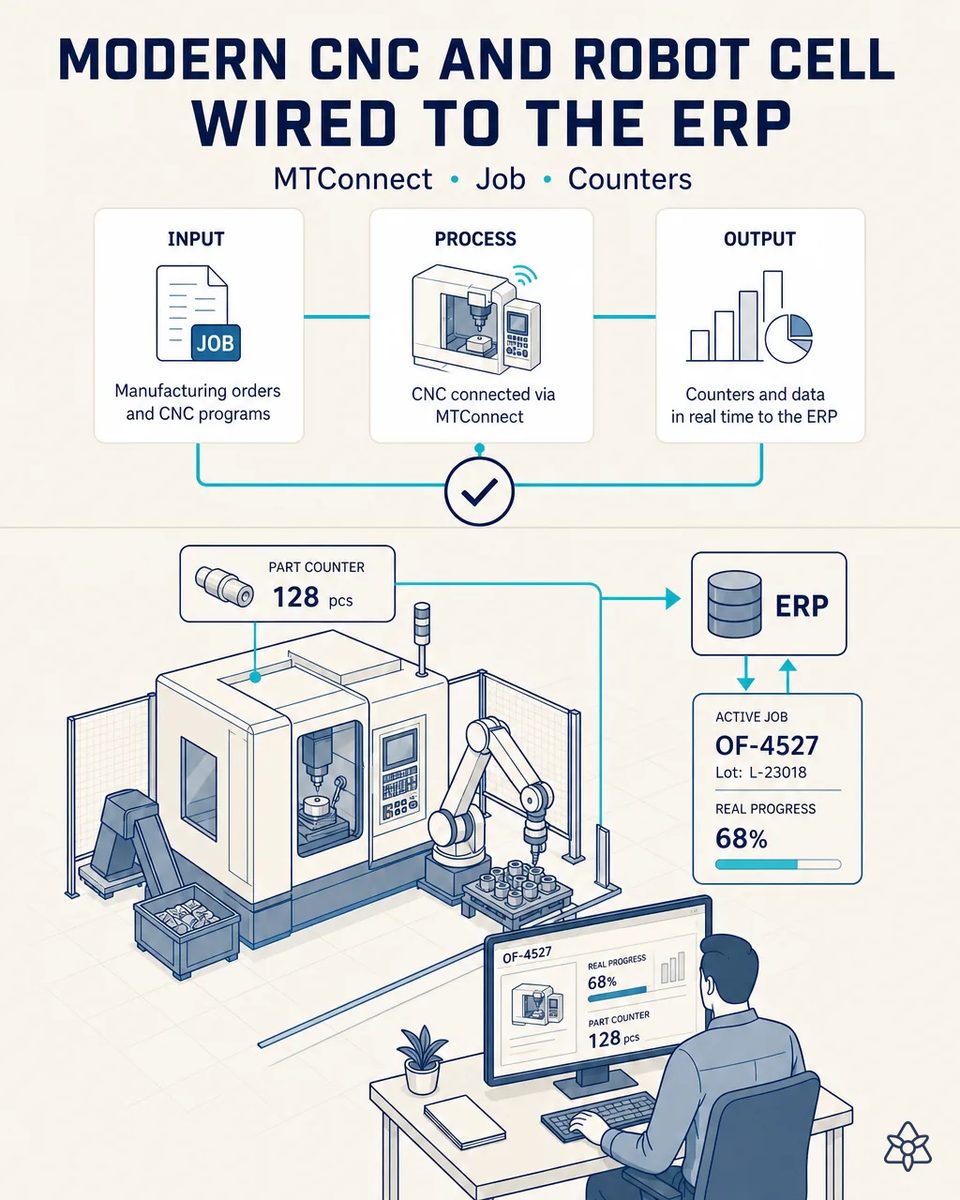
The machine publishes its counter; the ERP still waits for a paper tally.
Machining centers and lathes from the last ten years, and many robot-loaded cells, already expose data through MTConnect or OPC UA: status, part counter, active program, alarms. But they are almost never wired to the ERP. So the operator writes counts on paper, the supervisor rekeys them into the ERP at the end of the shift, and the planner never knows a job's real progress until the next day. On top of that, the right program for each job is loaded by hand.
- Machining centers and lathes from the last ten years, and most robot-loaded cells, already expose status, part counter, active program and alarms through MTConnect or OPC UA.
- Yet they are almost never wired to the ERP, so the operator writes counts on paper and the supervisor rekeys them at shift end, with the errors that come with it. The protocol was paid for with the machine and has never been used.
- The planner does not know a job's real progress until the next morning, and promises delivery dates to customers on yesterday's numbers.
- In the other direction, the right program and revision for each job is still picked and loaded by hand at the control, one more place for a mistake.
Connect stitches machine and ERP together — two systems that already exist, finally talking.
iLEAN Connect reads what the machine already publishes through MTConnect or OPC UA and mirrors it in the ERP: good parts, cycle times, stops. In the other direction, when the ERP starts a job, iLEAN proposes the right program and revision to the machine. Neither the machine nor the ERP is replaced. Each job start and the proposed program are confirmed on the cell tablet: the AI prepares, the operator is in command.
Neither the machine nor the ERP is replaced, and no new MES sits in between. iLEAN reads what the control already publishes and writes what the ERP already expects, which is why this is usually the fastest return in the matrix and the easiest one to explain to the owner. It also gives the legacy-panel case a modern counterpart, so every machine reports the same way.
A tally sheet at the machine versus counters flowing to the ERP
| Aspect | Today | With iLEAN Connect |
|---|---|---|
| Good parts per job | Tallied on paper, rekeyed later | Machine counter straight into the ERP |
| Job progress for the planner | Known the next day | Real time |
| Cycle time per part number | Estimated from the quote | Measured on every cycle |
| Stops and alarms on modern controls | Remembered, if noticed | Logged with time and code |
| Program for the next job | Picked by hand at the control | Proposed from the job, confirmed by the operator |
| Double entry of production data | Every shift | Gone |
Output written on paper and rekeyed at shift end → machine counters straight into the ERP. Job progress known the next day → in real time. Program loaded by hand → proposed from the job.
Impact estimate — to be validated against your planner's daily rework.
The block below is an estimate to be validated against your plant's actual data. We put it forward so the committee has an order of magnitude; we refine it during the assessment.
- Estimated payback 3-6 months, mostly from the double entry and the paper tallies that disappear.
- Zero double entry of production data: counters reach the ERP without passing through paper.
- The planner sees each job's real progress in real time and commits delivery dates on today's numbers, not on yesterday's paper tallies.
- And real cycle times per part number feed back into quoting, where a job shop wins or loses its margin: the next quote is priced on measured hours, not on hope.
Payback 3-6 months · zero double entry of production data (estimate to be validated) The planner sees real progress for every job in real time and double entry disappears. We estimate a 3 to 6 month payback; estimate to be validated.
And the fair question from the production manager
“What if it proposes the wrong program for a job?” — matching a job's part number and revision to the program library is an anchored task, where the best models drop below 1.5% error [1]. And the proposal is never loaded silently: the operator sees program and revision on the cell tablet and confirms before the job starts. If the library holds several candidate programs, all of them are shown with their revision and date so the choice is explicit.
[1] OpenAI paper "Why Language Models Hallucinate", 2025 — on the reliability of AI in anchored tasks.
What people ask about wiring MTConnect machines to the ERP
Which machines can already be read this way?
Most controls from the last ten years offer MTConnect or OPC UA, sometimes as an option that only needs enabling. We check your fleet machine by machine before quoting anything, and tell you which ones need only a setting switched on.
Do we need a new MES between the machines and the ERP?
No. iLEAN reads the machine's data and writes into the ERP through its API, without adding another system for the shop to license and maintain. Your ERP stays the system of record.
Does it send programs to the machine automatically?
It proposes the program and revision for the job. The operator confirms on the tablet; nothing is loaded without that confirmation, and the choice is logged. A program loaded for the wrong revision is one of the most expensive mistakes in a job shop, and the confirmation step exists for it.
What about the older machines with no protocol?
They are covered by reading the control screen with a camera, so legacy and modern machines end up in the same view and the same utilization report. The planner does not have to care which machine is which generation. Good parts, stops and cycle times look the same for both.
Can robot cells be counted separately from the machine?
Yes, the robot's load and unload events are read as their own signal, which shows when the cell waits on the robot or the robot on the machine. That is usually the first surprise in a robot cell's real utilization.
More cases from this series
- Lights-out night shift without surprisesConnect, Edge, JIDOKA AI and Agents working together to run CNC cells unattended at night: more spindle…
- PPAP and FAI evidence pack, always readyEvery setup, first article and validated measurement generates evidence; Agents builds the PPAP or FAI…
- Two-tap human validation at the cellWhat iLEAN captures appears on the cell tablet; the operator validates it with two taps before it…
- Drawing revision change caught instantlyiLEAN reads the customer email, spots the new drawing revision and matches it to the job on the machine…
- The shift supervisor, hands-freeThe supervisor dictates issues while walking the floor; iLEAN structures them by machine, job and shift…
- The legacy CNC lathe that now talksAn external camera reads the old CNC control screen: part counter, spindle load and alarms, without…
Tell us which of your machines can already talk and which cannot.
We work on your plant's real data, not ours. Assessment with no commitment.
Request estimated ROI within 48h ‹ See all cases of CNC machining See metal fabrication and capital equipment