Burrs and missing features caught in line
A robot-loaded CNC cell produces hundreds of parts per shift. Final visual inspection is done by a person, by sampling, at the end of a long day. iLEAN Edge places a camera at the cell exit and a vision model trained on good and bad parts of your part number.
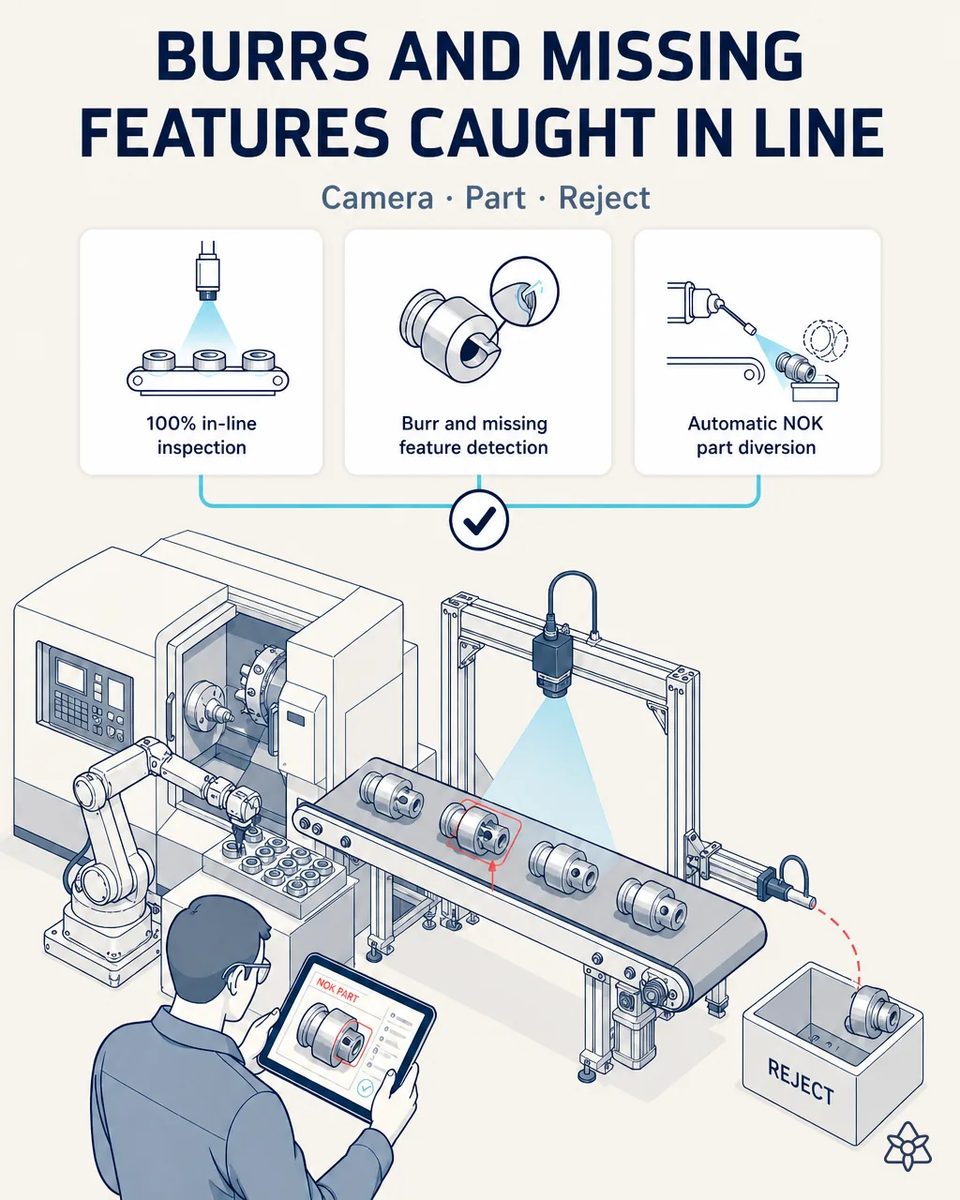
At the end of a long shift, sampling is the weakest control in the cell.
A robot-loaded CNC cell produces hundreds of parts per shift. Final visual inspection is done by a person, by sampling, at the end of a long day. A burr in a bore, a thread not cut because the tap broke, a tool mark on a functional face. If one escapes, the OEM customer files a complaint, demands 100% containment and lowers your supplier rating.
- A robot-loaded CNC cell produces hundreds of parts per shift, and final visual inspection is done by a person, by sampling, often at the end of a long day.
- A burr inside a cross-drilled bore, a thread never cut because the tap broke, a tool mark on a sealing face: they all look fine from a meter away. And the inspector checking the sample is also the person setting up the next job.
- If one escapes, the OEM customer files a complaint, demands 100% containment and lowers your supplier rating, which weighs on the next quote.
- And a broken tap does not make one bad part: it makes every part until someone notices, sometimes a whole shift's worth.
Edge — local vision at the cell exit, nothing sent to the cloud.
iLEAN Edge places a camera at the cell exit and a vision model trained on good and bad parts of your part number. It infers locally, in milliseconds, without sending images to the cloud, and diverts the doubtful part before packing. Diverted parts go to the inspector's tablet with the defect marked. The inspector decides: reject, rework or release. Every decision makes the model better.
A broken tap shows up as a missing thread on the very next part instead of at the end-of-shift sample. That alone turns a containment of a whole shift into a handful of diverted parts, and it is the same camera that later makes unattended running possible. Without 100% inspection, nobody leaves a robot cell alone at night.
Sampling at the end of the shift versus Edge on every part
| Aspect | Today | With iLEAN Edge |
|---|---|---|
| Parts inspected visually | A sample | 100% seen by the camera |
| Burr inside a cross-drilled bore | Missed unless the sample catches it | Detected and marked on the image |
| Thread not cut after a broken tap | Every part until someone notices | Caught on the next part |
| Where a doubtful part goes | Into the box | Diverted before packing |
| Final decision on a diverted part | — | The inspector: reject, rework or release |
| Part images leaving the shop | — | None: inference is local |
Visual inspection by sampling → 100% of parts seen by the camera. Escapes reaching the customer → doubtful parts diverted before packing.
Impact estimate — to be validated against your current escape rate.
The block below is an estimate to be validated against your plant's actual data. We put it forward so the committee has an order of magnitude; we refine it during the assessment.
- Estimated payback 5-12 months, depending on your escape rate and what each customer complaint costs you.
- From sampling to 100% visual inspection of every part leaving the cell, on every shift, without adding an inspector.
- Fewer customer complaints and fewer 100% containments, which is what protects the supplier rating and the time of the quality team that runs them.
- And a broken tool shows up within one part instead of one shift, saving the scrap that follows it.
Payback 5-12 months · 100% visual inspection of parts (estimate to be validated) You move from sampling to seeing every single part, with fewer complaints and fewer containments. We estimate a 5 to 12 month payback depending on your escape rate; estimate to be validated.
And the fair question from the production manager
“What if it starts rejecting good parts?” — false positives are the real risk of any vision system, which is why the model is trained on good and bad parts of your own part numbers, under that cell's lighting. Classifying a known defect at a fixed station is an anchored task, where the best models drop below 1.5% error [1], and doubtful parts are not scrapped: they go to the inspector, who decides. Every reject, rework or release decision is stored and feeds the next training round for that part number.
[1] OpenAI paper "Why Language Models Hallucinate", 2025 — on the reliability of AI in anchored tasks.
What people ask about vision at the CNC cell exit
Can it keep up with the robot cell's cycle time?
Yes. Inference runs locally on the Edge device and resolves in milliseconds per part, without depending on the network or the cloud. The divert signal reaches the conveyor before the part reaches the packing box.
Do coolant film and chips on the part confuse it?
They are part of the training. If the parts come out wet or with chips, the model learns them that way; an air blow-off before the camera helps when needed. Lighting is designed for the cell, not borrowed from a generic setup.
Can the camera check dimensions or only appearance?
It is a visual check: burrs, missing features, tool marks, uncut threads. Dimensions stay with the CMM, the gauges and your control plan. The two are complementary: the camera sees every part, the CMM measures the ones that matter.
How many images does a new part number need?
A few hundred good parts and a set of real defects is usually enough to start. Each inspector decision then improves the model for that part number. We start with the defects that have actually reached customers. Those are the ones whose cost you already know, and the business case is built on them.
Does it work for a high-mix cell with many part numbers?
Yes, the model switches with the active job read from the ERP or the machine, which is normal in a job shop with frequent changeovers. A new part number can run under supervision while its model is trained.
More cases from this series
- Lights-out night shift without surprisesConnect, Edge, JIDOKA AI and Agents working together to run CNC cells unattended at night: more spindle…
- PPAP and FAI evidence pack, always readyEvery setup, first article and validated measurement generates evidence; Agents builds the PPAP or FAI…
- Two-tap human validation at the cellWhat iLEAN captures appears on the cell tablet; the operator validates it with two taps before it…
- Modern CNC and robot cell wired to the ERPiLEAN reads what the machine publishes via MTConnect or OPC UA and mirrors it in the ERP; the ERP…
- Drawing revision change caught instantlyiLEAN reads the customer email, spots the new drawing revision and matches it to the job on the machine…
- The shift supervisor, hands-freeThe supervisor dictates issues while walking the floor; iLEAN structures them by machine, job and shift…
Send us photos of your good and bad parts from one cell.
We work on your plant's real data, not ours. Assessment with no commitment.
Request estimated ROI within 48h ‹ See all cases of CNC machining See metal fabrication and capital equipment