Paperless shop traveler and first article
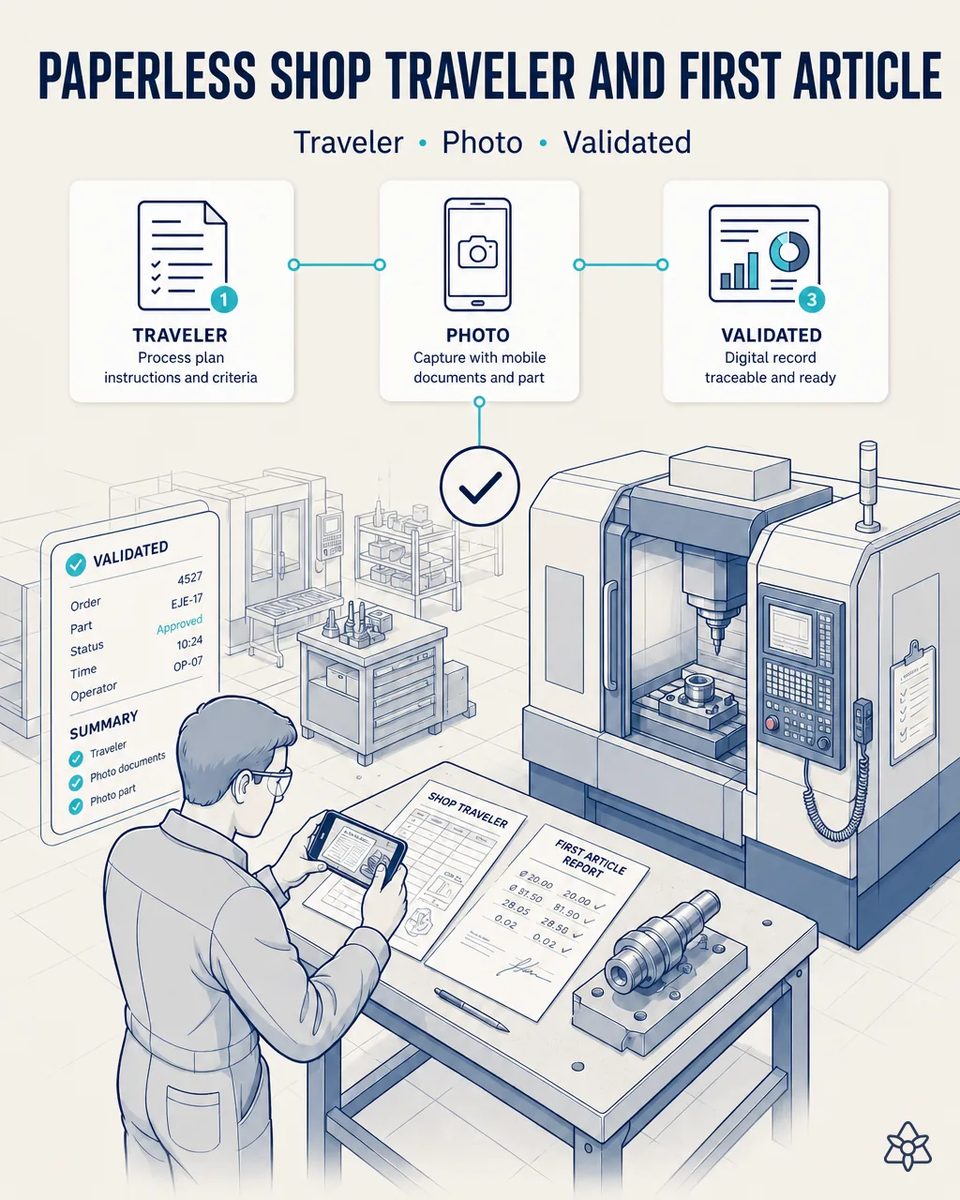
In a CNC machining shop every work order starts the same way: a printed shop traveler that travels with the material, and a first-article report the operator fills in by hand with the measured dimensions. Those two sheets define the batch: part number, drawing revision, program and the measurements that came out. With iLEAN Connect the operator takes one photo of the traveler and another of the first-article report.
In a job shop the batch is defined on two sheets of paper nobody reads until evening.
In a CNC machining shop every work order starts the same way: a printed shop traveler that travels with the material, and a first-article report the operator fills in by hand with the measured dimensions. Those two sheets define the batch: part number, drawing revision, program and the measurements that came out. The problem is that the paper travels with the part and sits in a folder until someone collects it at the end of the shift. For four to eight hours the system does not know the job started or what it measured. And when the customer audit comes, someone has to rebuild it.
- The shop traveler carries part number, drawing revision, routing and program number, and it rides on the cart with the raw stock from the saw to the lathe to the machining center.
- The first-article report is filled in by hand at the machine: nominal, measured, the caliper or micrometer used, and the operator's initials. That sheet is what releases the rest of the batch.
- Both end up in a tray until someone collects them at shift end, so for four to eight hours the ERP does not know the job started or what the first part measured.
- When the customer audit comes, or a part is returned months later, someone has to dig through binders to rebuild which revision and which dimensions that batch was released on. Half the time the answer is a photocopy of a traveler with the critical column smudged.
Connect in photo mode — the traveler stays on the cart, the data goes live.
With iLEAN Connect the operator takes one photo of the traveler and another of the first-article report. The system recognizes the layout, extracts part number, revision, operation and dimensions, and stores them in central memory. The operator keeps the same routine and the same paper. Before anything reaches the system, the operator sees a summary on the cell tablet and confirms with two taps. Humans in command: the AI reads, the person decides.
The operator keeps the same traveler, the same first-article form and the same routine; the only new step is two photos. In a shop that has tried paperless projects before and quietly gone back to paper, that is usually what gets this one approved, and why it is the natural first case of the twelve. The paper stays as a backup; the data stops depending on it.
A traveler in a tray versus a traveler captured at the machine
| Aspect | Today | With iLEAN Connect |
|---|---|---|
| Job start visible in the ERP | 4-8 h later, when the tray is emptied | Second zero |
| Measured values on the first part | Handwritten, in a binder by job number | Searchable by part number and batch |
| Drawing revision the batch ran on | Whatever the traveler copy said | Extracted and stored with the job |
| Pen notes on the traveler | Lost unless someone retypes them | Read and linked to the operation |
| Rebuilding a batch for a customer audit | Hours of digging through folders | One lookup |
| What changes for the machinist | — | Two photos and two taps |
4-8 h between job start and data in the system → second zero. Manual rebuild of first-article reports before audits → instant lookup by part number and batch.
Impact estimate — to be validated with your daily work-order count.
The block below is an estimate to be validated against your plant's actual data. We put it forward so the committee has an order of magnitude; we refine it during the assessment.
- Estimated payback 4-9 months, depending on how many work orders you open per day and how many operations each routing carries.
- From 4-8 hours between job start and data in the system down to second zero, including the weekend jobs that today wait until Monday.
- Manual rebuild of first-article records before audits replaced by an instant lookup by part number and batch.
- Hours recovered by quality and the office, who today retype travelers and first-article sheets at the end of every shift, and who can spend that time on the inspection work only they can do.
Payback 4-9 months · from 4-8 h of latency to second zero (estimate to be validated) The result is moving from hours of latency to second zero, and from scattered paper to an instant lookup by part number and batch. We estimate a 4 to 9 month payback depending on daily work orders; this is an estimate to be validated with your data.
And the fair question from the production manager
“What if it misreads a measured diameter on the first-article sheet?” — reading fields from a form with a known layout is an anchored task, where the best models drop below 1.5% error [1]. And there is a second net: the summary appears on the cell tablet next to the drawing tolerance, any value out of band is highlighted, and the operator confirms or corrects before anything reaches the ERP.
[1] OpenAI paper "Why Language Models Hallucinate", 2025 — on the reliability of AI in anchored tasks.
What people ask about photographing the traveler and the first article
Do we have to redesign our first-article inspection form?
No. iLEAN learns the layout of the form you already use, including the columns for nominal, measured and gauge. Changing the form is the fastest way to have the floor reject the project, so we never ask for it.
Does it read handwriting on a traveler that has been around the shop all day?
Yes, including pen notes, crossed-out values and coolant stains. Any field read with low confidence is flagged on the tablet for the operator to confirm instead of being guessed. The operator sees the photo and the extracted value side by side, so checking takes a glance.
What about jobs with several operations on different machines?
Each operation on the routing can be photographed when it starts, so the job shows its real progress from saw to lathe to machining center instead of one stamp at the end. The planner sees where each job really is.
Does it check that the traveler revision matches the released drawing?
It extracts the revision and compares it with the one the ERP has for that part number. A mismatch is shown before the batch runs, and a person decides what to do. That single check is often worth the whole case the first time it catches a superseded traveler.
Do we need the ERP connection on day one?
No. The case works from the first job against iLEAN's central memory, and the push to the ERP is added once the shop has seen the data is reliable. Many shops run it that way for the first few weeks.
More cases from this series
- Lights-out night shift without surprisesConnect, Edge, JIDOKA AI and Agents working together to run CNC cells unattended at night: more spindle…
- PPAP and FAI evidence pack, always readyEvery setup, first article and validated measurement generates evidence; Agents builds the PPAP or FAI…
- Two-tap human validation at the cellWhat iLEAN captures appears on the cell tablet; the operator validates it with two taps before it…
- Modern CNC and robot cell wired to the ERPiLEAN reads what the machine publishes via MTConnect or OPC UA and mirrors it in the ERP; the ERP…
- Drawing revision change caught instantlyiLEAN reads the customer email, spots the new drawing revision and matches it to the job on the machine…
- The shift supervisor, hands-freeThe supervisor dictates issues while walking the floor; iLEAN structures them by machine, job and shift…
Send us one of your real shop travelers and a filled-in first-article sheet.
We work on your plant's real data, not ours. Assessment with no commitment.
Request estimated ROI within 48h ‹ See all cases of CNC machining See metal fabrication and capital equipment