Bar stock receiving with mill certs by photo
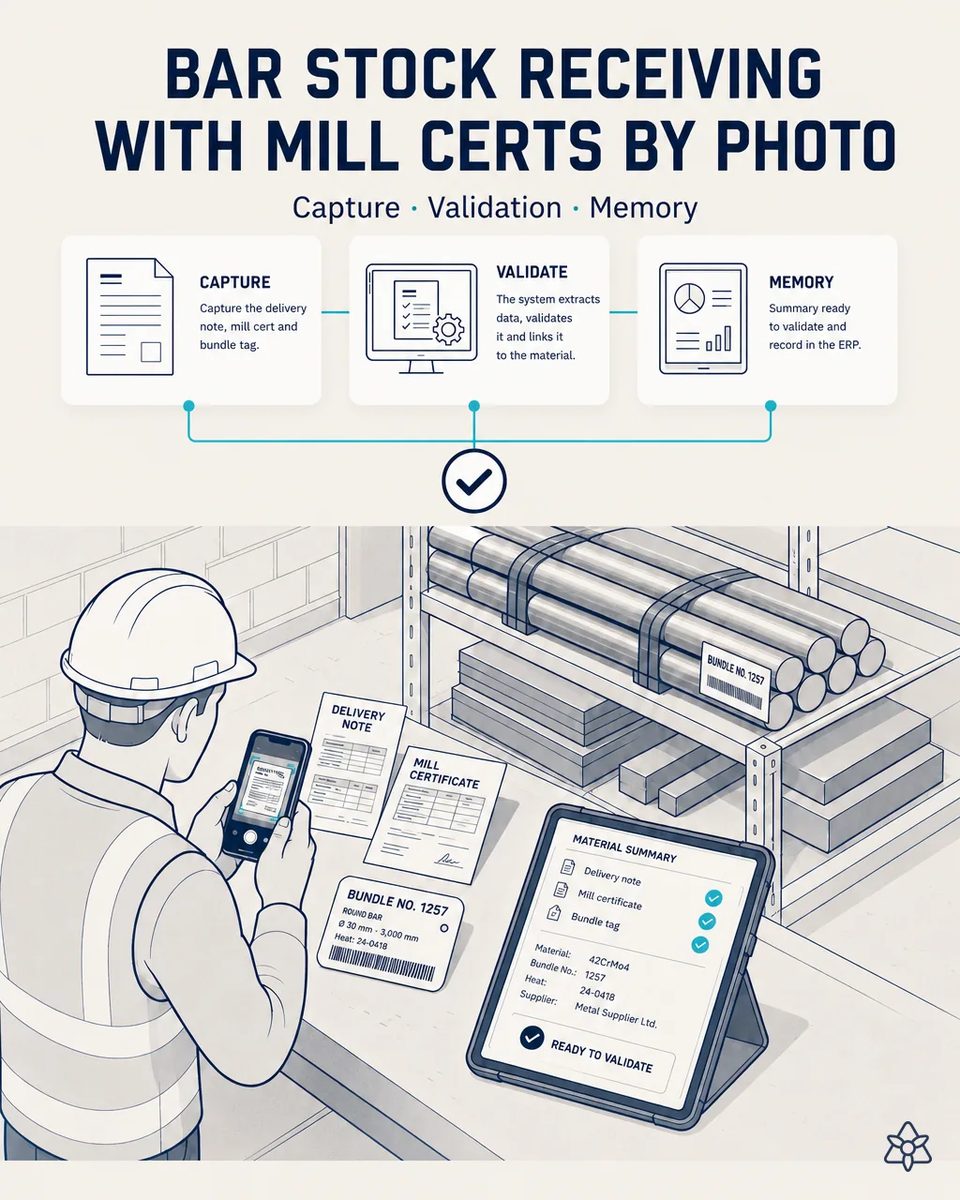
The truck arrives with steel, aluminum or stainless bar stock. Each bundle carries a tag with the heat number, and the supplier hands over a delivery note and a material certificate. In automotive, aerospace or medical work, that heat must stay linked to every part made from it. With iLEAN Connect the lead takes three photos: delivery note, mill certificate and bundle tag.
In a job shop, the heat number is typed by hand while the driver waits.
The truck arrives with steel, aluminum or stainless bar stock. Each bundle carries a tag with the heat number, and the supplier hands over a delivery note and a material certificate. In automotive, aerospace or medical work, that heat must stay linked to every part made from it. Today the warehouse lead logs into the ERP and types it in line by line while the driver waits. In a rush, a wrongly keyed heat number shows up weeks later in a complaint nobody can trace.
- The truck arrives with steel, aluminum or stainless bar stock. Each bundle carries a tag with the heat number, and the supplier hands over a delivery note and a mill certificate.
- For aerospace, medical or automotive work, that heat must stay linked to every part machined from it, through saw, lathe and machining center, and onto the customer's certificate. One broken link and the whole batch is suspect.
- Today the receiving lead logs into the ERP and types it line by line while the driver waits, which takes 30 to 45 minutes per delivery.
- In a rush one digit of a heat number gets mistyped, and it shows up weeks later in a complaint nobody can trace back to the bar it came from.
Connect photo-to-analog — the mill's paperwork, read exactly as it arrives.
With iLEAN Connect the lead takes three photos: delivery note, mill certificate and bundle tag. iLEAN recognizes the supplier's layout without asking them to change it, reads barcodes, QR codes or plain text, extracts material, heat, quantity and standard, and leaves it ready for one-tap validation. Once validated, it goes into the ERP through the API. The receiving module usually needs two or three active licenses. With Connect only the lead validates, without logging into the ERP: a typical 50 to 70% reduction in receiving and warehouse licenses.
Suppliers are not asked to change a single document: iLEAN learns each mill's certificate layout as it is. That is what makes traceability complete on day one instead of after a supplier standardization project that never finishes, and it frees the receiving lead to get back to the floor. The driver signs and leaves in minutes instead of waiting while someone types.
Receiving bar stock by keyboard versus by camera
| Aspect | Today | With iLEAN Connect |
|---|---|---|
| Unloading and keying a delivery | 30-45 min | About 5 min |
| Heat number on the bundle tag | Typed by hand | Read from the tag and the cert |
| Mill cert layout per supplier | Each one different | Learned as it is |
| Heat traced to the finished part | Gaps after a typo | Complete, with the photo |
| ERP seats at receiving and warehouse | 2-3 active users | 1 |
| Grade or diameter differs from the PO | Found at the saw | Flagged at receiving |
30-45 min unloading and keying → 5 min. Wrong heat numbers surfacing in complaints → complete traceability by photo. 2-3 receiving licenses → 1.
Impact estimate — to be validated against what receiving costs you today.
The block below is an estimate to be validated against your plant's actual data. We put it forward so the committee has an order of magnitude; we refine it during the assessment.
- Estimated payback 3-8 months, plus the yearly license saving on the receiving module.
- Unloading and keying drop from 30-45 minutes to about five per delivery, and the driver leaves on time. On a dock that receives several trucks a day, that adds up to hours every week.
- Typically 50 to 70% fewer receiving and warehouse ERP licenses, because only the lead validates and nobody else logs in to type.
- And complete heat-to-part traceability by photo, which is what an aerospace or medical customer asks for first when a part comes back.
Payback 3-8 months · −50 to −70% ERP licenses in receiving (estimate to be validated) Unloading drops from almost an hour to minutes, and heat-to-part traceability is complete by photo. We estimate a 3 to 8 month payback plus the yearly license saving; estimate to be validated.
And the fair question from the production manager
“What if it reads a 6 as an 8 in the heat number?” — reading known fields from a mill certificate and a printed tag is an anchored task, where the best models drop below 1.5% error [1]. And it cross-checks: the heat on the tag must match the heat on the certificate and the grade must match the purchase order. Any disagreement goes to the receiving lead before validation, with the three photos side by side so the check takes seconds. Nothing reaches the ERP with a heat number nobody has looked at.
[1] OpenAI paper "Why Language Models Hallucinate", 2025 — on the reliability of AI in anchored tasks.
What people ask about receiving bar stock and mill certs by photo
Do our mills have to send certificates in a standard format?
No. iLEAN recognizes each supplier's layout without asking them to change it, whether it is a scanned PDF, a printed sheet or an EN 10204 3.1 certificate.
What if one delivery contains several heats?
Each bundle tag is photographed and linked to its own heat on the certificate. The summary shows one line per heat for validation, so nothing is merged by mistake. Partial bundles and split heats are handled the same way.
Does it read chemical composition and mechanical properties too?
Yes, they are extracted and stored with the heat, so they can go into a PPAP or FAI package without retyping and be checked against the material spec on the drawing. A heat that does not meet the spec is flagged before the bar reaches the saw.
Can it read barcodes or QR codes on the bundle tags?
Yes, barcodes, QR codes or plain printed text, whichever the mill uses. When a tag carries both, they are cross-checked, and a mismatch between the barcode and the printed heat is flagged instead of accepted.
What hardware does receiving need?
A phone or tablet with a camera. Nothing is installed in the warehouse, and the photos are kept as evidence with the heat. If the receiving lead is busy, anyone on the dock can take the photos and the lead validates later.
More cases from this series
- Lights-out night shift without surprisesConnect, Edge, JIDOKA AI and Agents working together to run CNC cells unattended at night: more spindle…
- PPAP and FAI evidence pack, always readyEvery setup, first article and validated measurement generates evidence; Agents builds the PPAP or FAI…
- Two-tap human validation at the cellWhat iLEAN captures appears on the cell tablet; the operator validates it with two taps before it…
- Modern CNC and robot cell wired to the ERPiLEAN reads what the machine publishes via MTConnect or OPC UA and mirrors it in the ERP; the ERP…
- Drawing revision change caught instantlyiLEAN reads the customer email, spots the new drawing revision and matches it to the job on the machine…
- The shift supervisor, hands-freeThe supervisor dictates issues while walking the floor; iLEAN structures them by machine, job and shift…
Send us a real delivery note and mill certificate from one of your suppliers.
We work on your plant's real data, not ours. Assessment with no commitment.
Request estimated ROI within 48h ‹ See all cases of CNC machining See metal fabrication and capital equipment