Metrology Excel straight into the ERP
In a CNC shop the metrology lab records dimensional reports every shift: critical dimensions, surface roughness, coordinate measuring machine results. All of it lives in Excel, in a shared folder. iLEAN Connect listens inwards: it observes the shared folder, not the person.
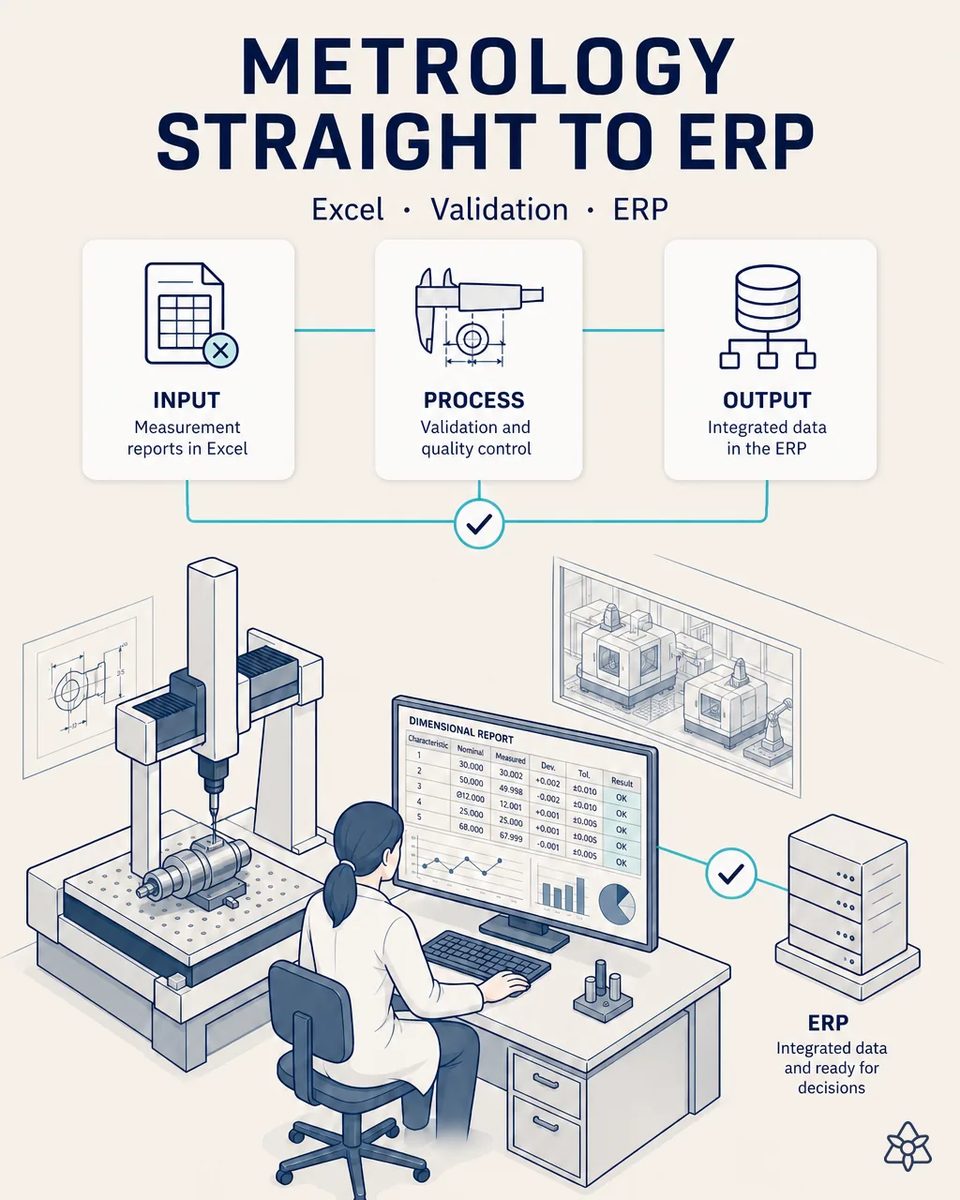
The measurements that release a batch live in a spreadsheet the ERP cannot see.
In a CNC shop the metrology lab records dimensional reports every shift: critical dimensions, surface roughness, coordinate measuring machine results. All of it lives in Excel, in a shared folder. The ERP needs that data to release batches and to issue the customer quality certificate. Today someone rekeys it by hand, days or weeks late and with typing errors. And every person who logs into the ERP to enter data is a license.
- The metrology lab records dimensional reports every shift: critical dimensions, surface roughness, coordinate measuring machine results, all in Excel on a shared folder.
- The ERP needs those values to release batches and to issue the customer's certificate of conformance, and without them finished parts sit waiting at shipping. Sometimes they ship anyway, and the paperwork follows days later.
- Today someone rekeys them by hand, days or weeks late and with typing errors that appear exactly when a customer questions a dimension.
- And every quality person who logs into the ERP just to enter measurements is a named license paid every year, whether they use it for ten minutes or eight hours.
Connect listening inward — it reads the metrology folder, not the person.
iLEAN Connect listens inwards: it observes the shared folder, not the person. When the Excel file is saved, it reads the change, interprets it with an anchored model, stores it in central memory and, after the quality lead validates it, pushes it into the ERP through the API. If five quality people log into the ERP today just to enter measurements, that is five licenses. With Connect only the lead who validates needs access: a typical 50 to 80% reduction in quality-module licenses, a recurring saving every year.
The certificate of conformance stops being built from a copy of a copy: it comes from the values the CMM produced, validated by the quality lead. And the license line on the ERP invoice gets shorter at every renewal, which is the part the finance team remembers. Quality, meanwhile, remembers that nobody had to retype a CMM report again.
The metrology spreadsheet today versus the spreadsheet that flows
| Aspect | Today | With iLEAN Connect |
|---|---|---|
| CMM result to ERP | Days or weeks | Second zero after validation |
| Rekeying roughness and dimensions | By hand, with typos | None |
| Certificate of conformance | Built from retyped values | Built from the measured values |
| The lab's spreadsheet template | Must not be touched | Read as it is, even as it evolves |
| ERP seats in the quality module | Several, one per person typing | One: the lead who validates |
| Roughness or diameter out of tolerance | Spotted when someone reads the sheet | Flagged on save |
Days or weeks between measurement and ERP → second zero after validation. Manual rekeying with errors → no rekeying. Several quality licenses → one.
Impact estimate — to be validated against the license line of your ERP contract.
The block below is an estimate to be validated against your plant's actual data. We put it forward so the committee has an order of magnitude; we refine it during the assessment.
- Estimated payback 4-9 months, plus the yearly license saving, which keeps paying after the payback is reached.
- Typically 50 to 80% fewer quality-module ERP licenses: if five people log in today just to enter measurements, only the lead who validates keeps access.
- From weeks of lag between the CMM and the ERP to second zero after validation, so batches are released on the day they are measured and finished parts stop waiting at shipping for paperwork.
- And no more rekeying errors surfacing on the customer's certificate of conformance.
Payback 4-9 months · −50 to −80% ERP licenses in the quality module (estimate to be validated) You go from weeks of lag to second zero, and the quality certificate comes from real data. We estimate a 4 to 9 month payback plus the yearly license saving; estimate to be validated against your ERP invoice.
And the fair question from the production manager
“Our lab has edited that spreadsheet for years — will it cope?” — that is the expected case: parsing does not depend on fixed cell positions, it interprets columns, units, merged cells and notes in the margin. It is an anchored task, where the best models drop below 1.5% error [1], and the quality lead validates every report before it is pushed through the ERP API. A value that does not parse cleanly is shown with its original cell highlighted, so the lead sees exactly what the technician typed.
[1] OpenAI paper "Why Language Models Hallucinate", 2025 — on the reliability of AI in anchored tasks.
What people ask about pushing CMM spreadsheets to the ERP
Do we have to standardize the metrology template?
No, and we advise against it. iLEAN reads the workbook the lab already uses, in its current format, and tolerates columns being added or moved over time. Asking a metrology lab to change its sheet is the quickest way to have the project ignored.
What happens if the file is saved several times in a shift?
Each save is read as a change. Only new or modified rows are proposed for validation, so nothing is pushed twice and nothing is lost between saves. A full history of changes is kept with each report.
Does it catch a roughness or diameter value out of tolerance?
Yes, it compares each value with the tolerance in the sheet or in the ERP and highlights it for the quality lead before validation, so a nonconforming batch is not released by accident. The lead can still release with a documented deviation if the customer has agreed one.
Can the CMM software export be read directly as well?
Yes, if it writes a file to a folder. The same listening applies to CSV or PDF reports dropped by the measuring machine or the roughness tester. Nothing has to be installed on the CMM computer itself.
How sure is the license saving?
It depends on your contract, which is why we size it against last year's invoice. The logic is simple: anyone who logs in only to type stops needing to. The people who analyze data in the ERP keep their access as before. We list, name by name, who would keep a seat and who would not before you decide.
More cases from this series
- Lights-out night shift without surprisesConnect, Edge, JIDOKA AI and Agents working together to run CNC cells unattended at night: more spindle…
- PPAP and FAI evidence pack, always readyEvery setup, first article and validated measurement generates evidence; Agents builds the PPAP or FAI…
- Two-tap human validation at the cellWhat iLEAN captures appears on the cell tablet; the operator validates it with two taps before it…
- Modern CNC and robot cell wired to the ERPiLEAN reads what the machine publishes via MTConnect or OPC UA and mirrors it in the ERP; the ERP…
- Drawing revision change caught instantlyiLEAN reads the customer email, spots the new drawing revision and matches it to the job on the machine…
- The shift supervisor, hands-freeThe supervisor dictates issues while walking the floor; iLEAN structures them by machine, job and shift…
Tell us how many people log into your ERP just to enter measurements.
We work on your plant's real data, not ours. Assessment with no commitment.
Request estimated ROI within 48h ‹ See all cases of CNC machining See metal fabrication and capital equipment